LUCID Vision Labs
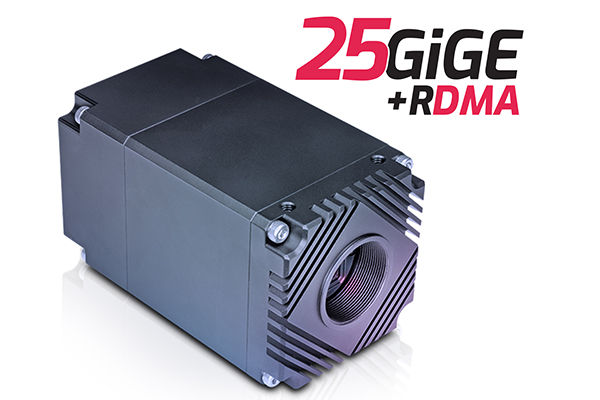
The new Atlas25 camera from LUCID Vision Labs comes with RDMA for high-speed industrial imaging.
Get news, papers, media and research delivered. Sign up for our free newsletters.
Stay up-to-date with news and resources you need to do your job. Research industry trends, compare companies and get weekly market intelligence with Robotics 24/7.
LUCID Vision Labs
The new Atlas25 camera from LUCID Vision Labs comes with RDMA for high-speed industrial imaging.
Canadian industrial camera designer and manufacturer LUCID Vision Labs announced the launch of the Atlas25 camera series, featuring a 25GigE interface and RDMA (Remote Direct Memory Access) for high-speed industrial imaging applications.
LUCID said that the Atlas25 combines Sony’s 4th generation Pregius S CMOS sensors with GigE Vision 3.0 and RoCE v2 (RDMA over Converged Ethernet) to deliver up to 25 Gbps data throughput with low latency and minimal CPU overhead.
Designed for applications requiring both performance and reliability, the Atlas25 provides a scalable upgrade path from existing 1, 2.5, 5, and 10 GigE systems while maintaining full GigE Vision compliance.
“Atlas25 represents a major step forward for high-bandwidth Ethernet-based imaging,” said Rod Barman, founder and president of LUCID Vision Labs. “By integrating the optical transceiver directly into the camera and supporting RDMA, we’re enabling customers to capture and transfer large amounts of image data efficiently over long fiber connections without compromising performance or reliability.”
The company said that the Atlas25 camera provides a direct LC duplex multimode fiber connection without the need for an external SFP module, simplifying system design, reducing power consumption, and improving overall reliability. Featuring a compact 55 × 55 mm housing, a new 17-pin GPIO connector with additional input and output lines and a wide operating temperature range from -20 to 50°C ambient, the Atlas25 ensures reliable operation in harsh industrial environments.
The first Atlas25 models include the Sony IMX530, IMX531, IMX532, and IMX535 CMOS sensors, delivering resolutions up to 24.5 megapixels and frame rates up to 184 fps. With its fanless thermomechanical design, LUCID said the Atlas25 dissipates heat efficiently without external heatsinks or fans, ensuring quiet and maintenance-free performance in space-constrained systems.
With GigE Vision 3.0 and RDMA (RoCE v2) support, the company said its Atlas25 achieves deterministic, low-latency data transfer by bypassing the CPU and operating system layers. This architecture allows image data to stream directly into host memory, freeing up system resources for image processing, AI inference, or other critical tasks. The result is high throughput, reduced CPU load and predictable real-time performance over standard Ethernet infrastructure.
Enjoyed this article? Add Robotics 24/7 as a preferred source in Google Search.
Edge computing gives AI agents the processing power to turn instructions into…
Daimon-TWM world model debuts for the public
Platform helps robots adapt to complex tasks

Look beyond the headlines for the latest in humanoid robots