Dexory
Dexory announced an integration with NVIDIA Cosmos to expand its DexoryView Storage Health capabilities, and work with Halo to test next-generation robotics safety possibilities.
Get news, papers, media and research delivered. Sign up for our free newsletters.
Stay up-to-date with news and resources you need to do your job. Research industry trends, compare companies and get weekly market intelligence with Robotics 24/7.
Dexory
Dexory announced an integration with NVIDIA Cosmos to expand its DexoryView Storage Health capabilities, and work with Halo to test next-generation robotics safety possibilities.
Dexory announced two updates on how the company is working with NVIDIA technology to advance physical AI in warehouse environments.
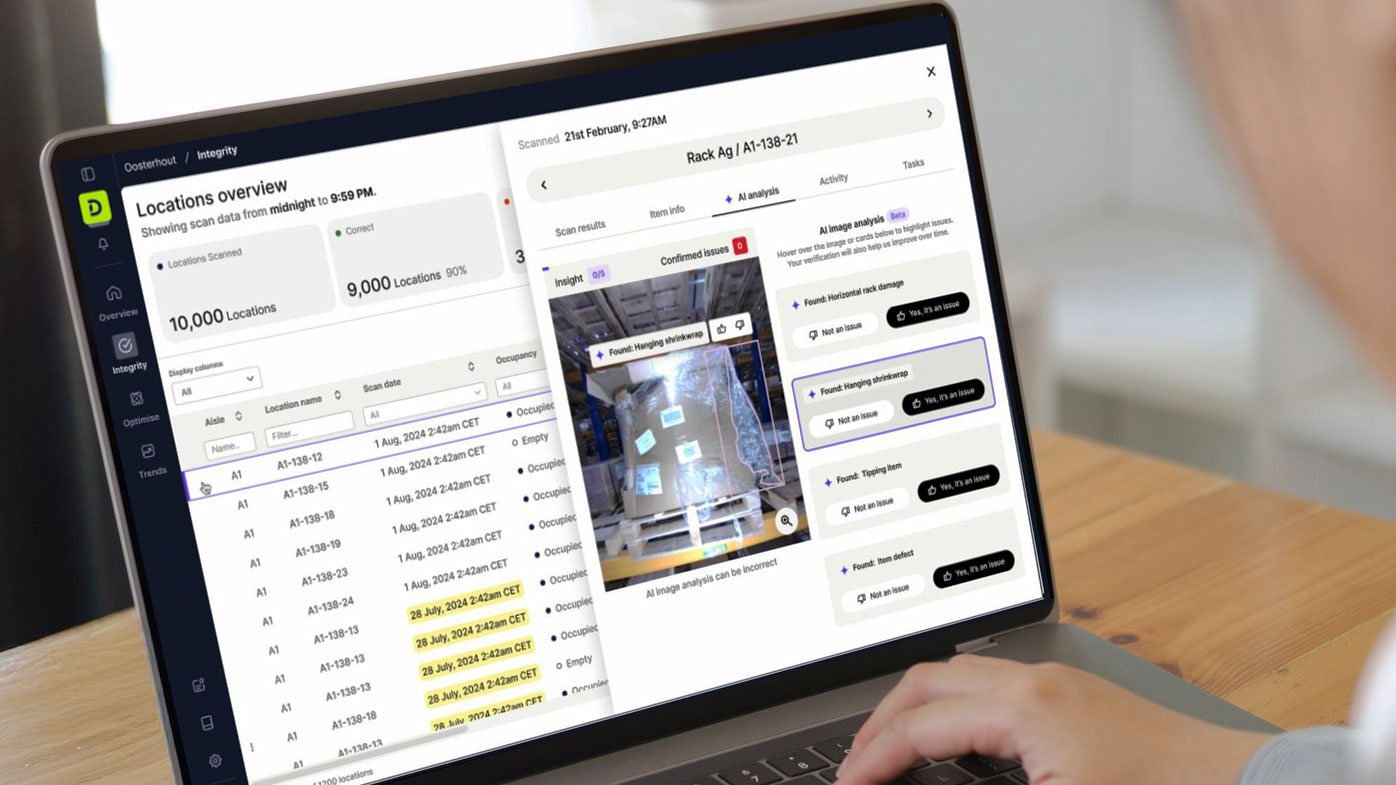
First, the company announced an integration with NVIDIA Cosmos to expand DexoryView Storage Health capabilities, using foundation model reasoning to identify a broader range of warehouse storage issues, including open boxes, misaligned pallets and misplaced goods.
The company also said that it is working with NVIDIA Halos to test next-generation robotics safety capabilities, with plans to roll out the technology across its global fleet of autonomous warehouse robots.
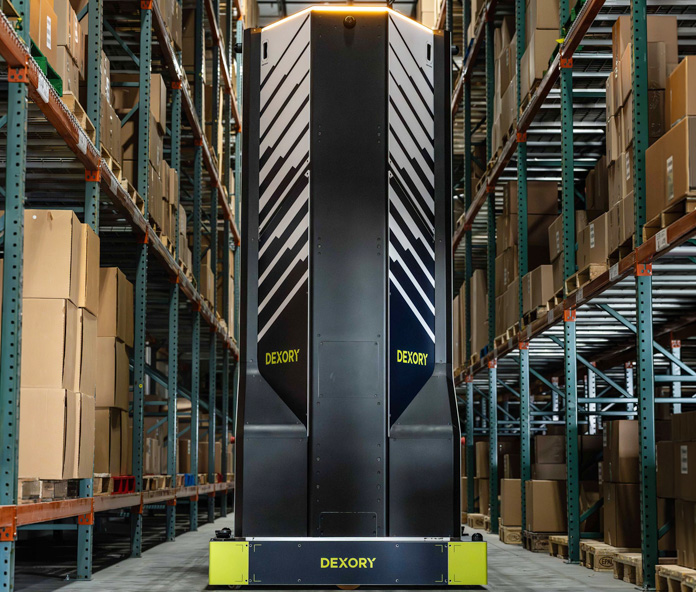
Dexory said that storage issues can be difficult to spot, particularly at height or in densely packed storage areas. The company said that Storage Health analyses high-resolution imagery captured by the company’s autonomous robots as they navigate warehouse aisles, helping teams identify and flag potential storage anomalies across rack levels.
The company said that the Storage Health and NVIDIA Cosmos-Reason2-2B integration brings NVIDIA’s foundation model technology into a real-world warehouse application. Using natural-language prompts, Dexory said that the model can identify different storage issues and provide an additional layer of analysis when existing models return low-confidence results, helping improve the reliability of the final output.
“Warehouses are dynamic environments, with storage conditions varying significantly across sites and operations,” said Andrei Danescu, co-founder and CEO of Dexory. “By bringing NVIDIA Cosmos into Storage Health, we are expanding the capability with foundation model reasoning alongside the high-frequency data captured by our autonomous robots, enabling us to identify and understand an even broader range of storage anomalies.”
Dexory said that it has fine-tuned the model on its own warehouse imagery to recognize storage-specific conditions, including open boxes, goods pulled forward from their expected position and misaligned pallets. After evaluating both the 2B and 8B versions of Cosmos-Reason2, Dexory said that it selected the 2B model for production based on its combination of accuracy and deployment efficiency, with the approach tested using data from multiple warehouse sites.
With NVIDIA Cosmos integrated into Storage Health, Dexory said that it is extending how AI can be applied to warehouse operations, helping teams gain greater insight into storage conditions across their facilities.
Dexory said that NVIDIA Halos unifies real-time AI, functional safety and edge computing with NVIDIA IGX Thor to engineer robotics safety across every layer of design. The company said that these capabilities are critical in the environments where Dexory’s autonomous robots already operate 24/7 alongside people, forklifts and other equipment across warehouses, manufacturing and logistics sites.
Drawing on this operational experience, Dexory said that it brings deep expertise in the functional operation of autonomous mobile robots in complex indoor environments, considering its aforementioned integration with NVIDIA Cosmos.
Now, Dexory said that it is exploring the Halos safety stack to build a single-board architecture that will improve safe autonomy and expand perception capabilities for inside-out safety. Dexory said that it is planning to roll out the technology across its fleet deployed worldwide.
“Our robots operate every day in highly dynamic environments, giving us a unique perspective on what safe autonomy requires in the real world,” Danescu said. “By collaborating with NVIDIA Halos for our autonomous robots, we’re combining that operational experience with NVIDIA’s leadership in AI computing and functional safety to help advance the safe, reliable deployment of physical AI at industrial scale.”
Dexory said that this work comes as physical AI plays an increasingly important role in warehouse and industrial operations. As autonomous systems become more capable and operate more closely alongside people and machinery, the company said that robust safety architectures will be critical to deploying these technologies at scale.
Artificial Intelligence Deep Learning Machine Vision Machine Learning Autonomy Lift Trucks Mobile Robots Components Sensors Cameras Lidar Software Cloud and Edge Data Management Fleet Management News Press Release Autonomous Mobile Robots Dexory Navigation NVIDIA Perception Physical AI Safety Storage
Enjoyed this article? Add Robotics 24/7 as a preferred source in Google Search.
Edge computing gives AI agents the processing power to turn instructions into…
Daimon-TWM world model debuts for the public
Platform helps robots adapt to complex tasks
Look beyond the headlines for the latest in humanoid robots