Mecalux
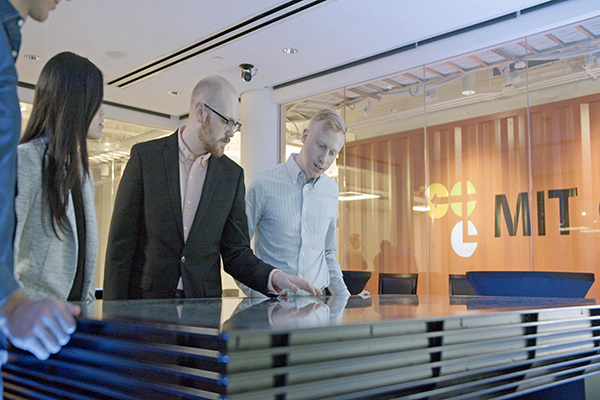
MIT and Mecalux announced a collaborative project through MIT's Intelligent Logistics Systems Lab that will develop two key areas of research to boost warehouse robot productivity and optimize order distribution. Researchers will train self-learning AI models to learn from demand patterns and anticipate new customer buying habits.
Get news, papers, media and research delivered. Sign up for our free newsletters.
Stay up-to-date with news and resources you need to do your job. Research industry trends, compare companies and get weekly market intelligence with Robotics 24/7.
Mecalux
MIT and Mecalux announced a collaborative project through MIT's Intelligent Logistics Systems Lab that will develop two key areas of research to boost warehouse robot productivity and optimize order distribution. Researchers will train self-learning AI models to learn from demand patterns and anticipate new customer buying habits.
The Massachusetts Institute of Technology Center for Transportation & Logistics (MIT CTL) and intralogistics group Mecalux announced a five-year collaborative project to expedite the integration of self-learning artificial intelligence (AI) in logistics.
Through MIT’s Intelligent Logistics Systems Lab, the two institutions will explore new applications of AI models with significant potential for businesses and society.
In the project’s first year, teams at the Intelligent Logistics Systems Lab and Mecalux will develop two key research areas to accelerate innovation. The first will focus on increasing the productivity of autonomous warehouse robots. Using advanced simulation, optimization, and machine learning techniques, researchers will develop a “swarm intelligence” system enabling multiple robots to operate as a single entity, making collective decisions.
“The objective of our collaboration with Mecalux is to foster disruptive innovation and achieve two highly impactful use cases where AI transforms industry decision-making,” said Dr. Matthias Winkenbach, director of research at MIT CTL and the Intelligent Logistics Systems Lab. “We will train complex self-learning machine learning models to ultimately reduce costs, lower carbon footprints and improve service quality for customers.”
The second research area will center on training self-learning AI models. The Intelligent Logistics Systems Lab will design systems capable of learning from demand patterns and anticipating new customer purchasing habits.
“Current distribution systems fail to account for the full complexity of logistics networks and often make strong simplifying assumptions,” Winkenbach added. “This project seeks to help companies operating large networks of warehouses, distribution centers and stores automatically determine the most efficient way to fulfill each order taking into account the real-time status of the distribution network.”
This research partnership between MIT CTL and Mecalux will help logistics experts, warehouse staff and carriers perform their jobs with maximum precision.
“Having contributed to founding MIT’s Intelligent Logistics Systems Lab, Mecalux has leveraged its practical expertise in warehousing and its software and automation experts to support MIT’s research,” said Javier Carillo, CEO of Mecalux. “The goal is to transform companies’ logistics operations to achieve greater efficiency.”
GENISOM AI makes ICRA debut at conference in Vienna

World's first omni-modal evaluation including tactile sensing for…

Ultrasonic sensing enhances robotics perception
Cybernetix Ventures’ event kicks off Robotics Tech Week 2026 slate of events