By
Roberto Michel
October 30, 2020
Get news, papers, media and research delivered. Sign up for our free newsletters.
Stay up-to-date with news and resources you need to do your job. Research industry trends, compare companies and get weekly market intelligence with Robotics 24/7.

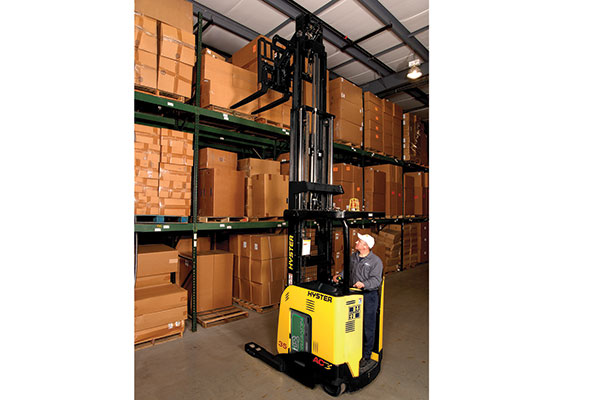
Power choices involve a balancing act that pits factors like maintenance habits of operators, space concerns related to charging infrastructure, and the need for reliable uptime against cost considerations, according to Steven LaFevers, vice president of emerging technology for the Hyster Company.
“We think power choice is going to be an increasingly important decision for our customers,” says LaFevers. “My first piece of advice is when making lift truck decisions, are you considering all available power options objectively?”
In recent years, the dominant power choice for indoor lift truck use has been conventional, lead acid batteries. While they still might be an excellent choice for many sites, other valid power choices exist for use indoors, including lithium ion (Li-ion) batteries, thin-plate pure lead (TPPL) batteries, which are an advanced type of lead acid battery, and lift trucks that use hydrogen fuel cells.
No single type of power source is best for all warehouses, explains LaFevers, because it all depends on factors like sensitivity to cost or issues like downtime from improper charging routines. While a relatively newer power choice like Li-ion may seem attractive because of virtues like its fast-charging time or that you don’t need a large battery room as is common with large fleets running lead-acid trucks, it pays to closely examine all the operational constraints.
For example, says LaFevers, Li-ion batteries charge much faster than lead acid, with 15 minutes of charge giving the unit essentially an hour of run time. That means Li-ion powered units can run all day without battery swaps with regular opportunity charging. However, that means the operation needs to be smart about where to place opportunity charging locations and have confidence the operators will rigorously carry out the charging to avoid downtime.
“With lithium, you need to ensure you can avoid interruption,” says LaFevers. “It has amazing fast-charging characteristics, but I think many people underestimate the needs of lithium from a charging practices standpoint.”
Cost is always a factor. Hydrogen has some attractive characteristics including extremely fast refueling that gives a duty cycle much like that of an internal combustion (IC) lift truck, but hydrogen is relatively costly, according to LaFevers. “Though customers may have to pay a premium to go with a hydrogen solution, they can realize some great benefits that make it worthwhile in the right situation,” he says.
Hydrogen lift trucks have been around for a relatively short time compared to electric trucks running on lead-acid, but are making inroads due to characteristics like fast refueling, sustainability benefits, and consistent forklift power, even in cold conditions. According to the U.S. Department of Energy, more than 20,000 hydrogen fuel cell lift trucks were in use in the U.S. market in 2018.
To make a smart power choice, it’s best to back up and look at operational and facility factors like how many shifts at a site, how many hours of actual unit run time per shift, and other considerations like space and operator charging habits, stacked up against cost of the technology, LaFevers advises. For some operations that have less intensive lift truck use, lead acid batteries may remain a great choice, while some companies may decide to use different power sources for different parts of their operations. To help customers in such decisions, Hyster has devised a “Power Match” online tool that collects decision factors and provides guidance.
“It’s best to approach the power decision based on what’s best for your particular operation,” says LaFevers. “You’re trying to find which power choice is going to provide the best balance of highest productivity, lowest total cost of ownership and lowest amount of asset turnover. When you find that balance, you have a sweet spot that fits your operation.”

Roberto Michel, senior editor for Modern, has covered manufacturing and supply chain management trends since 1996, mainly as a former staff editor and former contributor at Manufacturing Business Technology. He has been a contributor to Modern since 2004. He has worked on numerous show dailies, including at ProMat, the North American Material Handling Logistics show, and National Manufacturing Week. You can reach him at: [email protected].
Enjoyed this article? Add Robotics 24/7 as a preferred source in Google Search.
Edge computing gives AI agents the processing power to turn instructions into…

Daimon-TWM world model debuts for the public

Platform helps robots adapt to complex tasks

Look beyond the headlines for the latest in humanoid robots