By
Eugene Demaitre
November 12, 2021
NVIDIA
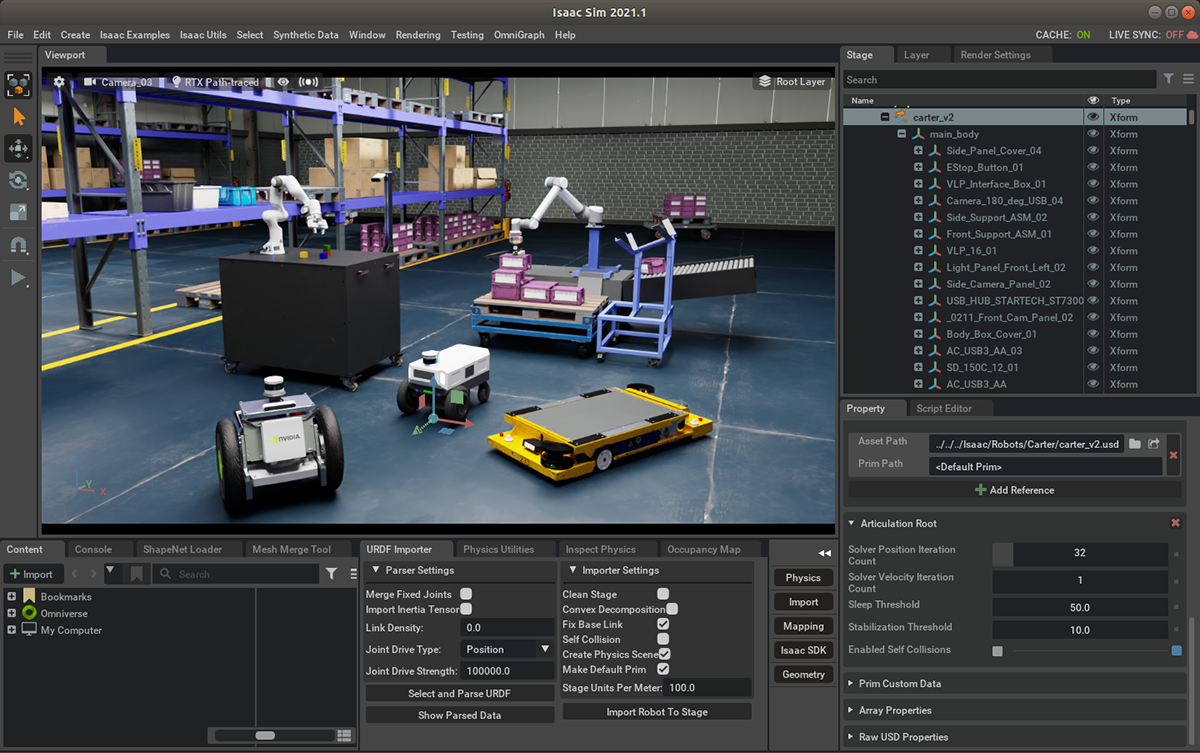
NVIDIA's Isaac Sim is built on the company's Omniverse simulation platform.
Get news, papers, media and research delivered. Sign up for our free newsletters.
Stay up-to-date with news and resources you need to do your job. Research industry trends, compare companies and get weekly market intelligence with Robotics 24/7.
NVIDIA
NVIDIA's Isaac Sim is built on the company's Omniverse simulation platform.
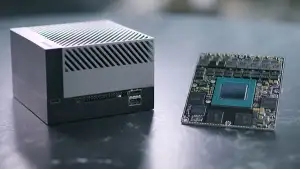
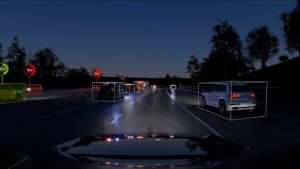
At its fall GPU Technology Conference, or GTC, this week, NVIDIA Corp. announced several new technologies intended to help robotics developers, including enhancements to the Omniverse simulation environment, the Jetson AGX Orin computer, integration with the Robot Operating System, and the NVIDIA DRIVE platform for autonomous vehicle development.
For instance, Jetson AGX Orin features high-speed interfaces, faster memory bandwidth, and multimodal sensor support. This enables it to feed multiple concurrent artificial intelligence application pipelines, said NVIDIA.
"As robotics and embedded computing transform manufacturing, healthcare, retail, transportation, smart cities, and other essential sectors of the economy, the demand for processing continues to surge,” said Deepu Talla, vice president and general manager of embedded and edge computing at NVIDIA. “Jetson AGX Orin addresses this need, enabling the 850,000 Jetson developers and over 6,000 companies building commercial products on it to create and deploy autonomous machines and edge AI applications that once seemed impossible.”
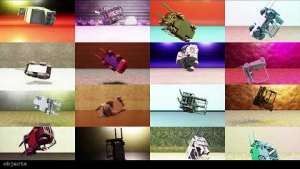
Since its launch late last year, Omniverse has been downloaded 70,000 times by designers at 500 companies, said NVIDIA. The virtual world simulation and collaborative platform for 3D workflows can be used in product design, testing, and training. The Santa Clara, Calif.-based company said it has continued to refine its approach to generating synthetic data, which it said enables developers to scale applications more rapidly than with annotated collected data.
"Adopting a data-centric approach to model development when using synthetic data is a very iterative process," said NVIDIA. "Trained models are evaluated, and improvements in the dataset are identified. New datasets are then generated, and a new cycle of training is initiated. This process of generating data, training the model, evaluating the model, and generating more data is continued until the model performs as desired."
"Because the data in each iteration is being generated in simulation as opposed to being collected in the real-world and subsequently labeled, the speed of model training is greatly accelerated," the company said. "These datasets which can be generated at scale are output in a format that can be directly used by the training tools. This eliminates the need for another step of data pre-processing."
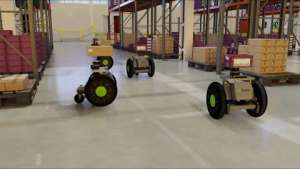
Among its announcements at GTC, NVIDIA announced the Omniverse Replicator synthetic-data generation engine for Isaac Sim for robotics and NVIDIA Drive for autonomous vehicles. It demonstrated a mobile robot trained with a model built in Replicator.
The company generated more than 90,000 images for the demonstration. It also used the new Omniverse Farm to manage the GPU (graphics processing unit) compute resources that created the dataset. Despite the limitations of lidar, the robot was able to avoid colliding with a forklift.
"Improving performance for challenging AI-based computer vision applications requires large and diverse datasets that replicate the inherent distribution of the target domain," said NVIDIA. "The new NVIDIA Omniverse Replicator for Isaac Sim is a powerful tool to generate production-quality synthetic datasets to train robust deep-learning perception models."
“The goal is for the robot to not know whether it is inside a simulation or the real world,” said Jenson Huang, founder and CEO of NVIDIA. Replicator simulates the sensors, generates data that is automatically labeled, and with a domain randomization engine, creates rich and diverse training data sets, he explained.
Omniverse Enterprise is now available, starting at $9,000 a year. NVIDIA's GTC session recordings and resources are also available online to registrants.
For 10 announcements from NVIDIA GTC, see the slideshow at top right.
NVIDIA CEO Jensen Huang covers the highlights of his GTC21 November keynote that presents the latest breakthroughs in AI, data science, high performance computing, graphics, edge computing, networking, and autonomous machines.

Eugene Demaitre was editorial director of Robotics 24/7. Prior to joining Peerless Media, he was a senior editor at Robotics Business Review and The Robot Report. Demaitre has also worked for BNA (now part of Bloomberg), Computerworld, and TechTarget. He has participated in numerous robotics-related webinars, podcasts, and events worldwide.
Artificial Intelligence Deep Learning Machine Vision Machine Learning Autonomy Autonomous Vehicles Autonomous Trucks Mobile Robots Components Processors Motion Control Sensors Cameras Lidar Software Cloud and Edge Data Management Robot Operating System Simulation News NVIDIA Simulation SoC Surgical
Enjoyed this article? Add Robotics 24/7 as a preferred source in Google Search.
Edge computing gives AI agents the processing power to turn instructions into…
Daimon-TWM world model debuts for the public
Platform helps robots adapt to complex tasks
Look beyond the headlines for the latest in humanoid robots