Interact Analysis
Current industry challenges and a wide range of other contributory factors caused Interact Analysis to downgrade its mobile robot market forecast.
Get news, papers, media and research delivered. Sign up for our free newsletters.
Stay up-to-date with news and resources you need to do your job. Research industry trends, compare companies and get weekly market intelligence with Robotics 24/7.
Interact Analysis
Current industry challenges and a wide range of other contributory factors caused Interact Analysis to downgrade its mobile robot market forecast.
Market research firm Interact Analysis said that after previous rapid expansion and investment in the mobile robot industry, it is now undergoing a period of challenges and readjustment.
In its latest mobile robot market report, Interact Analysis revised its predictions to reflect current global conditions and set new expectations as to how it will develop in the future.
The report saw a significantly lower forecast, citing a complex mix of geopolitical, economic and industry-specific challenges, along with changes to Interact Analysis’ methodology in calculating market sizes.
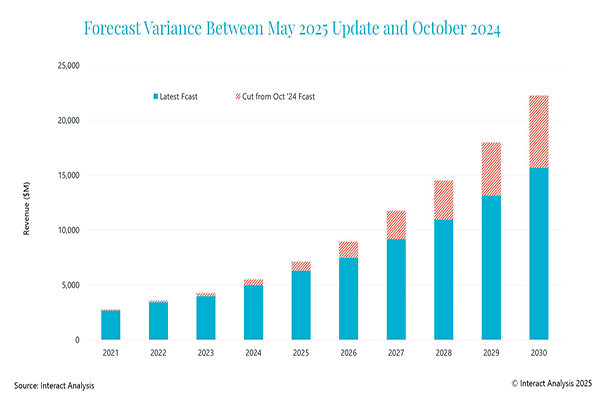
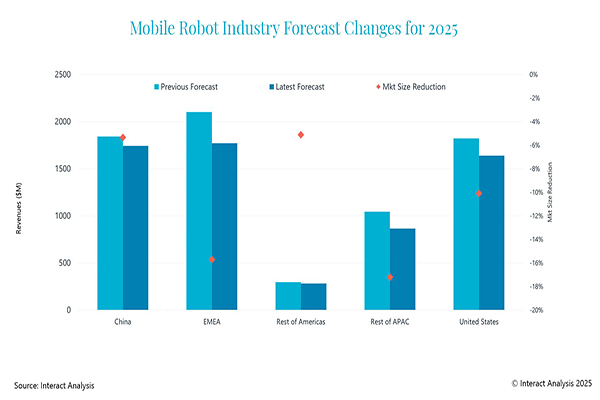
Interact Analysis’ latest report presented an $800 million reduction in the 2025 market forecast, with lower growth predicted in each of the major regions. This adjustment reflects a broader reassessment of the industry’s growth trajectory, with the 2030 revenue projection now standing at $15.6 billion, down from its earlier, more optimistic estimates. The resulting compound annual growth rate (CAGR) for the next five years has also been trimmed from 26% down to 21%.
At the heart of the forecast revision lies the uncertainty surrounding global tariffs, instigated by the new U.S. administration under President Trump. These tariffs are reshaping global supply chains and injecting a high degree of uncertainty into capital investment decisions, causing delays.
Interact Analysis said companies are holding back on large-scale automation investments, wary of shifting trade policies and uncertainty over both their costs and the fiscal health of customers and vendors. The Global Economic Policy Uncertainty (GEPU) Index hit an all-time high of 430 in January 2025. This level of uncertainty exceeds that seen during the 2008 financial crisis and the COVID-19 pandemic. As a result, many companies are adopting a “wait-and-see” approach, delaying strategic investments in warehouse automation and infrastructure.
Aside from the increased costs, which Interact Analysis said would likely be passed through (partially or totally) to end customers, decades of globalization have meant products are rarely constructed entirely in a single country. Mobile robots are no different and foreign vendors (most notably Chinese) will struggle to remain competitive in the U.S. (and possibly Europe). Similarly, domestic U.S. vendors will incur higher costs (at least in the short term) as they import components and sub-systems from China and APAC.
While there are tentative signs of recovery in warehouse construction, especially in the US and Japan, growth remains sluggish. Interact Analysis revised the global forecast for new warehouse capacity in 2025 slightly upward, but it remains in negative territory at -2.0% year-over-year out to 2030. Elevated construction costs, industrial overcapacity and policy uncertainty continue to weigh heavily on the sector.
Aside from the external factors outlined above, much of Interact Analysis’ reduction in forecasts has come from the way it measures and predicts demand for mobile robots.
A reassessment of vendor-by-vendor volumes led the firm to an 8% reduction in its market sizes for 2024 and earlier. At the same time, IA said it has conducted a thorough analysis of all possible customer sites for automation.
It said that by better considering the throughput levels of customer sites, IA has adjusted its expectations for mobile automation (compared with fixed automation and manual labor). The net result of this is that the serviceable available market (SAM) for mobile robots is lower than previously projected, as market penetration for order fulfillment robots is assumed to be limited to low and mid-throughput sites.
Finally, after researching this market since 2017 and now with 8 years of historical data, Interact Analysis said it is in a stronger position to understand the likely average growth rate for this industry following both the peak and trough of market cycles. The overall impact of the above factors is a hefty reduction in our forecast for autonomous mobile robots (AMRs) and automated guided vehicles (AGVs).
Interact Analysis released the following observations on mobile robot types:
Interact Analysis’ main message from the report is that the mobile robot industry is still growing, but not as fast or as smoothly as once expected. Tariffs, economic uncertainty and shifting global dynamics are forcing companies to rethink their strategies and timelines.
For stakeholders across the automation ecosystem - from vendors and integrators to end-users and investors - Interact Analysis said that this is a time for strategic patience and adaptability. The fundamentals of automation remain strong, but the path forward will require some careful navigation.
Enjoyed this article? Add Robotics 24/7 as a preferred source in Google Search.
Edge computing gives AI agents the processing power to turn instructions into…
Daimon-TWM world model debuts for the public
Platform helps robots adapt to complex tasks

Look beyond the headlines for the latest in humanoid robots