Stratview Research
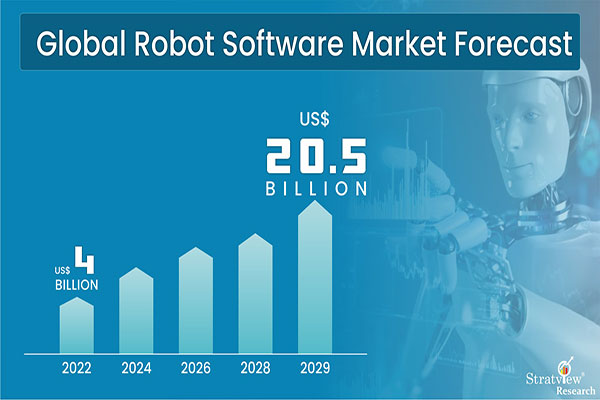
Stratview Research said the global robotics software market is projected to grow 5x, to over $20.5B, by 2029.
Get news, papers, media and research delivered. Sign up for our free newsletters.
Stay up-to-date with news and resources you need to do your job. Research industry trends, compare companies and get weekly market intelligence with Robotics 24/7.
Stratview Research
Stratview Research said the global robotics software market is projected to grow 5x, to over $20.5B, by 2029.
As industries embrace automation and smart manufacturing, the demand for sophisticated robotic offerings will continue to surge, paving the way for innovative robotic software.
Despite obstacles, the reliance on automation and increasing integration of robotics in various industries continues to drive growth in the robotics software market. Stratview Research, in its Global Robot Software Market Report projects the robotic software market to grow approximately 5x by 2029, expanding from $4B in 2022 to $20.5B by 2029.
The majority of innovations today are closely linked to automation, which is enhancing efficiency and redefining possibilities across various industries, according to Stratview Research. But beneath every robot’s movement, and every automated process lies something less tangible but equally essential, their brain - their software, that serves as the backbone of their functionality, transforming initial concepts into fully realized technologies.
Robot software is everything from simple scripts to complex systems, that utilize disruptive technologies, including artificial intelligence (AI) and machine learning to control communication between robots and other systems, manage algorithms and provide real-time monitoring and performance optimization.
In short, it enables robots to operate according to the given commands, essentially transforming a mechanical device into a functional, autonomous system capable of carrying out specific actions without constant human intervention.
Today, robots are everywhere, making significant impacts across various sectors as the demand for automation in different sectors grows. From autonomous drones and robotic arms in factories to medical robots, humanoid robots, smart home bots, and AI-powered service bots robot software is the underlying force that drives robotic systems.
Robot manufacturing includes several steps. Once the hardware elements - including controllers, sensors, actuators, motors, etc. for the robot have been selected, the focus shifts to the software framework. Software for a robot consists of tools and standards designed for development and the deployment of robotic systems. Various types of software, such as design software, middleware and control software, are integral to robotics development.
Selecting suitable software for a robot depends on different criteria, compatibility with robot hardware, budget constraints, resources, skill level of the team, etc.
The software that powers any robot, be it industrial or service, is crucial for functionality, enabling the robots to perform complex tasks autonomously and interact with human operators and other systems.
Designed to operate in varied environments such as homes, hospitals and hotels, service robots require software that enables them to perform tasks alongside humans requiring features like speech recognition and gesture detection, allowing them to adapt to dynamic situations and user needs.
In contrast, industrial robots are primarily deployed in controlled manufacturing settings where they perform repetitive tasks like welding, painting, assembly, material handling, etc. Their software typically focuses on precision control and efficiency, often utilizing real-time operating systems to ensure the timely execution of predefined tasks. Industrial robots generally operate autonomously with minimal human interaction, relying on specialized programming tailored to specific applications.
In short, every industry demands software for a perfectly functioning robot.
However, the growing trend of industrial automation globally presents significant opportunities for robot software in the industrial sector. The International Federation of Robotics (IFR) states that in 2023 alone over 541,000 industrial robots were newly installed globally, bringing the total operational stock of industrial robots to an all-time high in number to over 4.3 million.
IFR also predicts that the industrial robots’ annual installation count could go as high as 602,000 units by 2027.
Stratview Research said the Asia-Pacific (APAC) region is considered to be the economic powerhouse, generating increased demand for labor-saving technologies across industries, making it the largest region with a high demand for industrial robots. Nearly 70% of the total newly deployed robots installed in 2023 were in Asia, according to IFR.
With over 50% of all industrial robots installed in 2023, China - the global leader in absolute terms, is by far the world’s largest market with over 276,200 industrial robots installed in 2023.
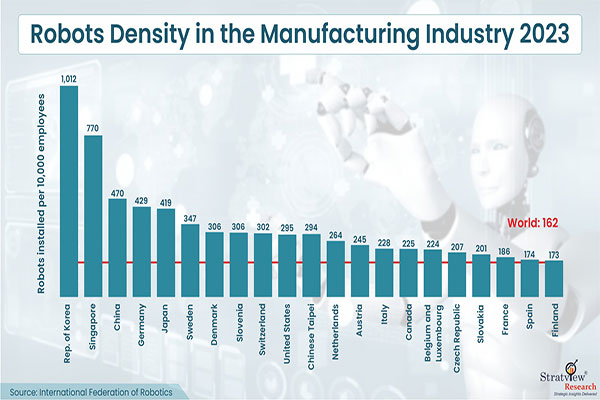
Robot density also serves as a barometer for measuring the level of automation adoption across industries, emphasizing the increasing demand for robot software in countries that are rapidly embracing automation.
The top three countries in 2023 where the robot fleet per worker were high are:
Additionally, while Germany ranks fourth with significant adoption, Japan follows closely in fifth place (with 419 robots installed per 10,000 workers - 10 less than Germany), further emphasizing the strong presence of APAC countries in the robotics landscape.
The growing robot fleet highlights the increasing adoption of intelligent robotic technologies, powered by advanced software that not just optimizes operations but also addresses workforce challenges, enabling organizations to leverage data-driven insights for improved decision-making and productivity.
The rise of new technologies such as AI, machine learning and advanced sensors started powering sophisticated robotic applications. The world is automating faster than ever, and to meet this demand, the need for robots and robot software to drive automated systems is on the rise. Robot manufacturing giants are rapidly upgrading their software and collaborating with other firms to match the shift.
Whether it’s addressing labor shortages, enhanced productivity without fatigue, improved quality and consistency in production, better workplace safety by handling hazardous tasks, or optimized floor space utilization, robots are here to help.
The adoption of robotics is a real industry process that requires a number of pieces to fall into place. Robust software is one of the vital criteria for any robot manufacturing company to look upon. The robotics industry is filled with tales of companies that have shut down, one of the reasons being faulty or delayed software updates.
Apart from this, there lies a challenge that acts as a pothole in the growing robot software market - data security concerns rising in conjunction with the number of connected bots and systems. Since the industry has adopted robotics systems faster than it has embraced cybersecurity practices, it is prone to cyber-attacks.
Editor’s Note: This summary was prepared with help from Stratview Research. A full, detailed breakdown of the global robotics software market is also available.
Artificial Intelligence Machine Learning Autonomy Drones Mobile Robots Industrial Automation Collaborative Robots Robot Arm Components Controllers Motion Control Motors and Drives Sensors Software Cloud and Edge Data Management Fleet Management Robot Operating System News Press Release IFR Market Research Reports Software

Ultrasonic sensing enhances robotics perception
World's first omni-modal evaluation including tactile sensing for…

Cybernetix Ventures’ event kicks off Robotics Tech Week 2026 slate of events
Preview the manufacturing and warehouse components that will be on the…