By
Roberto Michel
October 3, 2024
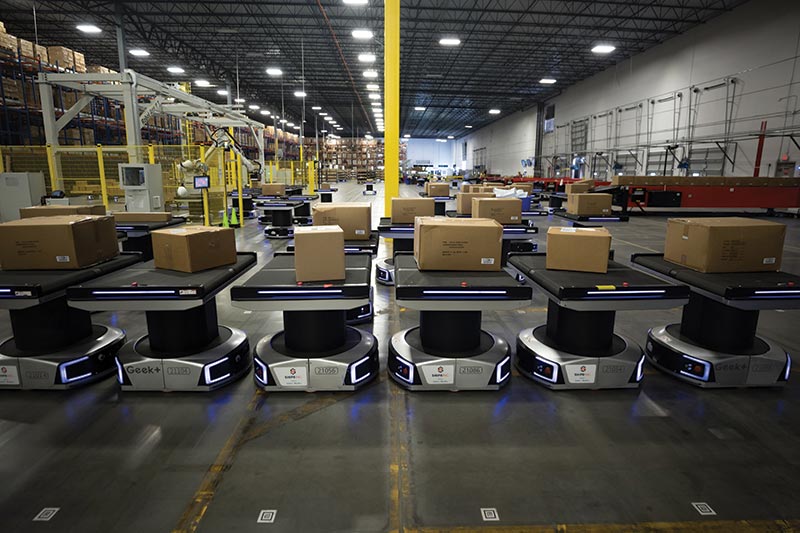
Source: Stephen B. Morton/Getty Images for Peerless Media
Get news, papers, media and research delivered. Sign up for our free newsletters.
Stay up-to-date with news and resources you need to do your job. Research industry trends, compare companies and get weekly market intelligence with Robotics 24/7.
Source: Stephen B. Morton/Getty Images for Peerless Media
For anyone stepping into SHIP8 INC.’s, busy warehouse in Port Wentworth, Ga., just a couple of miles from the Port of Savannah, the automation systems look like what you would find in a robotics innovation center, only scaled up with more than 100 mobile robots scurrying about to speed up the fulfillment of products including an array of home furnishing and home textile products.
Mobile sortation robots (Geekplus) are taking on cartons being unloaded from telescoping conveyors and autonomously bringing them to smart palletizing robots. A four-way robotic pallet shuttle automatically stores and retrieves palletized goods. It’s fed by another fleet of larger autonomous mobile robots (AMRs), as well as a shelf-to-person system, also based on AMR technology, which brings small items to light-directed picker workstations.
Associates are executing select tasks at a few points in the overall process, but much of the time-consuming warehouse travel and carton handling chores that in a manual operation would require large teams of associates and lift truck operators are now automated by this blend of smart intralogistics robots.
As SHIP8 takes on new customers, the scalability of these systems, combined with its warehouse capacity, positions the company to handle increasing demand.
The driver behind this move to a highly automated warehouse was not to prove a point about robotics—it was meant to solve the omnichannel fulfillment challenges of a high-volume DC operation.
Before adopting the robotics, says Ron Capranos, president of SHIP8, the DC operation relied on a largely manual approach which, while backed up by an effective warehouse management system (WMS) and training, had become increasingly difficult to scale up for peak seasons.
As a relatively new third-party logistics (3PL) business, but with deep expertise serving the fulfillment needs of its parent company, the SHIP8 team had a strong record for hitting service levels, explains Capranos, but meeting those goals during peak was getting harder to pull off with each successive year. It wasn’t just adding more people, he adds, but training them on how to use equipment like lift trucks, training on safety best practices as well as renting extra industrial trucks.
Overall, it was akin to tactical mobilization for each peak season, made even more challenging by the tight labor market in the Savannah area.
“Every year as we prepared to go into our peak season, it was almost like getting ready for battle,” says Capranos.
“We’d have to hire, between our two facilities in Port Wentworth, somewhere between 200 to 400 people, and we’d start the hiring in September. We’d be bringing in all these people, and we’d be training them, getting them certified to operate our equipment, and it was all for a five to six-week long peak season. Then once the peak time was over, you’d have to send back all equipment we’d rented, and let all these people go. With every year, it was becoming more costly and challenging for us to gear up for peak.”
As a result, even before the Covid-19 pandemic hit, SHIP8 began researching an automated warehouse solution, one that could scale up to peaks without adding many dozens of people, and one that could handle a greater proportion of labor-intensive e-commerce orders.
To come up with an optimal solution, they worked with a systems integrator (BlueSkye Automation) to design the needed systems. Another integrator SHIP8 works with (Oneiro Technologies) assisted in the concept and later with some of the integration, but the Port Wentworth project was led by BlueSkye.
After examining potential sites for an automated DC, SHIP8 decided to revamp one of its two existing DCs at Port Wentworth to become its automated facility, capable of handling direct-to-consumer (DTC) and business-to-business (B2B) orders.
SHIP8 has a unique history as a 3PL. Officially, it launched as SHIP8 INC. offering contract logistics and fulfillment services in early 2023, but its network and people have been handling omnichannel fulfillment for parent company E&E Co. Ltd, also known as JLA Home for the last couple of decades, with an operation in Port Wentworth for the past 17 years.
E&E is a global provider of home textiles and furnishings, supplying products to the likes of Amazon, Macy’s, Kohl’s Walmart, Target Stores, and others, carrying multiple successful brands, including Madison Park.
There is a good chance that any U.S. consumer buying items ranging from bed linens, to furniture, to complete “bed in a bag” sets in recent years has bought products fulfilled by SHIP8’s network.
“We’re a relatively new company from the perspective of formally being a 3PL, but we have a long history of expertise and performance behind us by providing services to our parent company, which is one of the largest home furnishing suppliers in North America,” says Capranos.
Because of this history, SHIP8 already had a DC network when it launched as a 3PL. Its network includes two warehouses in Port Wentworth, two DCs in Woodland, Calif., relatively close to the Port of Oakland, and warehouse space in Canada. Additionally, two of SHIP8’s sister companies have bolstered its capabilities over the years.
One of these is OA Express, a freight carrier with expertise in drayage and container transportation and Sync Soft, a software company that created the proprietary WMS that SHIP8 has used for many years.
This WMS manages the overall fulfillment process at Port Wentworth, integrating with the new robotic systems and coordinating with them around order release and related tasks that need to be executed.
In short, SHIP8 is no beginner as a 3PL and all that entails, from warehouse fulfillment processes, to covering transportation needs and working with carriers, and having a strategic network.
What SHIP8 did lack, however, was a highly automated DC at Port Wentworth that could handle a high volume of DTC orders, while also shipping by the pallet load to retailer DCs. The need for automation became even stronger during the depths of the pandemic, when consumer e-commerce ordering for home goods skyrocketed, and has remained a big slice of the order mix.
“We knew our business was strong and would continue to grow, but the biggest Achilles Heel and single highest expense we faced was around labor,” Capranos says. “That was the biggest factor that prompted us to go forward with a system like this.”
The solution devised for Port Wentworth is heavy on use of AMRs (Geekplus), and robot-to-robot workflows where the AMRs bring cartons to smart pick-and-place industrial robots (ABB Robotics).
Associates unload cartons and induct them onto telescoping conveyors (Caljan), and a shelf-to-person system from Geekplus brings smaller items to workstations for picking by associates, but much of the warehouse travel, palletizing, pallet handling and other fulfillment workflows now are covered by the multiple robotic systems.
Another benefit of the new systems, adds Capranos, is that they don’t add more lift trucks to the operations at Port Wentworth, using larger format AMRs to move pallets. Capranos says this contributes to a safer operation, since it doesn’t bring a massive increase in lift truck traffic, especially in peak season, with an influx of newly trained operators.
“Keeping our employees safe is by far the most important thing we do,” says Capranos. “We take lift truck training and certification of new hires very seriously, though when you do need to bring in many new operators for peak times, there’s some added exposure to risk. We were able to significantly eliminate that risk with this new system.”
Not only does the design at Port Wentworth leverage multiple robotic systems, the robots are multi-taskers.
For example, the four ABB robotic arms can use their pick-and-place intelligence, powered by an AI and 3D vision software platform (Mech-Mind) to either build up pallets as part of the inbound workflow, or pick full cartons to the mobile sorting robots, for outbound, full-carton orders.
The AMRs also execute multiple roles. For example, the site uses a fleet of larger-format P800 AMRs from Geekplus that can either bring palletized goods from the robotic cells to the shuttle automated storage and retrieval system (AS/RS), or transport mobile shelving to picker workstations.
The robots start their work within seconds after cartons get unloaded. Associates manually unload floor-loaded cartons from containers using 13 telescoping conveyors positioned at the site’s dock doors. The conveyors move the cartons straight onto the Geekplus S100C sorting AMRs, which have conveyor top modules designed to accept cartons.
The sortation AMRs pass through one of four scan tunnels, where they are scanned into inventory. After scanning, they are directed to one of four robotic cells to be placed on a pallet for storage.
About 100 of these S100C sorting bots operate on the ground level area near the site’s dock doors, which are located on one side of the building, and can be used as needed for either receiving or shipping.
When the flow of inbound work is heavier, more of the workload assigned to the robotic arms is to build up pallets for storage in the shuttle AS/RS. Once a pallet is built, a larger-format P800 AMR will transport the pallet load to an automated strapping machine to secure the load for storage. From there, a P800 will bring it to the shuttle for automated storage.
However, when there is high demand for single, outbound full cartons, more of the work allocated to the robotic arms is to pick cartons from pallets retrieved from the shuttle, onto a mobile sorting robot. The bot will then take that outbound carton through a print-and-apply station, and from there to the correct outbound dock door.
The shuttle AS/RS also serves multiple roles. It can store and retrieve pallets for outbound distribution; it can retrieve pallets needed at the robotic arms to fill full carton orders; and finally, it also stores and retrieves goods needed to replenish the shelf-to-person system.
The shuttle AS/RS has four levels, with 27,000 storage positions. The ground level is for staging goods and robot handoffs, with three storage levels above, with the total system’s footprint at just more than 225,000 square feet. The overall facility is 1.1 million square feet, leaving room to expand the automation.
One of the key roles of the robotic pallet shuttle is to hold and retrieve goods needed to replenish the shelf-to-person system that handles small-item order picking. An intake processing area is located at one corner of the AS/RS ground level where case/cartons are split open and restocked onto mobile racks. The larger P800 robots then move the full mobile shelves to the appropriate picker workstation.
The shelf-to-person system has four picker workstations, and mobile putwalls are adjacent to the workstations. Associates at the workstations pick eaches to containers on the putwalls, and when an order is completed, a P800 mobile robot comes along to remove the mobile putwall and transport it to one of 19 manual pack-out stations. When packing and labeling for an order is completed at a pack out station, a S100C transports the finished order to the correct shipping dock.
This flurry of robotic activity is directed by a combination of SHIP8’s WMS, which monitors the order pool, interoperating on tasks and completed orders with the Geekplus software for the AMRs, and the software that controls the robotic arms.
The overall solution has resulted in a roughly five-fold leap in labor efficiency versus what would have been possible in the 1.1 million-square-feet DC under manual processes, SHIP8 estimates.
“To run a system for the mix of products we handle and run it the way we need to run it [with the service levels involved], with conventional systems, we would need somewhere around 125 people per shift [during non-peak periods],” says Capranos. “But with this system, we’re down in the range of around 20 to 25 people, and to scale it up for peak season, we basically just have to run it more hours.”
In terms of throughput, the robotic arms can each process in the range of 400 to 500 picks per hour, depending on the size and characteristics of the cartons being handled. The throughput rate at the shelf-to-person workstations is less than that range rate, as associates at the stations are picking a wide variety of eaches, and also breaking down empty cartons from the mobile racks.
Overall, the DC now has the capacity to fill far more orders, in less time, with less labor, compared to its previous processes.
The new mix of automation, and the design of the revamped warehouse, also makes for a more flexible operation, able to accommodate demand spikes with minimal need for additional staff, as well as adapt to variations in the mix of inbound and outbound processes and related workflows.
This flexibility is further enhanced by SHIP8’s extensive warehouse and yard capacity, which allows the company to take on work for additional clients without compromising on service quality, says Capranos.
“With all the new systems we put in, we wanted them to automate both inbound and outbound workflows very flexibly,” says Capranos. “The robotic systems all support that, and when we were designing the dock positions and use of the 13 telescoping conveyors, we said, you know what, let’s put that all on one side of the building, rather than a traditional design with receiving on one side of the building, and shipping on the other, so that we could easily accommodate the way things ebb and flow with the mix of inbound versus outbound work.”
The density of the storage structure versus conventional racking resulted in a net gain in storage capacity for the revamped, automated DC. “This was another key goal of this project—being able to maximize use of our warehouse space,” says Capranos. “The automated storage and retrieval structure has been the answer to that.”
The value of the shelf-to-person system, Capranos explains, is that it makes each picking and packing far more labor efficient, since it works on a goods-to-person principle and eliminates all of the forklift travel involved in conventional picking of e-commerce orders.
“A growing part of our business has been fulfilling smaller items where we do the pick and pack,” says Capranos. “Today, the processing of pick and pack items is in the range of 20% to 25% of business, whereas in the past, it was only in the 5% to 10% range. But as our customers have expanded into more product categories with small items that need pick and pack, we needed a system design that could be really efficient in terms of both space and labor for fulfilling a high volume of work in those product categories.”
While the robotics at Port Wentworth provide SHIP8 with an efficient platform for omnichannel fulfillment for a wide mix of products, the automation can’t accommodate all potential products, which is why oversized goods, like furniture, are stored and fulfilled at SHIP8’s conventional, 1.3-million-square-foot facility located on the next street at Port Wentworth.
There, lift truck workflows are the means for handling and fulfilling SKUs such as large furniture items in heavy-duty cartons.
“The automation can’t handle absolutely everything,” says Capranos. “Some cartons are just too large to put through the automation, or it doesn’t make economic sense to apply automated palletizing if you can only fit two or three cartons on a pallet. We have profiles set up in our systems that determine if a product is AS/RS-compatible or not. For example, any carton that is bulky and heavy and needs two people to manipulate it would not run through the automated systems. Most of that inventory gets assigned to the facility across the street, or we do fulfill it through our sites in California.”
Looking forward, they have plans for a similar mix of robotics to be deployed at other SHIP8 sites as they anticipate further growth, but it may not be a carbon copy of the specialized systems in Port Wentworth.
“We’re definitely looking at how to apply more robotics automation as we grow our business and will design systems suited to best meet the needs of our growing business, so we might design it differently. Some of the elements used at Port Wentworth, like the pick-to-light technology or the mobile sortation robots, the [shelf-to-person] pack and pack automation, could work well for many companies and product mixes. As SHIP8 grows and we take on other customers, we’d probably look at something a little bit different, but using some the same elements from here,” Capranos adds.

Roberto Michel, senior editor for Modern, has covered manufacturing and supply chain management trends since 1996, mainly as a former staff editor and former contributor at Manufacturing Business Technology. He has been a contributor to Modern since 2004. He has worked on numerous show dailies, including at ProMat, the North American Material Handling Logistics show, and National Manufacturing Week. You can reach him at: [email protected].
From geometry preparation to AI-assisted analysis, integrated CFD workflows…
North America’s largest robotics and automation event winds down
Automate’s largest day ever draws huge crowds to McCormick Place

North America’s largest robotics and automation event kicks off