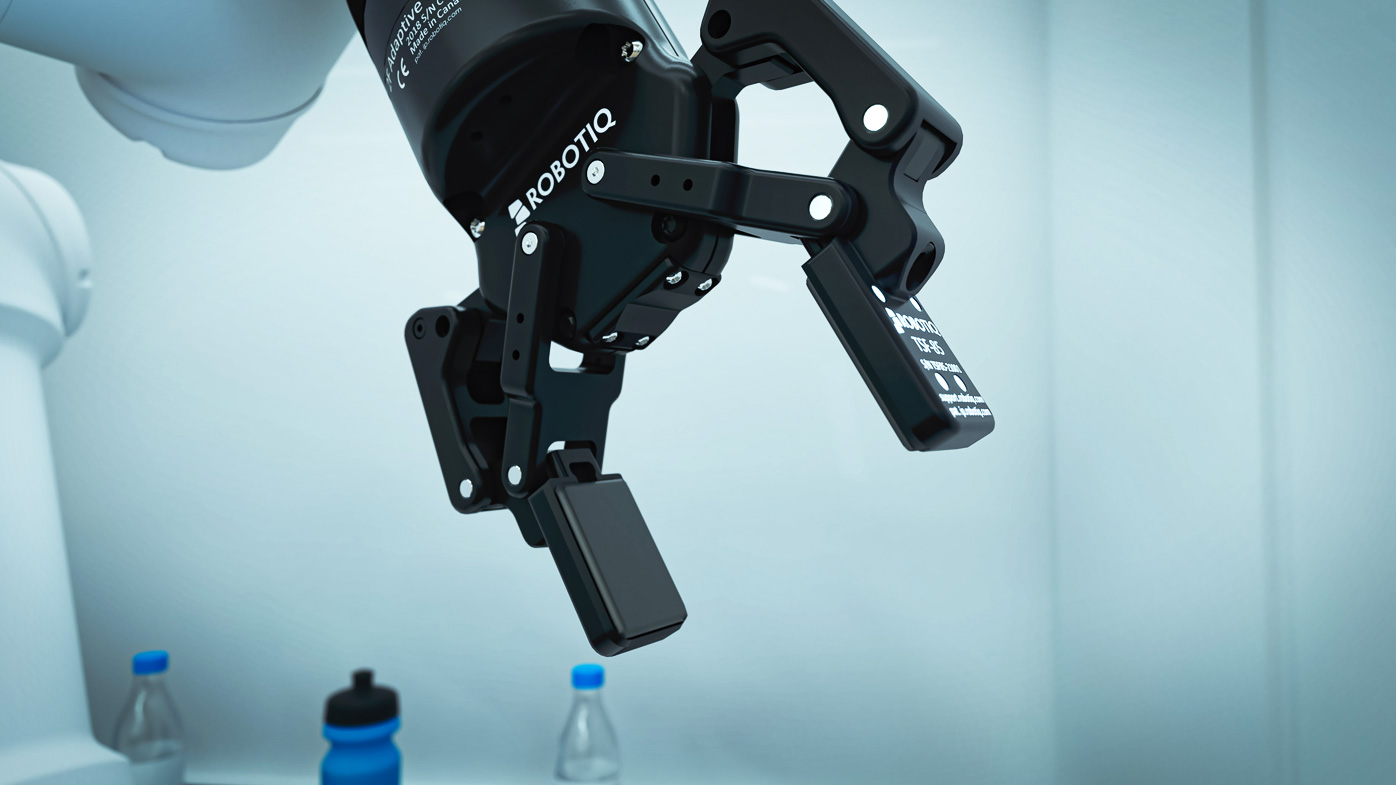
Robotiq
Robotiq said that tactile fingertips allow robots to understand contact geometry, detect incipient slip and improve generalization across diverse objects, capabilities that are critical for physical AI datasets.
Get news, papers, media and research delivered. Sign up for our free newsletters.
Stay up-to-date with news and resources you need to do your job. Research industry trends, compare companies and get weekly market intelligence with Robotics 24/7.
Robotiq
Robotiq said that tactile fingertips allow robots to understand contact geometry, detect incipient slip and improve generalization across diverse objects, capabilities that are critical for physical AI datasets.
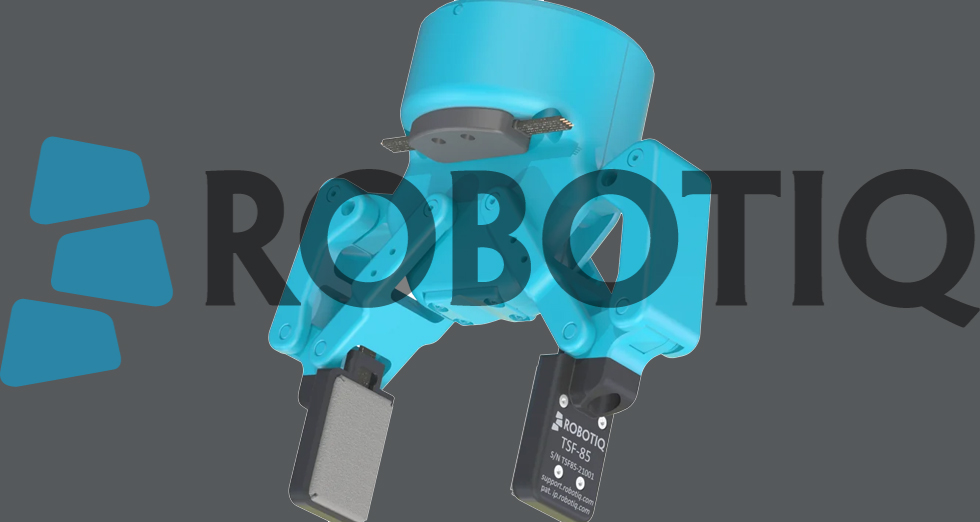
Robotiq announced the launch of its TSF-85 tactile sensor fingertips for the 2F-85 Adaptive Gripper, which the Quebec City-based company said gives physical AI systems the sense of touch needed for real-world manipulation.
With integrated tactile sensing, Robotiq said it enables robots to not only see the world but also feel, understand and reliably interact with it at scale. The company said that the Tactile Sensor Fingertips for the 2F-85 are now available.
Robotiq said that robots cannot learn the physical world through vision alone. Real-world manipulation requires contact awareness, force control, and feedback from interaction. With integrated tactile sensing, Robotiq said it designed the technologies for immediate use in AI training labs, humanoid robotics and industrial physical AI applications.
“Physical AI demands more than clever algorithms - it demands reliable interaction with the real world,” said Vincent Duchaine, CTO, artificial intelligence, at Robotiq. “By combining adaptive gripping with high-frequency tactile sensing, we’re giving robots the sense of touch and control they need to generalize across objects, tasks, and environments without the cost and complexity of anthropomorphic hands.”
Robotiq said its 2F-85 Adaptive Gripper is built on a patented mechanical design that goes beyond a traditional parallel gripper. While parallel grippers rely on precise positioning and rigid alignment, the company said that its 2F gripper provides inherent adaptability by offering both pinch and encompassing grips, with stroke lengths of 85 mm and 140 mm.
This allows the gripper to conform to object shape, reduce grasp planning complexity and minimize reliance on perfect vision, which Robotiq said makrd it well-suited for general-purpose physical AI systems designed to handle a wide variety of objects.
Details about the new tactile fingertips and its powerful sensing layer include:
Together, the company said that these capabilities allow robots to understand contact geometry, detect incipient slip and improve generalization across diverse objects, which are critical capabilities for physical AI datasets.
Unlike fragile, custom-built tactile hands that often struggle with durability and operational limits, Robotiq said that its technologies are designed for scalable, long-term deployment. Thousands of Robotiq grippers are already operating globally in demanding industrial and research environments, which the company said are delivering high uptime, consistent performance and low total cost of ownership.
The tactile-enabled 2F grippers integrate into existing systems using native RS-485 communication and a USB conversion board, enabling flexible deployment across robot brands and research platforms. The company said its tactile fingertips are designed to preserve the gripper’s encompassing and pinch grip mechanics, with minimal impact on stroke and reach, and feature robust cabling built for real-world operation.
With a lower bill of materials and replacement cost than anthropomorphic or DIY hands, Robotiq said that it provides a practical path from lab prototype to large-scale robot fleets.
Robotiq said it supports modern AI workflows by delivering reliable, feature-dense hardware designed to work consistently from proof of concept through real-world deployment. By providing stable sensing and repeatable interactions across environments, Robotiq said that it offers a reliable base for manipulation for reinforcement learning (RL), vision-language-action (VLA) models and imitation learning.
The company said that the TSF-85 tactile sensor fingertips are built on years of Robotiq research and field experience. By standardizing hardware and tactile data across robot fleets and research campuses, Robotiq added that it reduces integration friction and accelerates experimentation, which helps teams move faster from lab validation to production-scale Physical AI systems.
The TSF-85 joins Robotiq’s portfolio of physical AI-ready manipulation components, building on the company’s over 23,000 grippers deployed worldwide.
“To build physical AI that truly works, you need hardware that can sense, respond and learn from every interaction,” said Aleksei Filippov, head of business development at Yango Tech Robotics. “That's why we chose Robotiq. With Robotiq precision force control and reliable feedback, we capture rich sensory data from every grasp.”
From geometry preparation to AI-assisted analysis, integrated CFD workflows…

North America’s largest robotics and automation event winds down

Automate’s largest day ever draws huge crowds to McCormick Place

North America’s largest robotics and automation event kicks off