Tennant Co.
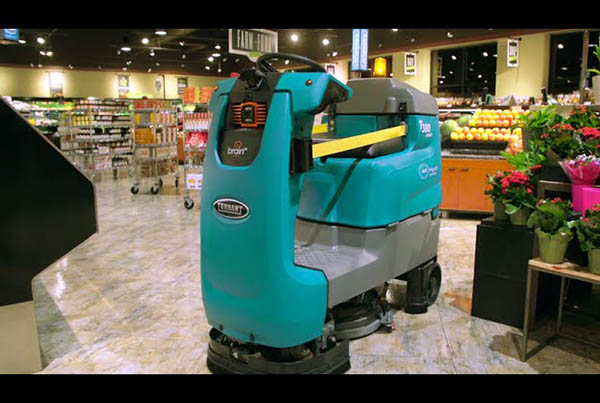
The Tennant T380AMR ride-on robotic scrubber uses BrainOS for autonomy.
Get news, papers, media and research delivered. Sign up for our free newsletters.
Stay up-to-date with news and resources you need to do your job. Research industry trends, compare companies and get weekly market intelligence with Robotics 24/7.
Tennant Co.
The Tennant T380AMR ride-on robotic scrubber uses BrainOS for autonomy.
Tennant Co. today said it has introduced lithium-ion technology to its portfolio of cleaning machines, including its T380AMR, T7AMR, and T16AMR. The company said the advanced battery technology and the mobile robots it has engineered with Brain Corp., will benefit customers around the world.
“Throughout its 150-year history, Tennant Co. has been dedicated to advancing the cleaning industry by relentlessly pursuing new technologies, and we are excited to continue this legacy with the addition of advanced lithium-ion battery technology to our autonomous machines,” stated Barb Balinski, senior vice president of innovation and technology at Tennant. “With longer run times and hassle-free maintenance, lithium-ion powered robotic scrubbers will help our customers increase their cleaning efficiency and optimize employee resources even more.”
Eden Prairie, Minn.-based Tennant Co. designs, manufactures, and markets cleaning systems for industrial, commerical, and outdoor environments. It had sales of $1.09 billion in 2021 and has about 4,250 employees. The company sells products directly in 15 countries and through distributors in more than 100 countries.
The Tennant T380AMR is a compact, 20-in. autonomous mobile robot (AMR) designed for retail stores, hospitals, and schools.
The T7AMR is a mid-size, 26-in. floor scrubber intended for midsize-to-large spaces like larger retail stores and warehouse clubs, campuses, and some logistics facilities.
Tennant said its T16AMR is the first robotic scrubber designed specifically for industrial and warehouse spaces, with a 36-in. scrub path.
The company claimed that lithium-ion provides several benefits in comparison with flooded lead-acid batteries, including the following:
Prior to the introduction of lithium-ion technology, Tennant’s AMR models could run on flooded lead-acid batteries for up to four hours. Customers will now have the option to choose between lead-acid and lithium-ion batteries in cleaning robots. The company said its new, lithium-ion battery option has a run time between five and 6.5 hours, depending on the model.
“Every day, we clean nearly 19 million sq. ft. of space in airports throughout the U.S., which is why we bought a fleet of Tennant’s robotic scrubbers,” said Kevin Barton, vice president of operations at FlagShip Facility Services Inc. “Our T7AMR lithium-ion machine at the Raleigh-Durham Airport [RDU] has been an incredible game-changer."
"The autonomous floor scrubbers allow airport employees to have more time to use their skills on other important responsibilities," he said. "Plus, with lithium-ion batteries, the machines run longer and require less maintenance—saving us money and time while providing consistent cleaning performance and a better traveler experience.”
Tennant Co. and partner Brain Corp together have deployed more than 5,400 robotic cleaners, which they said is the world’s largest fleet of autonomous floor scrubbers.
“We’re very excited about the introduction of lithium-ion batteries to the fleet of Tennant AMR machines powered by BrainOS,” said Jeff Heller, senior director of product at Brain Corp. “Simply put, the more time robotic machines are running, the more productivity gains our customers can realize."
"With BrainOS as the only platform enabling multi-purpose robotic solutions, including Tennant’s Inventory Scan, it’s now even more critical for machines to run longer so they can be utilized more frequently while employees focus on other value-added assignments,” he added.
Brain Corp said its BrainOS cloud-connected platform enables robotics developers to build scalable, self-driving robots to clean floors, move inventory, and sense environmental data—turning manual operations into automated workflows. It offers its systems through a robotics-as-a-service (RaaS) model.
The San Diego, Calif.-based company said Fortune 500 brands across multiple verticals use the growing portfolio of BrainOS-powered robots and its privacy, safety, and efficiency tools to easily manage and scale automation. Brain Corp said its software currently powers more than 16,000 AMRs.
Sam’s Club, a division of Walmart Inc. and a leading membership warehouse club, announced the national, chain-wide roll out of Inventory Scan that will be added to their existing fleet of robotic scrubbers in partnership with Brain Corp and Tennant Co.
Enjoyed this article? Add Robotics 24/7 as a preferred source in Google Search.
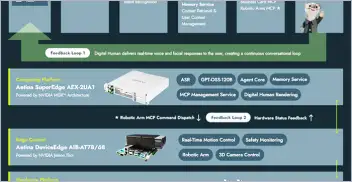
Edge computing gives AI agents the processing power to turn instructions into…
Daimon-TWM world model debuts for the public
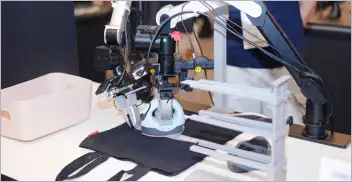
Platform helps robots adapt to complex tasks

Look beyond the headlines for the latest in humanoid robots