Vecna Robotics
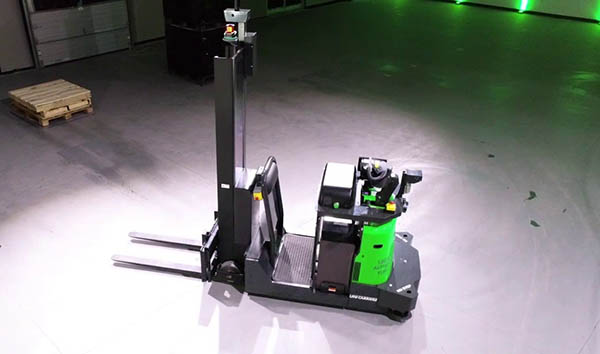
Vecna Robotics has updated both the hardware and software for its autonomous forklift.
Get news, papers, media and research delivered. Sign up for our free newsletters.
Stay up-to-date with news and resources you need to do your job. Research industry trends, compare companies and get weekly market intelligence with Robotics 24/7.
Vecna Robotics
Vecna Robotics has updated both the hardware and software for its autonomous forklift.
As warehouses add automation, they need more capable and integrated automation. Vecna Robotics today announced a major software release and hardware upgrades to its AFL-class autonomous forklift.
The warehouse automation market will double over the next five years, estimated LogisticsIQ. A survey conducted by Modern Materials Handling (a sibling site to Robotics 24/7) found that 15% to 20% of warehouses are currently using robotic palletizers and stretch wrappers, automated storage and retrieval systems (ASRS), and other conveyor-fed automation for palletized loads.
The need for flexible material handling equipment that can seamlessly integrate with robotic packaging and storage systems will only continue to grow, said Vecna Robotics. It noted that these workflows can account for 10% to 15% of activities in a typical warehouse and up to 70% of manufacturing production time.
The Waltham, Mass.-based company said the new capabilities expand its reach within warehouse and factory floors by further optimizing transport between other machinery and equipment, with a specific focus on low-lift workflows. The update supports inbound staging to ASRS induction.
It also enables the delivery of materials between workcells and ergonomic lift stands for work-in-process flows, as well as extraction from robotic palletizers and stretch wrappers for outbound staging, said Vecna.
“This upgrade to our AFL platform is a response to customer need to automate more workflows -- including low lift with conveyors and risers -- in the midst of persistent labor shortages,” stated Anthony Moschella, senior vice president of product management at Vecna Robotics.
“The ability to coordinate autonomous material transport with other automated systems and common warehouse equipment is the first critical step in our mission to help warehousing and manufacturing re-balance their worker-robot mix and free up labor for more valuable tasks,” he added.
The Vecna AFL, which has a 3,000 lb. capacity and lift up to 60 in., was designed to optimize work-in-process, packaging, and finished goods workflows. It provides autonomous material handling to and from conveyors, risers, and third-party automated or semi-automated equipment.
Vecna Robotics said its AFL can help improve efficiency and reduce costs by up to 30% for these common workflows while maintaining more than 99% uptime in autonomous mode via Vecna’s Pivotal Command Center.
The major release and AFL upgrade include the following features, according to Vecna:
Vecna Robotics offers more information about how Vecna AFL can help warehouse operators maximize throughput at www.vecnarobotics.com/AFL. The company will be exhibiting at Pack Expo in Chicago next week at Booth N-6366 in McCormick Place's North Building.
With systems engineered for seamless work between autonomous mobile robots (AMRs) and labor, equipment, and facilities, Vecna Robotics claimed it provides flexible, intelligent materials handling automation. The company's portfolio includes self-driving forklifts, pallet trucks, pallet jacks and tuggers -- powered by its Pivotal orchestration software and 24/7/365 Command Center.
It said they can help distribution, warehousing, and manufacturing organizations automate their most critical workflows, maximize throughput, and scale operations fast.
In December 2020, Vecna Robotics launched its fully autonomous counterbalanced fork truck.
Enjoyed this article? Add Robotics 24/7 as a preferred source in Google Search.
Edge computing gives AI agents the processing power to turn instructions into…
Daimon-TWM world model debuts for the public
Platform helps robots adapt to complex tasks
Look beyond the headlines for the latest in humanoid robots