By
DE Editors
July 3, 2019
Get news, papers, media and research delivered. Sign up for our free newsletters.
Stay up-to-date with news and resources you need to do your job. Research industry trends, compare companies and get weekly market intelligence with Robotics 24/7.

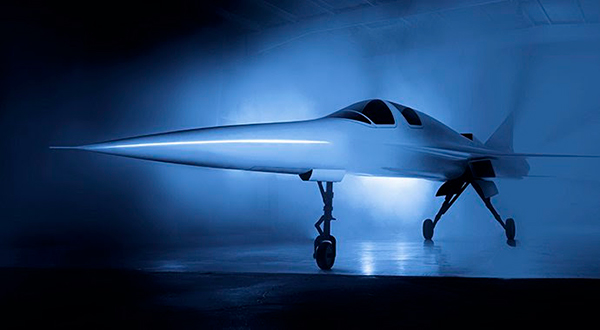
VELO3D announces that it has partnered with Boom Supersonic, the Colorado company building a fast supersonic airliner, to manufacture the flight hardware necessary to build XB-1, Boom’s Mach-2.2 supersonic demonstrator aircraft. Boom is leveraging VELO3D’s Intelligent Fusion technology.
XB-1 is an independently-developed supersonic jet that is aiming to prove the key technologies in-flight for safe, efficient travel at Mach 2.2 (1,687mph). XB-1 combines over 3,700 parts and some of the most advanced technologies including advanced carbon fiber composites, a refined delta wing planform, and an efficient variable-geometry propulsion system.
XB-1 has functional, performance, and precision requirements, so Boom turned to VELO3D to leverage its deep market expertise and customer support partnership. VELO3D’s Intelligent Fusion technology provides a level of control, design freedom, and quality assurance that is critical in challenging design environments such as supersonic aircraft performance. With VELO3D, Boom hopes to use metal additive manufacturing to accelerate aircraft development and improve system performance.
“High-speed air travel relies on technology that is proven to be safe, reliable, and efficient, and by partnering with VELO3D we’re aligning ourselves with a leader in additive manufacturing that will print the flight hardware for XB-1,” says Mike Jagemann, head of XB-1 Production, Boom Supersonic. “VELO3D helped us understand the capabilities and limitations of metal additive manufacturing and the positive impact it would potentially have on our supersonic aircraft. We look forward to sharing details about the aircraft development and improved system performance once XB-1 takes flight.”
Boom and VELO3D have already conducted validation trials, which performed accurately and to desired results. Now, VELO3D is developing two titanium flight hardware parts for XB-1, which will be installed on the prototype aircraft in early 2020. These 3D-printed parts are installed as part of the ECS system and ensure the aircraft can achieve safe flight at all conditions.
“Boom is reimagining the entire commercial aircraft experience, from the design, build, and materials used,” says Benny Buller, CEO of VELO3D. “Our technology is designed to help innovators like Boom rethink what’s possible, empower advanced designs with little or no post-processing, and enable an entirely new approach to production. Boom needed more than just prototypes and we’re thrilled to help them create the first 3D-printed metal parts for an aircraft that will move faster than the speed of sound.”
Sources: Press materials received from the company and additional information gleaned from the company’s website.

DE's editors contribute news and new product announcements to Digital Engineering 24/7 and the Robotics 24/7 sites. Press releases may be sent to them via [email protected].
Enjoyed this article? Add Robotics 24/7 as a preferred source in Google Search.

Edge computing gives AI agents the processing power to turn instructions into…
Daimon-TWM world model debuts for the public
Platform helps robots adapt to complex tasks

Look beyond the headlines for the latest in humanoid robots