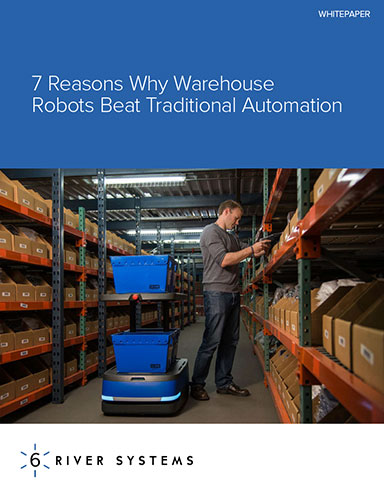
In 2020, global retail e-commerce sales are expected to grow to $4.88 trillion, more than double 2017 figures. The Amazon effect is at the heart of this e-commerce boom: consumers are empowered to demand what they want and when.
These demands aren’t what they used to be, catching retailers and service providers ill-equipped to keep up. With shrinking store footprints and faster product turns, warehouse operators have been shifting to accommodate more SKUs and lower order quantities, while struggling to staff for growing demand and supporting service level goals. This new fulfillment landscape is forcing the hands of supply chain executives, leaving them no option but to automate or fold.
Warehouse operators traditionally turn to large-scale automation solutions to handle these challenges. They buy multi-million dollar conveyor, shuttle and automatic storage and retrieval systems that take up to a year to implement and nearly six years to see return on investment.
The only problem? Suppliers without the regular-season volume or space to justify the cost and size of such systems are left out. These smaller operations can’t justify the bolted-down, caged-off systems, which add complexity and cost to warehouse layouts and budgets.
Most logistics leaders agree that warehouse automation is a must to remain relevant in today's economy. And now, there’s automation that provides the flexibility of manual cart picking with the performance of traditional automation. Collaborative mobile warehouse robots have emerged as the leading solution to help fill the gap for fulfillment providers, with the likes of XPO Logistics and others already using robots to fulfill orders.
What are collaborative mobile warehouse robots?
To understand what collaborative mobile warehouse robots are, operators need to understand the different types of warehouse robots on the market. Bob Trebilcock, editor of Modern Materials Handling, coined methodologies of leading warehouse robot solutions in a 2018 piece:
Fill out the information below to download this resource
The new fulfillment and e-commerce landscape has opened the doors to a new automation solution: Collaborative mobile warehouse robots.
Edge computing gives AI agents the processing power to turn instructions into…
Daimon-TWM world model debuts for the public
Platform helps robots adapt to complex tasks

Look beyond the headlines for the latest in humanoid robots