Get news, papers, media and research delivered. Sign up for our free newsletters.
Stay up-to-date with news and resources you need to do your job. Research industry trends, compare companies and get weekly market intelligence with Robotics 24/7.
Labor shortages, cost increases, demands for speed and reliability, and SKU proliferation have reshaped what it means to operate a high-performance warehouse. In 2026, retail success at scale will be dependent on strategically integrating some level of warehouse automation.
This shifts the conversation to determining the right approach to automation for your operation. For some retailers, this means evaluating the pros and cons of in-house automation versus outsourcing to a third-party logistics (3PL) provider. While a 3PL takes the supply chain responsibilities off retailers’ hands, this model often has a massive operating cost. In-house automation can have a higher learning curve and higher initial cost but often has a much lower operating cost than outsourcing.
Retailers choosing in-house automation should work with a trusted, experienced automation partner that can help ensure informed decisions and can help realize expected benefits. Those choosing a 3PL can take a forward role by encouraging their provider to partner with a reputable automation provider to best support the retailer’s business. Modern automation solutions must be able to be both reactive, to handle SKU proliferation, and proactive, like changing source nodes. Automation providers should also have a reputation for stability to give general merchandise retailers peace of mind that they’ll receive continuity of quality and support over the years.
AI and influencers significantly impact what today’s customers want—often with minimal ramp-up or predictability (think Stanleys and Labubus) and how they get it. Augmented reality changes how shoppers interact with the world: With a few taps on their Meta glasses, buyers can identify a product, find it online, and purchase it. This takes predictability even further out of the retailers’ hands. AI changes how effective retargeting and other consumer behavior ads function. And influencers help products go viral overnight.
Meeting huge, unpredictable volume spikes can challenge legacy static automation technology, which is limited in flexibility and is often rigid and difficult to change. In 2026, flexible automation technologies will become the more viable option. This includes industry-leading AutoStore systems and autonomous mobile robots (AMRs), which are modular and highly scalable. Warehouses can also cope with rapid changes in product volume by using AI-enabled technologies that can work "unsupervised" or even "self-supervised” for things like slotting, scaling, and even equipment selection for physical handling of material. Embracing these technologies can help general merchandise retailers meet demand for “the next big thing.”
Realities like tariffs and economic uncertainty are impacting general merchandise companies as much as viral product demand. Tariffs restrict the retail best practice of just-in-time inventory sourcing, forcing a choice: pay now for goods that may just sit in a warehouse unpurchased, scramble to source more at the last minute at a very high cost, or be unable to source altogether when demand comes.
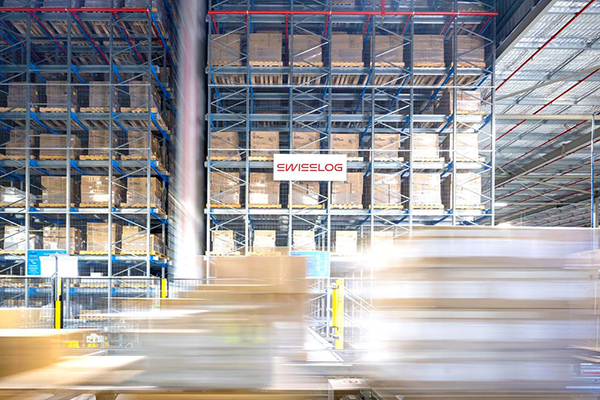
Magnitude of purchase power requires 2026 general merchandisers to adapt sourcing strategies and storage plans to increase flexibility. On-site automation hardware like high-density pallet shuttles and automated stacker cranes gives warehouses dynamic storage at relatively low cost and helps warehouses make the most of the vertical space without increasing facility footprint.
Amazon disrupted the retail industry with the promise of two- or next-day delivery. Most retailers have adopted competitive fulfillment times to meet customer expectations. However, with consumer spending taking a significant hit from economic conditions, fulfillment speeds are becoming less important than other value-adds for non-commodity retail shopping.
Brand identification is emerging as the new king. Consumers are increasingly purchasing from brands they identify with, from companies with a positive reputation, and to get benefits like free returns, surprise thank-you gifts with orders and a strong customer rewards program. Furthermore, buyers appear to be willing to sacrifice fast shipping in favor of brand loyalty and ethical purchasing behaviors. This is particularly true in the context of a K-shaped economy, with buyers in higher economic brackets spending more on higher cost-per-unit goods.
Savvy general merchandise retailers who have tapped into a loyal customer base should worry less about ultra-fast fulfillment speeds and focus instead on nurturing brand followers with other value-adds.
Attracting and retaining quality labor will remain an issue in 2026. But case study after case study has shown that automated warehouses can “flatten the curve” of peak period impacts on labor.
Leading up to Black Friday and lasting through New Year’s, retailers conventionally had to add hundreds or thousands of seasonal, part-time staff to meet peak. The massive ramp-up was painful for everyone involved: Companies would hire and onboard tons of people only to end up with attrition rates often exceeding 80%. Seasonal workers have employment for only a very short period of time and minimal training. Full-time workers are often frustrated with seasonal workers’ mistakes and absenteeism, and rates of on-the-job injury significantly increase when less-trained workers join the staff.
But increasing evidence is emerging that warehouse automation benefits everyone at a general merchandise warehouse: full-time workers, temporary staff, and businesses alike. By automating the tasks few workers desire to do, a 10x peak staffing increase may reduce to 3x. This slashes the hiring and training burden on companies and helps create a much more sustainable workforce for both full-time and seasonal workers. It also enables staffing and volume expansion and contraction, allowing retailers to create new peaks throughout the year, like Amazon’s Prime Days.
Retailers operate in a highly competitive space, constantly balancing many factors that impact success. Planning for the future can help merchandisers win in a tough market. The trends to watch for general merchandise in 2026:
Swisslog has the expertise to help retailers take on modern warehousing trends and challenges and has proven itself a reliable partner for over 100 years. With our deep industry experience, broad portfolio of solutions, and modular SynQ software platform, Swisslog is ready to help you get the most out of material handling automation as you look ahead to 2026 and beyond.
GENISOM AI makes ICRA debut at conference in Vienna

World's first omni-modal evaluation including tactile sensing for…

Ultrasonic sensing enhances robotics perception

Cybernetix Ventures’ event kicks off Robotics Tech Week 2026 slate of events