
Seabery
Get news, papers, media and research delivered. Sign up for our free newsletters.
Stay up-to-date with news and resources you need to do your job. Research industry trends, compare companies and get weekly market intelligence with Robotics 24/7.
Seabery
Comau and Seabery have joined forces to create an educational training program for students and workers that allows them to practice the skills needed to become proficient and certified robotic welders.
The training was designed to help fulfill the global demand for expert welding professionals, the companies said. Successful completion of the course leads to the acquisition of Comau’s Robotics Welding License.
Industry 4.0 automation is increasing the level of skills required by welding professionals, yet robotic welding training is seldom offered at traditional welding training institutions or vocational training centers, the companies argued. Furthermore, a standardized robotic welding training curriculum does not currently exist. Traditional welding training and practice is also costly, time-consuming, and requires dedicated safety equipment.
To meet these challenges, Comau and Seabery now offer a training method created with the Soldamatic welding simulator and the customizable, flexible, and scalable e.DO educational robot.
Comau is a part of automobile company Stellantis and produces a range of automotive and manufacturing products, including industrial robots. It was founded in 1973 and is headquartered in Turin, Italy.
Seabery is a software development company that makes augmented reality educational programming, with a focus on Industry 4.0 skills. It is based in Huelva, Spain.
“The collaboration with Seabery anticipates future training needs and reflects Comau’s ongoing commitment to developing innovative, hands-on training opportunities,” said Ezio Fregnan, Comau academy & education business director. “Thanks to the powerful combination of augmented reality and the e.DO educational robot, we are helping fill an important skills gap while empowering students with the know-how needed to pursue a career in robotics welding.”
“Soldamatic welding training simulation was invented to address the critical global shortage of welders and appeal to a new generation of welding students. With Soldamatic simulators in welding labs in more than 80 countries, robotic welding training has emerged as a clear and logical progression in our patented welding skills training,” said Ignacio Zalvide, product management director at Seabery.
“Our partnership with Comau e.DO is an opportunity to amplify our robotic welding training solution by partnering with the leader in industrial automation who is also equally passionate about promoting modern, interactive and effective educational tools for younger generations,” Zalvide added.
The companies said the new solution is highly efficient as it allows unlimited practice via a simulated training program that uses augmented reality technology to reproduce a real-life robotic welding environment. It includes a programmable teach pendant and features hundreds of welding procedures and positions to comprehensively train robot operators.
The Soldamatic simulator exclusively offers Hyperreal-SIMTM, a proprietary technology owned by Seabery, which is a multi-sensory training interface, including sight, sound and touch with a highly calibrated and parameterized system, which they said creates the most realistic welding training experience aside from actual welding.
The training is available now as a stand-alone training program or as part of Comau’s comprehensive e.DO offering.
It is well-suited for on-the-job upskilling as it can be programmed for nearly every welding procedure specification (WPS), allows the use of advanced welding joints, and creates robotic welding simulations for nearly any position, the companies said.
Comau's new generation robot.
Enjoyed this article? Add Robotics 24/7 as a preferred source in Google Search.
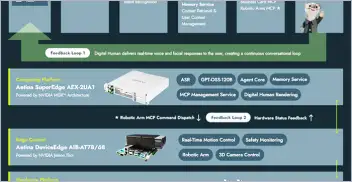
Edge computing gives AI agents the processing power to turn instructions into…
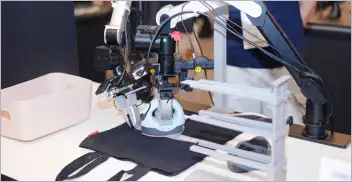
Daimon-TWM world model debuts for the public
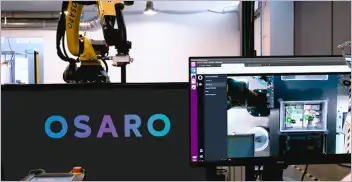
Platform helps robots adapt to complex tasks
Look beyond the headlines for the latest in humanoid robots