Fetch Robotics
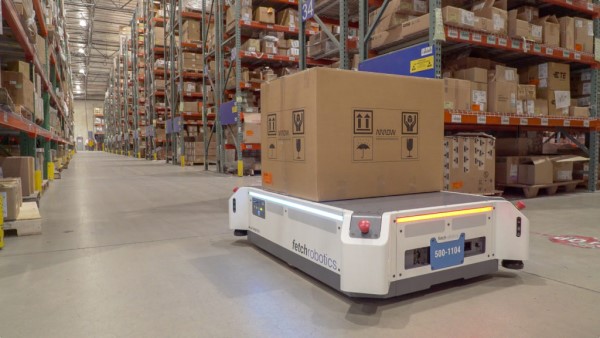
Fetch Robotics' robots all comply with the ANSI/RIA R15.08 standard for autonomous mobile robots and accessories.
Get news, papers, media and research delivered. Sign up for our free newsletters.
Stay up-to-date with news and resources you need to do your job. Research industry trends, compare companies and get weekly market intelligence with Robotics 24/7.
Fetch Robotics
Fetch Robotics' robots all comply with the ANSI/RIA R15.08 standard for autonomous mobile robots and accessories.
Fetch Robotics Inc. today announced that its entire portfolio of autonomous mobile robots conforms with ANSI/RIA R15.08, the new safety standard for industrial mobile robots. The San Jose, Calif.-based company said this means its robots are safe in all current use cases throughout warehouses, factories, distribution centers, and fulfillment centers.
Fetch said its Fetch Cloud Robotics Platform combines autonomous mobile robots (AMRs) with the power of the cloud to provide on-demand automation for materials handling and inventory management. The system enables businesses to find, track, and move almost anything in any facility, claimed the company.
Fetch Robotics said its products and services are deployed in leading distribution, fulfillment, and manufacturing centers around the world, augmenting workforces for increased efficiency and productivity.
In recent years, a growing number of manufacturing, distribution, and fulfillment centers have begun using AMRs for tasks ranging from moving packages between workstations to transporting pallets across a warehouse.
However, there was no safety standard specifically designed for mobile robots, which move autonomously through facilities and often need to avoid obstacles such as heavy machinery and human workers.
The Robotics Industries Association (RIA, part of A3, the Association for Advancing Automation) released R15.08 in December 2020. The standard provides technical requirements for the design and integration of AMRs.
R15.08 is intended to ensure that workers are protected from injuries that can result in civil and criminal liabilities, regulatory fines, and higher insurance costs for facilities operators.
“The publication of R15.08 is a watershed moment for the AMR industry,” stated Melonee Wise, CEO of Fetch Robotics. “Whereas previous safety standards were designed for industrial arms or automated guided vehicles, R15.08 is specifically designed to address safety concerns unique to fully autonomous robots. This new standard will set the foundation for safer workplace environments overall.”
The new standard provides a comprehensive framework to assess the safety of AMR systems, which are defined as both the robot base and any additional accessories.
R15.08 specifies that if the original manufacturer or a third party adds an attachment to an AMR, creating an AMR system, it is considered a system manufacturer and therefore is responsible for the certification and safety of that device.
As a result, the standard covers a wide number of manufacturing arrangements, such as when an AMR manufacturer sells the robotic base to an integrator, which then adds an attachment like a rack, cart, bin or arm so the robot can complete workflows.
The standard also covers integrators that add attachments and stations to move items such as pallets on or off of an AMR base. Specifying the coverage of R15.08 for both the AMR itself and the complete AMR system mitigates risk for end users, who prior to R15.08 may have been using an AMR that conformed to R15.08 with an attachment that did not conform to R15.08.
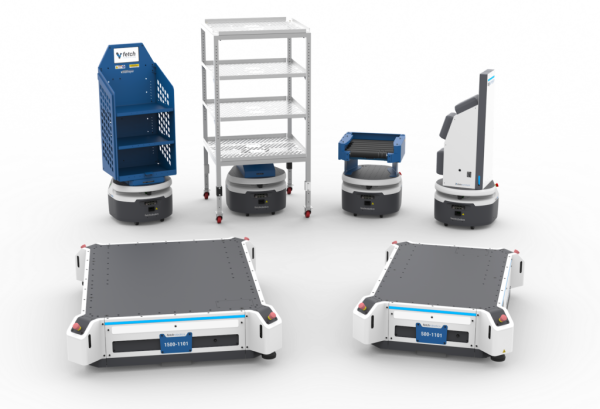
As the manufacturer of both AMRs bases and accessories, Fetch Robotics said it ensures that its AMR systems, from 100kg to 1500kg models, conform with the new safety standards, giving customers peace of mind when deploying the technology.
“Safety is our top priority in selecting and deploying automation solutions in our manufacturing and warehousing facilities,” said Harry Chase, director of advanced materials at GE Appliances, a Haier company. “Fetch Robotics is our main provider of autonomous mobile robots. The fact that their AMRs conform to R15.08 gives us confidence they improve employee safety as well as help us achieve our efficiency goals.”
Fetch's announcement came shortly after the release of its newest AMR. The PalletTransport1500 supports cross-docking, returns, and case picking workflows for contactless pallet transport in distribution centers.
Fetch Robotics and Honeywell Intelligrated provide autonomous mobile robots for materials handling operations.
Enjoyed this article? Add Robotics 24/7 as a preferred source in Google Search.
Edge computing gives AI agents the processing power to turn instructions into…
Daimon-TWM world model debuts for the public
Platform helps robots adapt to complex tasks

Look beyond the headlines for the latest in humanoid robots