By
Tim Culverhouse
October 16, 2025
ABB
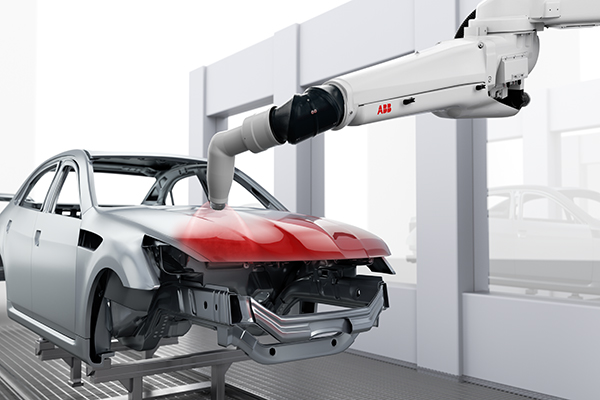
ABB's RB1000i-S paint atomizer limits overspray and dramatically reduces waste in automotive painting, a key component of ABB's sustainability measures.
Get news, papers, media and research delivered. Sign up for our free newsletters.
Stay up-to-date with news and resources you need to do your job. Research industry trends, compare companies and get weekly market intelligence with Robotics 24/7.
ABB
ABB's RB1000i-S paint atomizer limits overspray and dramatically reduces waste in automotive painting, a key component of ABB's sustainability measures.
As one of the world’s largest robotics and automation companies, ABB’s breadth of technologies encompasses countless industries and geographies.
Specifically, ABB’s lengthy history in the automotive manufacturing industry has driven (pun intended) countless vehicles off assembly lines around the world.
Now, as ABB approaches its fifth decade and the soon-to-be divestment of its Robotics division to SoftBank, there’s always something going on under the company’s hood.
Sustainability remains one of ABB’s key pillars in its manufacturing technologies and processes, along with the end products that its robots manufacture.
Electric vehicles are all the rage. Thanks to global environmental initiatives, EVs are more prevalent in 2025 than in any other year in history. And with continued advancements and regulations, EVs are a major segment of the automotive industry, in conjunction with their internal combustion engine (ICE) counterparts.
But EVs also present a significant manufacturing challenge for companies like ABB.
At the heart of these manufacturing challenges are the underlying vehicle chassis and the heavyweight EV battery.
“The construction of the car is influencing the chassis and the body,” said Joerg Reger, managing director of ABB Robotics Automotive Business Line. “I would say that the key difference is that we are now having the battery tray - this high voltage component - including the motor, changing the chassis because of the weight of the battery tray. Customers are now trying to reduce weight to get the cost down."

To combat this major overhaul of automotive assembly, ABB launched a new line of heavy payload robots, bringing the company to 11 robot families and 60 robot variants.
In addition to these changes, EV manufacturers like Tesla are rethinking vehicle assembly, adding another layer of complexity for the ABB’s of the world to adapt and address.
“Tesla is now driving further with the car body, by splitting it into three sections: the front, the middle and the back part,” Reger said. “They’re doing all the assembly on the front, middle and back, and later on, they’re putting it all together. The idea here is to move the body line… Tesla calls it the ‘Unbox System,’ and you are able to install all parts right away on these three sections. Then, you merge the body and the final trim in one area, which brings much more automation to that.”
The manufacturing robots require precision and the ability to move nimbly throughout the interior and exterior of the car body, managing the casting, parts and electrical components that make the vehicle go.
From a software standpoint, ABB’s new controller is bridging the sustainable manufacturing process and the sustainable vehicle.
“We have developed a new controller that, combined with our other processes, is now bringing less energy,” Reger said. “We are able to reduce 20-30% energy in combination with this controller, which results in cost reductions, and continues supporting sustainability for our customers.”
Along the automotive assembly line, the painting booth is often considered the most “wasteful” segment for the waste generated and energy required to operate these machines.
ABB has addressed this area of concern with multiple products:
In 2024, ABB launched the RB1000i-S paint atomizer for automotive paint shops. It represents the latest in the company’s painting end-of-arm tooling components geared toward minimizing waste and reducing overspray.
“We developed a high transfer efficiency atomizer,” Reger said. “It’s already on a level of around 95-99% transfer efficiency. Also, the overspray with this atomizer is super low… Normally, a big percentage of the paint is going into the air. Then you have to clean the air, and it's going into a scrubber, and then to sludge. And then at the end, you have waste. You need to pay to dispose of this waste in a landfill, or it’s getting burned.”
ABB has seen its atomizers deployed at automotive assembly plants around the world. Mazda, which selected the RB1000i-S for painting at its Ujina plant No. 1, estimates that 60% of manufacturing CO2 emissions come from painting, highlighting its significance to carbon neutrality.
But what if the paint wasn’t really “paint?”
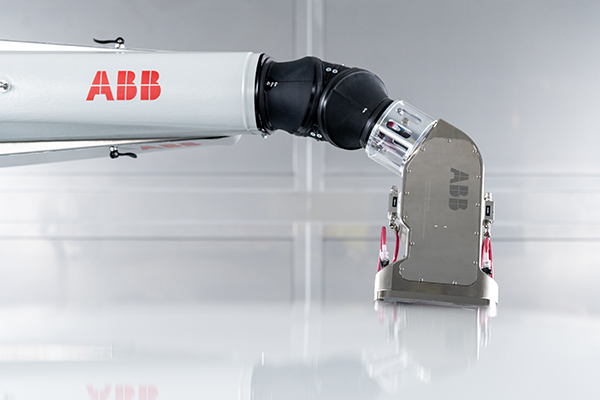
ABB’s PixelPaint program has overhauled the traditional automotive “painting” process, and instead focused on “printing” paint on the car body.
The result? A non-overspray technology that incorporates an inkjet-printer-type head on the end of the robot arm that offers customizable painting without the masking requirements of traditional methods.
“With PixelPaint, we have just pressure and printing,” Reger said. “There is no air needed. This by itself is reducing energy. And then when you don't have overspray, you don't need the booth. You don't need the big ventilation system. You don't need the cleaning system. And, you don't have to pay for the waste. It’s a lot of cost reduction.”
Mercedes-Benz is utilizing PixelPaint to develop personalized paint options. Currently, the ABB technology is used on the Mercedes-Maybach SL 680 Monogram Series, with an MSRP of $226,000.
“We’ve seen the success with Mercedes, and now we [at ABB] are discussing taking the next step, building a line where we can paint 80-90% of the car body with printing,” Reger said. “And for the rest, we can use the high-transfer efficiency atomizer.”
The difficult areas, like the interior of the car and locations with sharp edges or that suffer from paint sagging, are primed for automation, albeit with some manual oversight.
The prevalence and ongoing evolution of artificial intelligence and simulation are front and center with ABB’s innovations.
ABB invested in vision AI company LandingAI in September 2025. ABB said the collaboration will integrate LandingAI’s vision AI capabilities, like LandingLens, into ABB Robotics’ own software suite.
In automotive manufacturing, Reger said AI, vision and simulation are offering ABB and its customers more opportunities to utilize automation.
“We are on the way to the lab to develop learning models so that the customers can use them later on with our robots, in combination with our controllers, so that they get these learning systems,” he said. “For example, when you do an assembly line, when you have a pick-and-place system, it’s learning different kinds of things to pick. Then it builds up a library in the background. The system is learning. And it’s reducing the whole programming and commissioning time significantly. With this AI, what we can do is reduce risk and reduce the development time of a car body. This is all leading to less cost, and we are supporting sustainability at the same time.”

Tim is the Editorial Director of Robotics247.com. His mission is to provide valuable information and insights to robotics professionals and decision-makers, and to help them solve business challenges. He is a creative, deadline-driven, and detail-oriented storyteller. In addition, he is a sports broadcaster and public address announcer.
GENISOM AI makes ICRA debut at conference in Vienna

World's first omni-modal evaluation including tactile sensing for…

Ultrasonic sensing enhances robotics perception

Cybernetix Ventures’ event kicks off Robotics Tech Week 2026 slate of events