By
Bob Trebilcock
February 8, 2023

Get news, papers, media and research delivered. Sign up for our free newsletters.
Stay up-to-date with news and resources you need to do your job. Research industry trends, compare companies and get weekly market intelligence with Robotics 24/7.
Radial
Louisville, Ky.
Size: 500,000 square feet
Throughput: 20,000 parcels per day, with capacity to process 50,000 parcels per day during peak
Products Handled: Health and beauty products
SKUs: 3,000
Shifts per day/ Days per week: 2 shifts per day, 7 days a week
Read the full feature article on Radials robotic putwall operations here.
Radial’s Kentucky facility was designed to maximize labor efficiency and quickly assemble orders using 12 robotic putwalls.
Picking is done in four three-level pick modules. Associates pick from pallet flow rack in two of the modules—each location can hold three pallets, which are replenished from the rear of the pick module. The other two are case flow, which are also replenished from the reach of the pick module.
The facility uses batch picking. Each batch assignment can include up to six totes. When a tote enters a zone, picking instructions are delivered by voice. Once the tote is picked complete in that zone, it is conveyed to the packing area.
The facility uses 12 robotic putwalls for normal demand; manual putwalls are put into service during peak. The U-shaped robotic putwalls are configured with 96 or 120 cubbies, depending on the size of the products the cubbies have to accommodate. Each of the robotic putwalls can process between 450 and 500 units per hour, or 100,000 units per month. While the average order is eight units, putwalls are used to sort single- and multi-line orders. When a tote arrives in the packing area, the robots place the items into cubbies. Once all of the items for an order have been placed in a cubby, a packer on the other side of the putwall is notified by voice that an order is ready to go. The associate applies a license plate bar code label to a box, places the contents for that order inside and inducts the box on the shipping sorter.
From packing a box is conveyed to a station where dunnage and a packing slip is automatically inserted into the box before it is taped. Boxes are then delivered to an automatic print-and-apply station where the shipping label is applied. The box is now ready to ship and is sorted to the designated carrier lane.
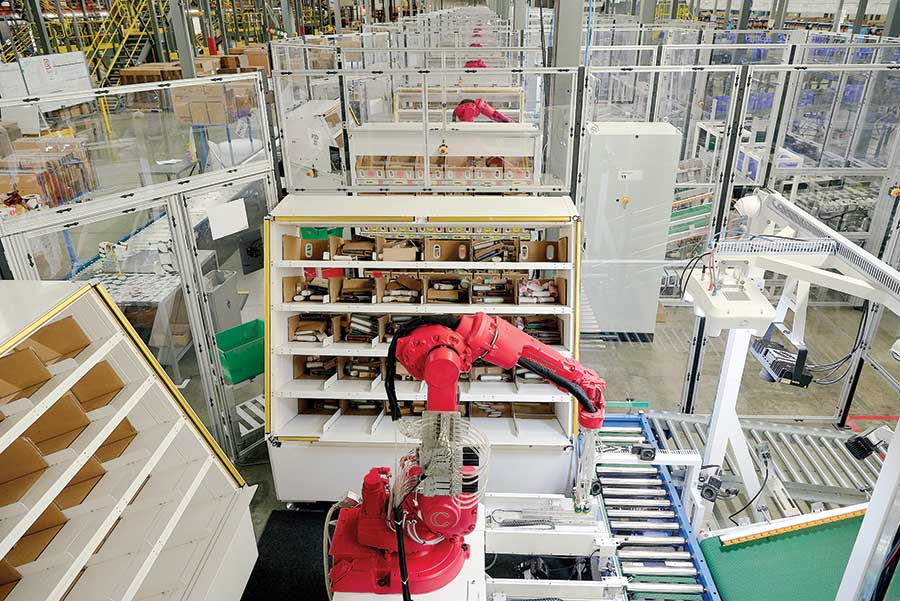
Robotic Putwall: Covariant

Bob Trebilcock was the executive editor for Modern Materials Handling and an editorial advisor to Supply Chain Management Review. He has covered materials handling, technology, logistics, and supply chain topics for nearly 30 years. He is a graduate of Bowling Green State University. He retired in 202 but serves as a consultant to Modern and Peerless Media.

GENISOM AI makes ICRA debut at conference in Vienna

World's first omni-modal evaluation including tactile sensing for…
Ultrasonic sensing enhances robotics perception

Cybernetix Ventures’ event kicks off Robotics Tech Week 2026 slate of events