mimic robotics
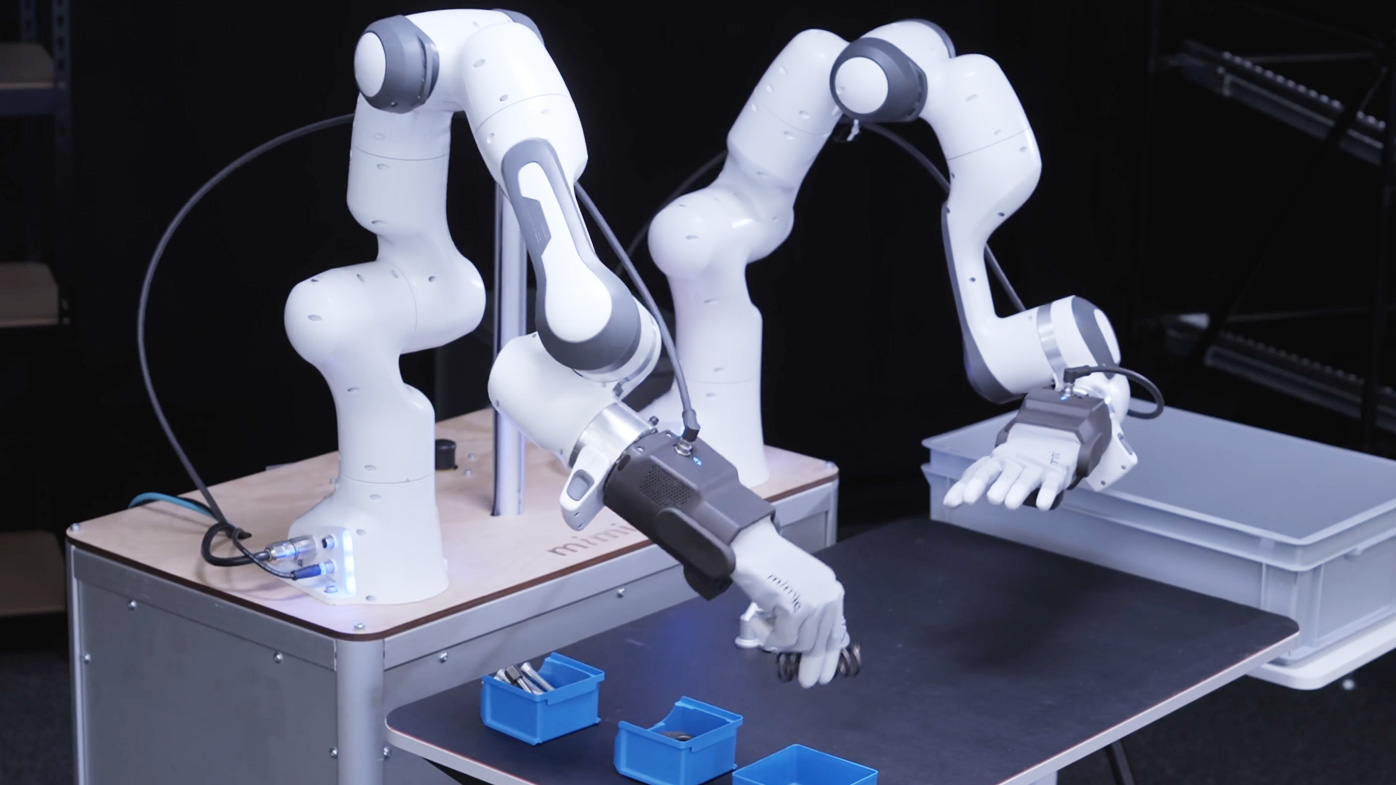
mimic robotics said that FLUX-mimic - built in collaboration with Black Forest Labs, learns high-dexterity tasks from video, using a fraction of the demonstration data existing approaches require.
Get news, papers, media and research delivered. Sign up for our free newsletters.
Stay up-to-date with news and resources you need to do your job. Research industry trends, compare companies and get weekly market intelligence with Robotics 24/7.
mimic robotics
mimic robotics said that FLUX-mimic - built in collaboration with Black Forest Labs, learns high-dexterity tasks from video, using a fraction of the demonstration data existing approaches require.
mimic robotics, a physical AI company utilizing Video-Action Models for general-purpose industrial automation, announced the introduction of FLUX-mimic.
The company said that FLUX-mimic is a next-generation Video-Action Model developed in collaboration with Black Forest Labs, which enables robots to learn and perform complex manipulation tasks in real-world industrial environments.
mimic robotics said that FLUX-mimic combines mimic's experience in robot learning, dexterous manipulation and production deployment with the frontier visual intelligence architecture of Black Forest Labs’ new FLUX 3 video model.
mimic’s earlier work, “mimic-video,” introduced Video-Action Models by taking a pre-trained video generation model and adding the capability to predict robot actions. The company said that FLUX-mimic builds on that foundation with an architecture purpose-built for physical AI.
“Robotics is one of the clearest proofs of visual intelligence. To generate convincing video, a model must learn how the physical world behaves; that same understanding enables acting in it,” said Robin Rombach, co-founder and CEO of Black Forest Labs. “By combining FLUX 3’s learned model of the world with mimic’s expertise in robot learning and deployment, FLUX-mimic makes it easier for robots to adapt to new tasks and production environments instead of being engineered for one task at a time.”
mimic said that most modern robot learning pipelines today are built on Vision-Language-Action models, with the backbone pre-trained on static image-and-text pairs. As a result, the company said that they must learn physical dynamics almost entirely from scarce, expensive robot demonstration data. mimic said that instead, FLUX-mimic builds on a generative video model that already understands dynamics and behavior from large-scale video pre-training, then trains an action decoder to predict robot actions directly from that visual prediction.
mimic said that, depending on task difficulty, the model can be fine-tuned for a specific manipulation task with as little as 30 minutes of robot data, where prior approaches have required 30 or more hours.
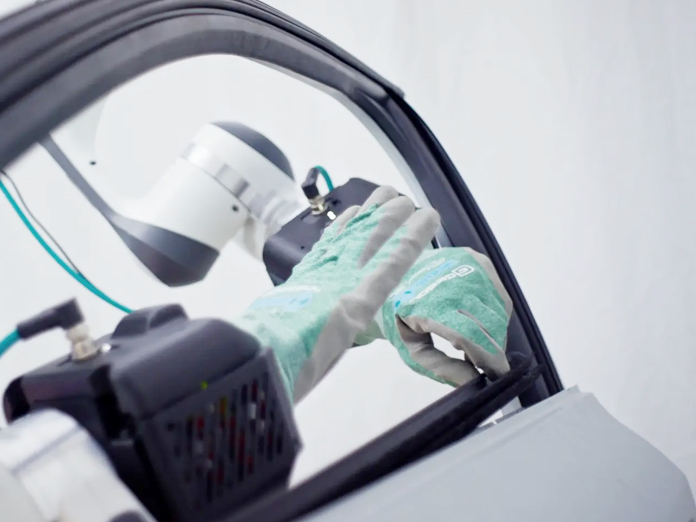
mimic said that it is already implementing FLUX-mimic with manufacturing leaders like Audi. Together, the companies are exploring how frontier Video-Action Models can reduce deployment time, engineering effort and robot training requirements for real-world industrial automation.
"In partnership with mimic, Audi has been testing and deploying FLUX-mimic. We have seen these robots solve complex soft-body manipulation work that would have been simply impossible with conventional robotics. This new technology can have a major impact in assisting our employees, increasing efficiency, and expanding flexible automation across production and logistics operations," said Christoph Schneider from the Audi Production Lab. "For us, partnering with pioneering companies such as mimic and Black Forest Labs is essential in pushing the frontier of physical AI and validating these innovations in real-world production environments."
mimic said that Audi operates one of the most highly automated production networks in the automotive industry, giving it a precise view of where conventional automation still falls short. Despite decades of investment in industrial robotics, the company said that tasks involving flexible parts and fine manipulation have remained manual for Audi. The variant diversity of premium automotive production makes conventionally programmed robot cells too costly to re-engineer. mimic added that learning-based systems change that calculation, and open a path toward Audi’s longer-term vision: transforming plants into smart factories where AI and robots act as a partner for employees - providing tailored support and taking over repetitive and physically demanding tasks.
"Audi represents the kind of manufacturing partner we built FLUX-mimic for," said Stephan-Daniel Gravert, co-founder & chief product officer at mimic robotics. "Their production environments demand automation that is flexible enough to handle unstructured tasks, reliable enough for continuous operation, and can be integrated without months of engineering overhead. Through this partnership with Audi, we want to prove that FLUX-mimic can meet those demands on real production lines."
From geometry preparation to AI-assisted analysis, integrated CFD workflows…
Software-based GripperAI manages mixed picking through basic geometry
Safety, communication and motion control components enable smooth operation
North America’s largest robotics and automation event winds down