Mitsubishi
Mitsubishi Electric said it has developed a new "teaching-less robot system."
Get news, papers, media and research delivered. Sign up for our free newsletters.
Stay up-to-date with news and resources you need to do your job. Research industry trends, compare companies and get weekly market intelligence with Robotics 24/7.
Mitsubishi
Mitsubishi Electric said it has developed a new "teaching-less robot system."
Taking advantage of its proprietary artificial intelligence technology, Mitsubishi Electric Corp. today announced a new robot workstation system designed to significantly reduce production times.
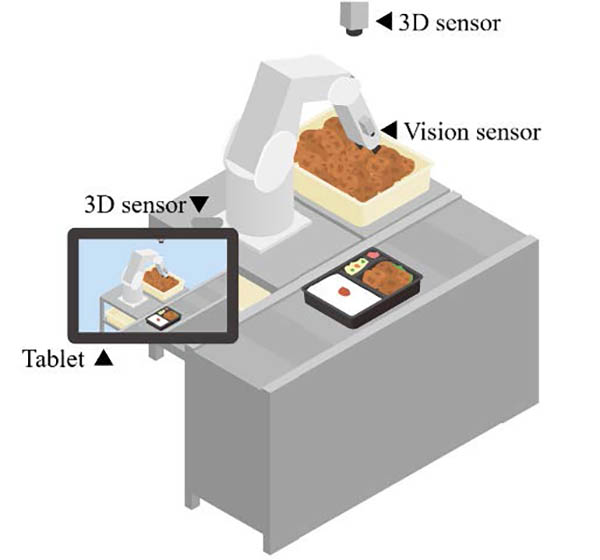
The company said the new station uses its Maisart AI system, which includes high-precision speech recognition software, 3D sensors and cameras, to help its robots sort and arrange items. Maisart is an abbreviation for “Mitsubishi Electric's AI creates the State-of-the-ART in technology."
Workers will be able to dictate commands to the robot system either by voice or by using a tablet. The system is pre-programmed to complete tasks and is capable of self-adjusting if it is assigned new duties on the fly or faces obstacles, the company said. It is designed to be used by non-specialists.
The company called it a “teaching-less” robot, given its AI capabilities. Mitsubishi claimed that its technology requires one-tenth of the programming and adjustment time of conventional systems and can operate at the same rate as a human.
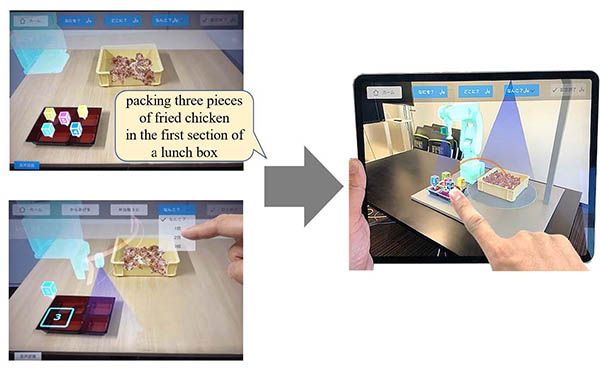
In addition, the company expects the technology to be applied in food processing, where automation has been difficult because of frequent item changes. For example, in a food-processing factory, a non-specialist could instruct a robot simply by saying something like "Pack three pieces of chicken in the first section of the lunch box," it said.
Mitsubishi plans to start commercializing the system “in or after 2023.”
Mitsubishi Electric said it offers the first voice-instruction user interface deployed by an industrial robot manufacturer.
The AI can infer implied meanings if a voice instruction is ambiguous, such as determining how much a robot must move. It is designed to understand phrases such as “A little more to the right,” for example.
Alternatively, a tablet equipped with menus can be used to issue instructions or to select categories such as “where,” “what” and “how many” to generate simple programs, the company said.
The system is designed to scan its surroundings using 3D sensors. With that information, which includes image and distance data, it can automatically program the robot’s movements.
The tablet also can be used to view stereographic augmented reality (AR) simulations that allow the operator to confirm that instructions will have the intended results.
For added convenience, the system also can recommend the ideal positioning of a robot in an AR virtual space without requiring a dedicated marker, another industry first, the company said.
By optimizing robotic arm and hand movements, Mitsubishi Electric said its new system can grasp and places items in their designated areas in a minimum of 2 seconds.
Mitsubishi Electric said it has developed a trajectory-generation technology to optimize robot movements using information about surrounding obstacles and robot performance.
The company has also developed an acceleration/deceleration-optimization technology that automatically generates a velocity pattern to achieve the shortest possible arm travel time within the permissible range of force that can be exerted by the robot. Both technologies help to shorten the time required to adjust the robot’s movements.
Optimizing the timing of hand opening/closing also helps to reduce work time. Conventionally, such adjustments are performed manually using simulations and operating the robot.
However, the new technology automatically adjusts and optimizes this timing according to the characteristics of the hand and the object to be grasped, eliminating lengthy manual adjustments while also improving work efficiency, said Mitsubishi.
In addition, the grasping-recognition AI and a three-dimensional sensor fixed above the system quickly determine the best position for grasping, thereby reducing wasted time.
Furthermore, visual information from a camera attached to the robot hand allows the robot to self-correct its movement if the position of the robot or the target object shifts.
To simplify the process of adding custom functions, Mitsubishi Electric's new system supports the Robot Operating System (ROS).
Mitsubishi has also developed a linkage function to centrally manage information on its Edgecross edge-computing software, ROS, and the entire system.
Connectivity and multi-vendor capability can simplify the monitoring and analysis of entire production lines for enhanced productivity and quality, said the company.
Mitsubishi Electric AI Technology named Maisart which has 10 catagories statistic method to utilize GUI to achieve effective off-line analysis and instant diagnosis at less program. It is easier to find out and analysis problem that to enhance productivity and quality on site.
GENISOM AI makes ICRA debut at conference in Vienna
World's first omni-modal evaluation including tactile sensing for…
Ultrasonic sensing enhances robotics perception
North America’s largest automation and robotics event takes place June 22-25