By
Brian Albright
March 27, 2019
Get news, papers, media and research delivered. Sign up for our free newsletters.
Stay up-to-date with news and resources you need to do your job. Research industry trends, compare companies and get weekly market intelligence with Robotics 24/7.
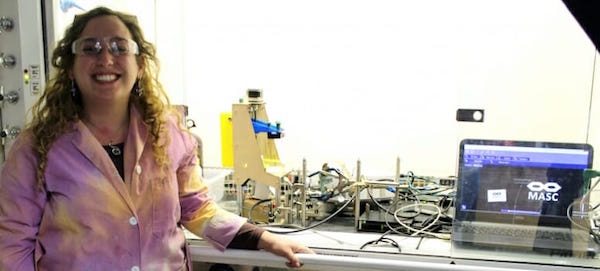
Multi-material 3D printing can enable the creation of even more complex components and structures than single-material printing—by printing an object from several materials at once, manufacturers could further drive down complexity for a given assembly. Researchers at the University of Wisconsin-Madison have developed a 3D printer that uses visible and ultraviolet light to enable multi-material printing.
The printer uses light patterns to determine which of two monomers in the system are polymerized to form a solid. The research appeared in the journal Nature Communications in February.
“As amazing as 3D printing is, in many cases it only offers one color with which to paint,” said UW–Madison Professor of Chemistry A.J. Boydston, who led the project with graduate student Johanna Schwartz. “The field needs a full color palette.”
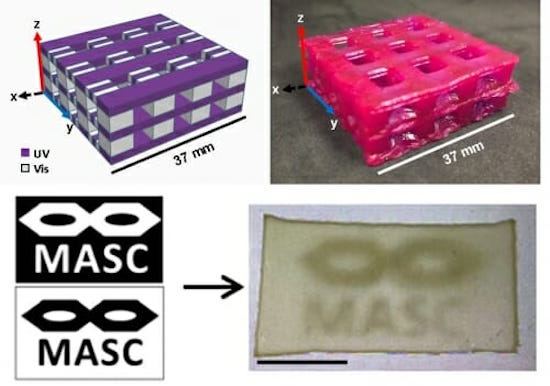
The top images show the digital design and its printed form. Purple corresponds to ultraviolet cured stiff epoxide regions, while the gray regions are visible light cured acrylate regions, which are soft and compliant. Image courtesy of A.J. Boydston and Johann Schwartz.
Current multi-material printers use separate reservoirs of filament or materials during the print process. The approach the research team took was to use a “single pot” system that relies on different wavelengths of light to control which starting materials polymerize into different sections of the solid product. These monomers can polymerize together into a longer string of chemicals.
The initial object design controls whether ultraviolet or visible light is used to polymerize the monomers. Using two projectors, the researchers directed light at the vat of liquid monomers. Layers of the object are built on a platform that moves up as each layer is completed.
“At this stage, we’ve only accomplished putting hard materials next to soft materials in one step,” Boydston says. “There are many imperfections, but these are exciting new challenges.”
Moving forward, the team wants to investigate other combinations of monomers and how different wavelengths of light can cure the materials.
Source: University of Wisconsin-Madison

Brian Albright is the editorial director of Digital Engineering and a contributor to Robotics 24/7.
Enjoyed this article? Add Robotics 24/7 as a preferred source in Google Search.

Edge computing gives AI agents the processing power to turn instructions into…
Daimon-TWM world model debuts for the public
Platform helps robots adapt to complex tasks
Look beyond the headlines for the latest in humanoid robots