By
Cesareo Contreras
September 12, 2022
Peer Robotics
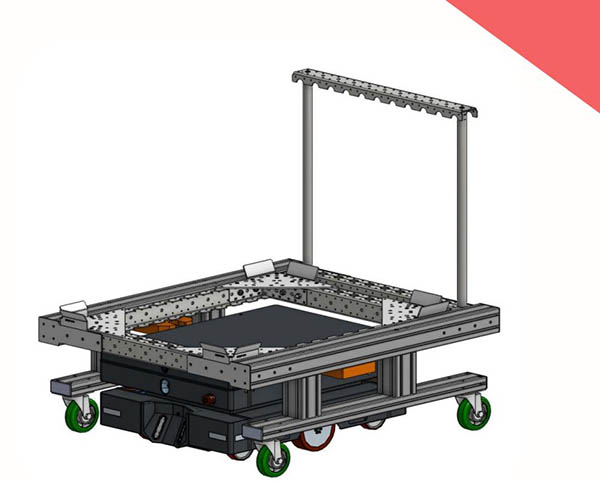
A drawing of Peer Robotics' trolley movement solution.
Get news, papers, media and research delivered. Sign up for our free newsletters.
Stay up-to-date with news and resources you need to do your job. Research industry trends, compare companies and get weekly market intelligence with Robotics 24/7.
Peer Robotics
A drawing of Peer Robotics' trolley movement solution.
At Peer Robotics headquarters in New Haven, Conn., CEO Rishabh Agarwal and his team are building mobile robots designed to understand human touch. Today, the three-year-old company announced it has raised $2.3 million in its seed round, which it said it will use to build out its fleet of robots in North America.
Peer Robotics has two robot systems in its lineup -- a trolley movement system, which includes an autonomous mobile robot (AMR) that carries payloads up to 100 kg (220 lb.), and a bin movement system, which includes an AMR that can carry payloads up to 250 kg (551 lb.).
Agarwal told Robotics 24/7 the AMRs were built to understand human haptics. Factory operators can teach a mobile robot the layout of a facility by walking it around the location. Agarwal compared it to walking around a grocery store with a shopping cart (see video below).
Once in operation, workers can also easily redirect the robot's path while in motion by placing their hands on the system and walking it in the direction it needs to go.
One of Peer Robotics’ biggest goals is to reduce the barriers that small and midsize enterprises (SMEs) face when trying to integrate autonomous systems into their workflows. The company currently has three customers in India and one in the U.S., but Agarwal noted that it is shipping five more robots in India, the U.S., and Germany.
Some major key performance indicators (KPIs) companies look for when choosing an autonomous system is how fast it takes to deploy and how adaptable it is to workflow changes, according to Agarwal. He acknowledged that he’s never had to discuss with an American customer the potential return on investment (ROI) because it has always seemed to clear to them.
However, that conversation is different in India, with a bigger focus on ROI there, Agarwal said. Companies don’t talk about cost savings in terms of labor or manpower but in money saved from not having to buy additional components.
“We are having a completely different conversation in India rather than the U.S. because I think in the U.S., the labor shortage and those costs are a little bit of a bigger concern than in the Indian market,” he said.
Agarwal continues to see more companies bringing their manufacturing operations back to the U.S.
Manufacturers have been driven to move back home, in part, in response to the impact the COVID-19 pandemic has had on global supply chains. Global supply chain consulting firm Kearney recently shared findings from its 2021 index reshoring report and found that the trend will likely continue for the next few years.
"Seventy-nine percent of executives surveyed who have manufacturing operations in China have either already moved part of their operations to the U.S. or plans to do in the next three years, and another 15% are evaluating similar moves," the report noted.
Agarwal said he believes part of it has to do with U.S government incentives and grants. Another big reason is that automation is driving costs down and allowing companies to bring operations closer to home, he said.
Peer Robotics has raised a total of $2.6 million. That includes the $300,000 it received for being a part of the STANLEY+Techstars Accelerator program portfolio.
Kalaari Capital led the funding round, along with existing investors Axilor Ventures, Connecticut Innovations, and Innopact VC.
“Having partners like Kalaari Capital and Connecticut Innovations really allows the entire team of Peer Robotics to double down their efforts and build solutions to empower our users,” Agarwal told Robotics 24/7. “The seed round serves as an important milestone for the entire team and our customer focus.”
Peer Robotics offers collaborative mobile robots for end-to-end material movement without any infrastructure change.

Cesareo Contreras was associate editor at Robotics 24/7. Prior to working at Peerless Media, he was an award-winning reporter at the Metrowest Daily News and Milford Daily News in Massachusetts. Contreras is a graduate of Framingham State University and has a keen interest in the human side of emerging technologies.
GENISOM AI makes ICRA debut at conference in Vienna
North America’s largest robotics and automation event winds down
Automate’s largest day ever draws huge crowds to McCormick Place

North America’s largest robotics and automation event kicks off