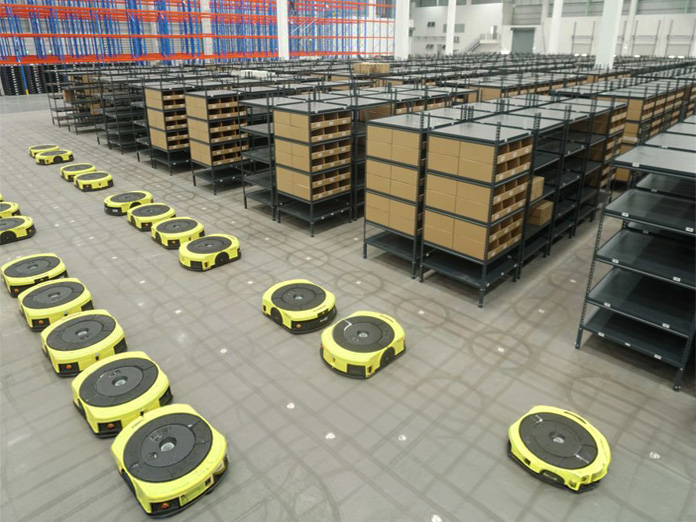
Flash Express Thailand, News agency, via Wikimedia Commons
AMR utilization is a major element of warehouse efficiency. Utilizing an ROI calculator to demonstrate how to optimize AMRs can yield major results.
Get news, papers, media and research delivered. Sign up for our free newsletters.
Stay up-to-date with news and resources you need to do your job. Research industry trends, compare companies and get weekly market intelligence with Robotics 24/7.
Flash Express Thailand, News agency, via Wikimedia Commons
AMR utilization is a major element of warehouse efficiency. Utilizing an ROI calculator to demonstrate how to optimize AMRs can yield major results.
Editor’s Note: This article was written by Amir Sharif, co-founder and COO of 3Laws. He is a member of Robotics 24/7’s Executive Advisory Board.
The robotics business is not unique: There's a moment in every B2B sales cycle where the conversation shifts from "interesting product" to "approved purchase." Most salespeople never figure out how to reliably trigger that moment. They pitch features. They send decks. They follow up. They wait.
The ones who close consistently do something different: they make the financial case undeniable. Not in a pushy way. But in a “Here's the math, check it yourself” way.
This is a case study about exactly that.
The customer operates a large factory - roughly 65,000 square feet with over 100 autonomous mobile robots (AMRs) running 2 shifts a day. The robots handle certain internal transport tasks, including:
The problem wasn't that the robots were broken. The problem was that they were slow and conservative - creeping along at 0.7 m/s to avoid collisions, stopping frequently and yielding constantly. In a factory where every second of robot unproductivity represents lost throughput, this stoppage has a real cost.
A robotics software vendor believed its safety software could let those same robots run faster and with higher utilization, without increasing collision risk. The question was: could they prove it financially before asking anyone to sign?
 Deployment details for this example case study. Source: Amir Sharif
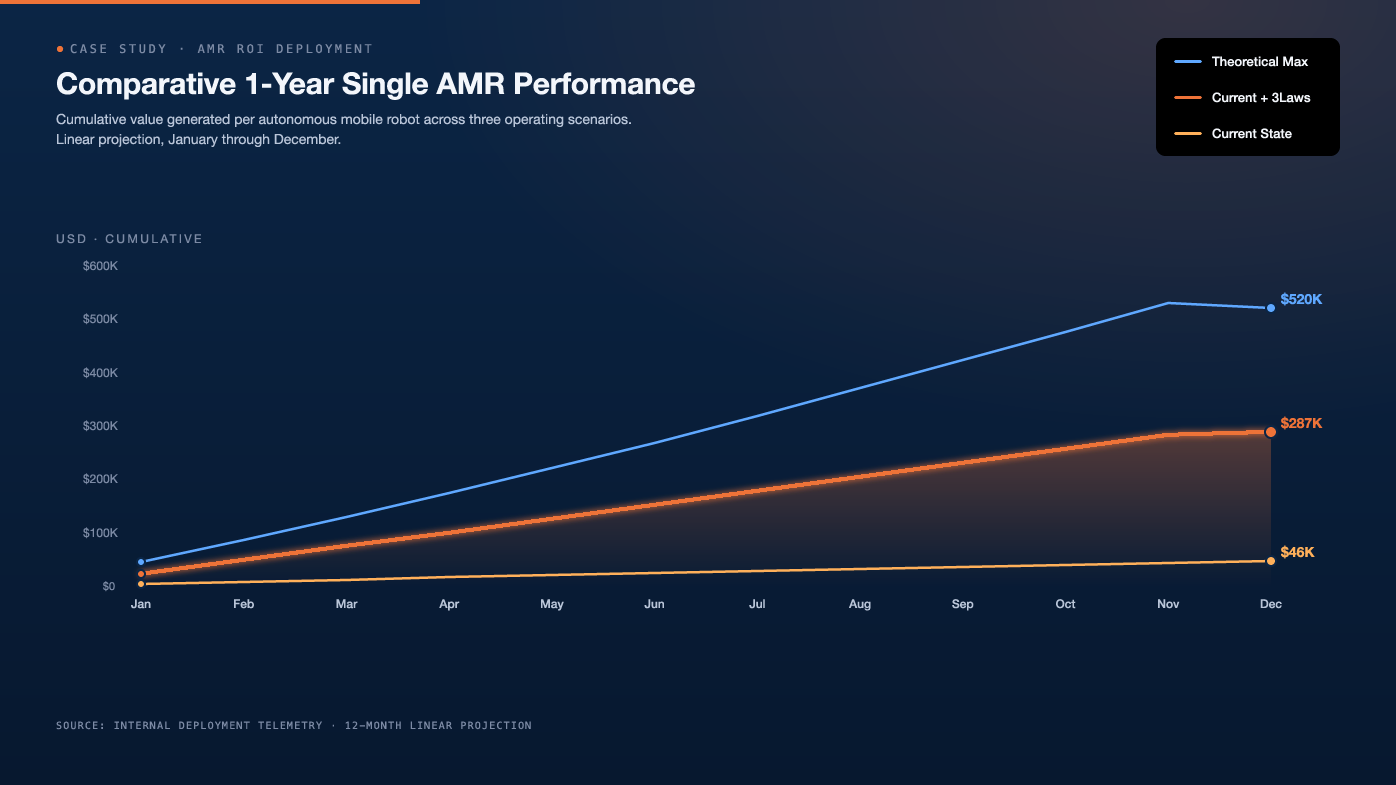
Rather than pitching features, the company built a financial model. It presented three scenarios side by side:
| Scenario | AMR Speed | Daily Utilization | Profit/Day (Fleet) |
| Maximum Potential | 2.0 m/s | 24 hrs | ~$140,000 |
| Current Performance | 0.6 m/s | 16 hrs | ~$17,000 |
| With Software | 1.4 m/s | 16 hrs | ~$109,000 |
The delta between "current" and "with Software" was approximately $92,000 per day. The software cost was $3,500 per AMR per year.
The payback period was less than a week.
When the math looks like that, procurement doesn't need convincing. They need permission.
I have found that most enterprise robotics pitches fail for the same reason: they argue from the vendor's perspective. "Our platform is faster, more reliable, more scalable." All of that may be true, but it doesn’t answer the question the customer is actually asking: What does this do for my P&L?
The ROI model answered that question precisely. It used the customer's own operational data - fleet size, current speed, daily hours, lane count - and ran the math. The customer could inspect every assumption. They could change the inputs and see what happened. It wasn't a pitch; it was a working financial instrument.
That's a fundamentally different posture. You're not asking the customer to trust your claims. You're inviting them to stress-test your logic.
One subtlety worth noting: the ROI model didn't close the deal. It opened the door to a pilot. And the pilot closed the deal.
Per my experience, this is actually the right sequence. No procurement team worth their salary signs a six-figure software contract based on an ROI model alone - even a good one. But they will approve a bounded pilot to validate the assumptions. And once the pilot produces real data that matches (or exceeds) the model's projections, the renewal conversation is almost perfunctory.
The model's job is to make the pilot a rational "yes." The pilot's job is to make the contract a rational "yes." Each step removes a layer of uncertainty and replaces it with evidence.
You don't need to be selling robotics software for this framework to apply. If you're selling anything with measurable operational impact - SaaS, hardware, professional services, logistics - the structure is the same:
| Step | What You're Doing | Why It Works |
| 1. Anchor on the customer's current state | Use their numbers, not yours | Creates credibility and ownership |
| 2. Define the upside scenario clearly | Show what "better" looks like in their KPIs | Makes the value tangible, not abstract |
| 3. Calculate the delta honestly | Don't cherry-pick; let the math speak | Builds trust; skeptics become allies |
| 4. Propose a bounded pilot | Reduce the ask to a testable hypothesis | Low-risk yes, unlocks high-value contract |
| 5. Let the pilot generate the evidence | Real data > projected data | Evidence closes deals |
This process works because it respects the customer's intelligence. You're not asking them to trust you. You're giving them a logical framework, showing them the math, and inviting them to verify it. That's a very different energy from a features pitch, and customers feel the difference.
The world is full of salespeople who can explain what their product does. The rare ones - the ones who close consistently - are the ones who can explain what it's worth.
Show them the money, and they'll show you the signature.
Want to build your own ROI model? Whether you’re selling software, hardware, or something in between - if you’re struggling to quantify your product’s value, reach out. I’m happy to think through the framework with you. Amir Sharif.
GENISOM AI makes ICRA debut at conference in Vienna

World's first omni-modal evaluation including tactile sensing for…

North America’s largest robotics and automation event winds down
Automate’s largest day ever draws huge crowds to McCormick Place