Omron
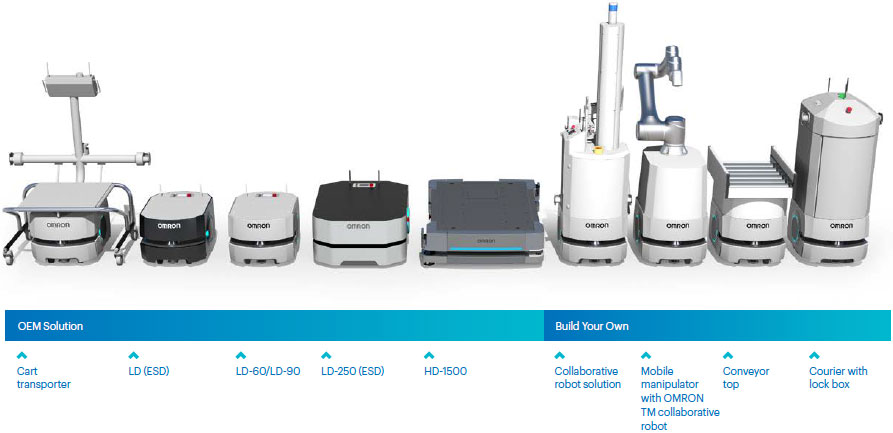
Omron mobile robot family.
Get news, papers, media and research delivered. Sign up for our free newsletters.
Stay up-to-date with news and resources you need to do your job. Research industry trends, compare companies and get weekly market intelligence with Robotics 24/7.
Omron
Omron mobile robot family.
Autonomous mobile robots, or AMRs, can optimize the transport of materials and overall logistics in existing facilities, according to Omron Automation. AMRs can navigate autonomously, adapt to changing environments, and safely perform a range of physical tasks that are challenging for humans, said Omron.
The successful introduction of autonomous mobile robots into ongoing operations requires careful consideration of existing conditions and factors, the company said. Omron described seven top things to consider:
The first step to successfully integrate AMRs into existing workflows is to thoroughly analyze the physical space within a warehouse, factory, or distribution center. Meticulously evaluate your plant layout.
Identify and map areas such as wide corridors and open spaces that can become optimal travel paths, as well as potential obstacles to movement.
The goal is to identify the paths that are easiest for robots to navigate for the most efficient materials movement.
You should identify and repair surface irregularities, cracks, sudden elevation changes, loose tiles, and surface imperfections that could hinder AMR movement. The condition and suitability of flooring is critical for AMRs, which typically perform best on flat, even surfaces.
Environmental conditions within a facility may impact AMR performance. Evaluate factors such as temperature, humidity, and lighting, as well as the presence of dust, debris, and hazardous materials. It is important to select AMRs that can operate well in these conditions.
Some AMRs may require additional protection or customization to handle extreme temperatures or challenging environmental factors. By considering the environment, organizations can ensure optimal AMR performance and longevity.
A critical aspect of successful AMR implementation is the robot's ability to detect its surroundings and navigate safely. Evaluate the work area to minimize or eliminate situations where the AMR may encounter challenges, such as intersections or blind spots.
Make sure that a particular robot model has the best combination of sensors and perception to effectively detect and move around obstacles. By optimizing the work area and equipping the AMR with robust navigation capabilities, organizations can look forward to smooth and collision-free operations.
Evaluate how well AMRs can integrate with existing infrastructure and systems within the facility. Assess compatibility with charging stations, Wi-Fi or network connectivity, and access to power outlets.
Integration with software such as inventory or warehouse management systems (WMS) allows for efficient data exchange, real-time monitoring, and centralized control. Facilitating the flow of information can help with optimizing robots and entire warehouse operations.
Consider the ability of AMRs to adapt to different tasks and workflows within the facility. Evaluate whether the robots can be easily programmed, reconfigured, or equipped with additional tools or attachments for specific tasks.
Flexibility in task customization enables AMRs to handle a wide range of logistics operations, such as materials handling, inventory management, or collaborative tasks alongside human workers. By leveraging the flexibility of AMRs, organizations can achieve enhanced operational efficiency and agility.
Maintenance requirements and reliable support are crucial for the sustainable operation of AMRs. Assess the availability of technical support from the vendor and the ease of performing routine maintenance tasks.
Regular maintenance, repairs, and software updates are essential to keep the AMRs functioning optimally. Accessible maintenance services and responsive support should ensure minimal downtime and promote reliable operation.
By carefully considering and addressing these key implementation considerations, organizations can successfully integrate AMR into their facilities, asserted Omron.
Hoffman Estates, Ill.-based Omron Automation creates, sells, and services systems including sensing, control, safety, vision, motion, robotics, and more. Established in 1933, parent company Omron Corp.'s 30,000 employees help businesses solve problems with creativity in more than 110 countries.
Mobile robots optimize materials movement. Source: Omron
Enjoyed this article? Add Robotics 24/7 as a preferred source in Google Search.
Edge computing gives AI agents the processing power to turn instructions into…
Daimon-TWM world model debuts for the public
Platform helps robots adapt to complex tasks
Look beyond the headlines for the latest in humanoid robots