By
Eugene Demaitre
August 14, 2021
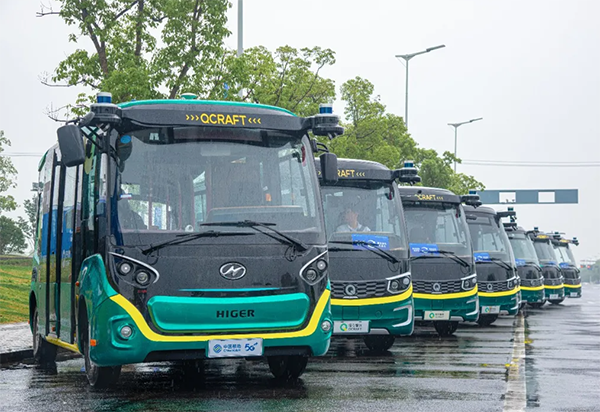
Qcraft
Qcraft said its "full-stack" autonomous technology is first being piloted in shuttle buses and ride-hailing services.
Get news, papers, media and research delivered. Sign up for our free newsletters.
Stay up-to-date with news and resources you need to do your job. Research industry trends, compare companies and get weekly market intelligence with Robotics 24/7.
Qcraft
Qcraft said its "full-stack" autonomous technology is first being piloted in shuttle buses and ride-hailing services.
In addition to self-driving passenger cars, delivery robots, and autonomous trucks, buses are another vehicle class that could eventually be driverless. Qcraft Inc. said it has raised $100 million in Series A+ funding. The Beijing-based company said it will use the financing to build an autonomous driving "super factory."
“Unmanned driving is a trillion-dollar, long-term race," stated Yu Qian, co-founder and CEO of Qingzhou Zhihang, which does business as Qcraft. "If you want to successfully run to the end, technically you can’t just have massive amounts of data, but you must rely on the 'super factory.' A high degree of automation is necessary to achieve cost-controllable scale and commercialization to realize our robobus and robotaxi strategies on open roads."
Qcraft described the its development of autonomous vehicles in three stages. The first step is to build an automated closed loop with simulation as the core and pursue research and development into the efficient use of massive data sets.
In the second step, Qcraft said its team's full-stack technical capabilities enabled it to launch the "Driven-by-QCraft" system that focuses on complex urban traffic scenarios. This includes a self-learning framework for decision-making and planning, and it uses 360-degree perception and 5G connectivity.
The third step is to use driverless minibuses to quickly achieve commercialization in nearly 10 cities, serve the needs of smart cities and new infrastructure, and provide services for tens of thousands of residents. So far, Qcraft said it is operating in five cities, including Suzhou, Shenzhen, and Wuhan, China.
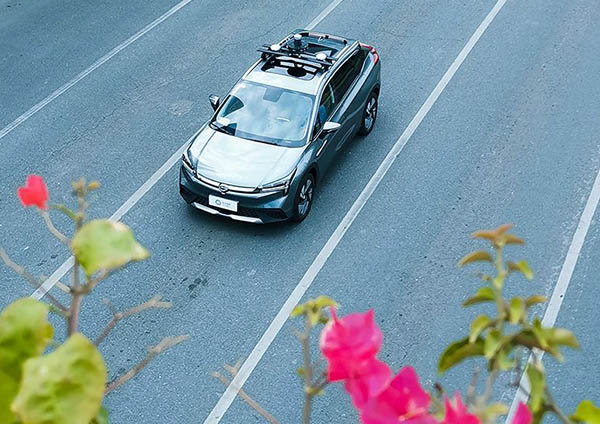
QCraft obtained permission to conduct public road tests in California four months after its founding in 2019. Since then, the company said it has entered a rapid growth phase. Qcraft has offices in Silicon Valley and in China.
Yunfeng Capital led the funding round, with participation from Genesis Capital, Longzhu Capital, and IDG Capital.
The startup dubbed its autonomous vehicles the Longzhou, or "Dragon Boat," series, which will include ride-hailing services, buses, and shuttle buses. Buses follow constrained routes, making them easier to program. Qcraft said it expects to deploy more than 100 vehicles this year.
In addition, the company said it is working with several global partners to deploy the QCraft driver in a variety of business applications and provide more efficient, safer, and low-carbon travel.

Eugene Demaitre was editorial director of Robotics 24/7. Prior to joining Peerless Media, he was a senior editor at Robotics Business Review and The Robot Report. Demaitre has also worked for BNA (now part of Bloomberg), Computerworld, and TechTarget. He has participated in numerous robotics-related webinars, podcasts, and events worldwide.
GENISOM AI makes ICRA debut at conference in Vienna

World's first omni-modal evaluation including tactile sensing for…

Ultrasonic sensing enhances robotics perception
Cybernetix Ventures’ event kicks off Robotics Tech Week 2026 slate of events