By
Tim Culverhouse
November 3, 2025
Association for Advancing Automation (A3)
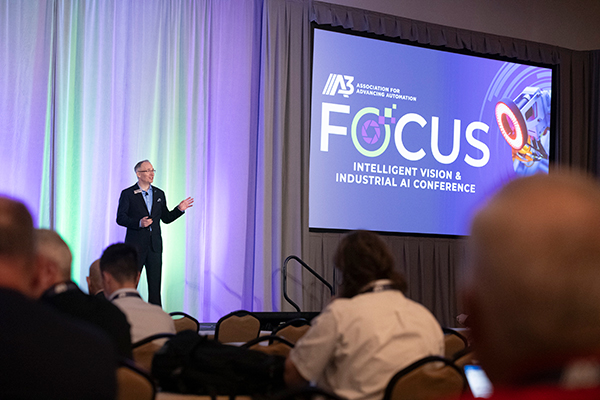
Robert Huschka of A3 joined Robotics 24/7 for a Q&A to recap the 2025 Humanoid Robot Forum & FOCUS: Intelligent Vision & Industrial AI Conferences,
Get news, papers, media and research delivered. Sign up for our free newsletters.
Stay up-to-date with news and resources you need to do your job. Research industry trends, compare companies and get weekly market intelligence with Robotics 24/7.
Association for Advancing Automation (A3)
Robert Huschka of A3 joined Robotics 24/7 for a Q&A to recap the 2025 Humanoid Robot Forum & FOCUS: Intelligent Vision & Industrial AI Conferences,
September in Seattle was a busy month for the Association for Advancing Automation (A3). The trade association hosted the second edition of the Humanoid Robot Forum, co-located with the launch of a new in-person event, the FOCUS: Intelligent Vision & Industrial AI Conference.
The three-day event attracted high-level attendees interested in learning more about three of the most pressing topics in robotics:
Robert Huschka, vice president of education strategies at A3, sat down for a Q&A with Robotics 24/7 to discuss his main takeaways from the events and why these technologies are driving innovation across industries.
Robotics 24/7: What are your thoughts in terms of last year's event in Memphis to this year's event in Seattle? What were the biggest changes, where was the biggest growth and what was the biggest difference between the first humanoid forum and the second one?
RH: When you look at sort of where humanoids are going from a market perspective, I think we're obviously cycling through the hype curve in terms of how humanoids are being viewed. Last year was incredibly bullish. There's tremendous excitement. While that's still there, we're certainly seeing the reality of humanoids begin to come in. People are focusing more on what actual work they're going to be doing and how quickly that work is going to be able to move to fruition. And another thing that we need to think about is how humanoids deploy. Safety, power considerations, scalability, all of those pieces. I think we moved from sort of the “rah-rah” hype moment to much more tactical discussions on how humanoids are going to be deployed. That's not to say there's not still tremendous optimism from the industry. We're still seeing piles and piles of investment. We're still seeing the fantastic videos on social media. But as customers begin to evaluate the technology, this is where the hard questions begin to be asked. I think the industry will have the answers for those, but I think that's one of the things we saw coming out of this Humanoid Robot Forum.
RB24/7: From your conversations at the event, would you say the focus of humanoid deployments is in the warehousing and manufacturing sectors, or is it the personal use/consumer service humanoid segment?
RH: I would say most people who are observing the market believe that the warehousing and industrial settings will be the first deployment space for humanoids. In robotics broadly, structured versus unstructured environments are always one of the dividing lines between not necessarily easy, but easier, and the more complicated and difficult environments. The more you can control the place your robot is working, be it a humanoid or any other type of robot, the easier it is to find success. I think warehousing will be the first place we see any large-scale deployments of humanoids. In fact, it's the one place we're seeing them do real work now. I think, as you talk about home robotics, there are differing viewpoints on how long it will be to get there, but those are really tough environments to make work. Those are really challenging environments. One of the speakers at Humanoid showed a towel-folding application. Humanoid robots have gotten pretty good at folding towels, but what if a cat is playing in your towels? There are all these extra considerations in non-structured environments. When you consider robot capabilities, along with safety and power, they are key considerations. Those become the hurdles as you move into more and more complex environments.
RB24/7: Were A3’s ANSI development and IEEE’s humanoid standard regulation conversations talking points during the Humanoid Robot Forum?
RH: I think as robotics and as humanoids move into real working environments, safety is obviously paramount. It's been a focus of our association, dating back to our early years, on how important it is to the industry to make robots safe. The industrial robot industry has a tremendous safety record compared to many other types of industrial technology. It's something we're very proud of, something we want to see continue as we see more bipedal and quadruped robots, and make sure those are safe as well. We've helped spearhead an ISO working group that is currently looking at legged and quadruped robotics and developing the safety standards for those in industrial settings. That work is underway now. One of the big issues, obviously, with these types of robots is that they require power for their stability. If you cut the power, some of these robots simply fall like a house of cards. How do you make sure when these technologies fail, and ultimately, all technology fails, that it fails in a safe way to any humans that are working in proximity to the robot? That's the work that's being done now.
RB24/7: We’ve seen a focus on that power element, whether it's charging or, for example, the robot that can swap batteries by itself. Would you say from the component side of it, as compared to the full robot, that power and charging were the main focus point at the event? Or was it on the LLM side, the interactivity with humans, or something else?
RH: I don't know if I would say power was a focus of the event. It certainly came up in one of our sessions, because this type of technology, humanoid robots, does require a fair amount of power to function. It's something you need to take into account when planning for it in operation. And companies are looking at different strategies to take that on. I don't think that will ultimately be the limiting factor for humanoids. I think if you're looking at the hottest topic that came up at the Humanoid Robot Forum, it was the idea of embodied AI and embodied intelligence, and how that's playing out in the humanoid space. It's really the perception models and the ability for robots to perceive and act on their environments. The strategies can vary from LLMs and VLMs and VLAs. But really, it’s this crux of building intelligence into your robotics. The other side of it that came up, though, was the ability for robots to have more, for want of a better term, emotional intelligence. Humans, from birth, communicate with their body language. They communicate with their eyes. We learn all of these social cues from fellow humans. What is the ability of humanoids, as they work more and more alongside their human coworkers, for them to pick up even on a small part of these social and physical cues that humans communicate beyond language at all times? It's really fascinating stuff there from both the technology and a sort of social sciences perspective.
RB24/7: Could you provide some insight on how FOCUS became an idea for another live event from A3 and the topics of artificial intelligence and vision?
RH: The interesting thing about the machine and computer vision world is, it's really been the first adopter of AI technologies. Going back decades to some of the early years, even before we called it AI, and looking at how those technologies were applied. If you were to survey industrial companies on their principal use of AI now, the largest majority of application spaces would be machine and computer vision applications, principally in inspection and quality control, but also in systems monitoring. In a variety of other use cases, we're seeing it now in safety applications, where there are applications that can make sure your employees are operating with the right safety gear on, for example. There can be safety screenings in that regard. Inventory management, too. There's just a tremendous plethora of use cases. And now we're seeing vision used in really sophisticated robotics controls. We're seeing it used to build really detailed simulations of your facilities. There's sort of an endless amount of use cases bubbling up out of the synergies between vision and AI. We're also seeing where that intelligence is being placed continue to evolve. Whether you put on the cloud, or near edge, or edge, where you make your decision to put your compute is really critical, and that's one of the things we discussed a lot at FOCUS. There's just a tremendous opportunity for companies to take advantage of these really smart applications now, without a ton of investment. Without a ton of setup time, machine vision is really a gateway at the beginning of a lot of companies' AI journeys.

RB24/7: Would you say that hardware or software is pushing this vision and AI evolution/revolution forward?
RH: The sophistication of the hardware is certainly valuable. The fact that we are able to move more and more intelligence at lower and lower power closer to the edge, and enabling low-latency decision-making, has certainly been critical. But I think most people would say the revolution has come in the algorithmic side of software technology. What we've seen in the advances in AI and in models has really driven the next wave of revolution in the machine and computer vision space. It's really exciting in that regard to see the synergy between what the component makers and manufacturers are able to do. And then applying these new AI and software techniques on top of that is driving unprecedented abilities, especially in inspection and quality control. The ability to do that in sort of off-the-shelf solutions is changing the game for a lot of companies that haven't always had the resources to be able to invest both from the financial side, but also from the, even more importantly, the technology expertise side of it.
RB24/7: What were your biggest takeaways from the first FOCUS event and what are you most excited about for in 2026?
RH: We were really excited about FOCUS as a first-time event. I think it had a really great mix of 10,000-foot talks along with talks that provided real-world advice on how to deploy the technology, while also looking ahead to what's just down the road. We had a bunch of great speakers that participated, and we're really excited to fine-tune it and do FOCUS 2.0 next year.

Tim is the Editorial Director of Robotics247.com. His mission is to provide valuable information and insights to robotics professionals and decision-makers, and to help them solve business challenges. He is a creative, deadline-driven, and detail-oriented storyteller. In addition, he is a sports broadcaster and public address announcer.
GENISOM AI makes ICRA debut at conference in Vienna
World's first omni-modal evaluation including tactile sensing for…

Ultrasonic sensing enhances robotics perception
Cybernetix Ventures’ event kicks off Robotics Tech Week 2026 slate of events