Interact Analysis
Interact Analysis said that robotic picking revenue is projected to see strong growth through 2030.
Get news, papers, media and research delivered. Sign up for our free newsletters.
Stay up-to-date with news and resources you need to do your job. Research industry trends, compare companies and get weekly market intelligence with Robotics 24/7.
Interact Analysis
Interact Analysis said that robotic picking revenue is projected to see strong growth through 2030.
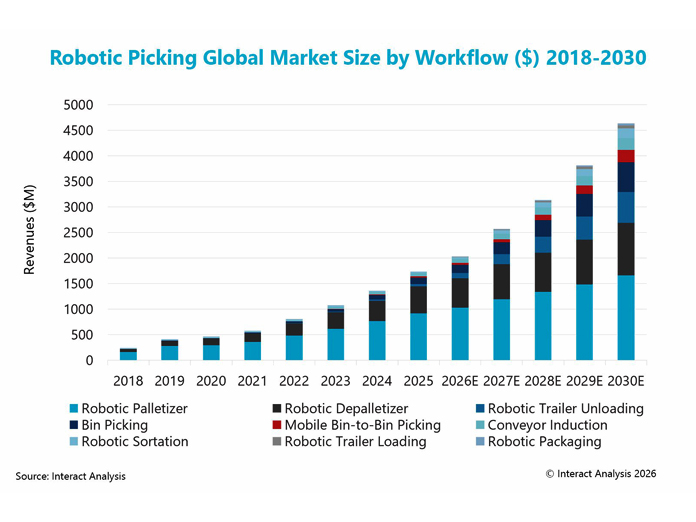
A new report from global market intelligence firm Interact Analysis found that robotic picking saw strong growth in 2025, with global revenue increasing from $1.4 billion in 2024 to $1.7 billion in 2025, representing a 28% year-on-year increase.
Interact Analysis said that robotic picking refers to the use of stationary robots with robotic arms to automate picking and handling tasks within warehouse operations, including palletizing, depalletizing and item or case picking.
Following a period of slower growth driven by fewer greenfield developments and longer sales cycles, the latest research from Interact Analysis suggests that the industry is now forecast to reach $4.6 billion by 2030, representing an average annual growth rate of just under 22%. IA said that this is driven in the short term by the increasing visibility of proven deployments and large customer orders, which are strengthening customer confidence in the technology's stability.
The research found that robotic palletizing & depalletizing remain the largest opportunities throughout the forecast period and together accounted for the largest share of the market in 2025, with both segments accounting for approximately 83% of the market. However, the latest robotic picking report from Interact Analysis suggests this will fall to approximately 58% by 2030, as growth is outpaced by other segments, particularly bin-picking and robotic trailer unloading.
Interact Analysis’ report said that while increased customer confidence is driving short-term growth in robotic picking, long-term segment expansion is primarily driven by the availability of more integrated bin-picking technologies.
As the technology becomes more commercially viable, it is expected to capture an increasing share of the market. The workflow generated $125 million in sales in 2025 and is projected to rise to $577 million by 2030, representing an average annual growth rate of approximately 36%. The strong growth rate for bin-picking offerings appears to be linked to the increasing availability of tightly integrated systems that simplify deployment, improve confidence and reduce uncertainty for customers considering robotic picking technologies. Because of this growth, IA said that bin-picking is expected to drive the robotic picking market’s overall success.
Both robotic and warehouse automation OEMs are demonstrating a growing interest in expanding into perception and action software. For robotic OEMs, IA said that this represents the development of their own AI models in this field, either in-house or through partnerships with companies such as NVIDIA. Warehouse automation system providers are increasingly seeking to integrate robotic picking natively into their existing solutions.
“From a value chain perspective, we observe several emerging trends,” said Irene Zhang, senior analyst at Interact Analysis. “First, robot OEMs are increasingly strengthening their in-house AI picking software capabilities. Over the long term, they are likely to move beyond supplying robot hardware and offer end customers fully integrated robotic picking systems directly. Second, warehouse automation system integrators are also expanding their capabilities in AI-powered robotic picking, either through strategic partnerships with AI software providers or through organic development.
Analysts also note that as robotic and warehouse automation OEMs look to expand into perception and action software, specialists in perception and action software are increasingly moving toward system integration. IA said that some companies are already offering combined robotics and software packages and entering into system integration, suggesting firms within robotic picking see strong revenue potential across the value chain.
“As software increasingly becomes a key differentiator, system integrators are seeking to build stronger in-house expertise to deliver more intelligent and integrated automation solutions,” Zhang added.
Enjoyed this article? Add Robotics 24/7 as a preferred source in Google Search.
Edge computing gives AI agents the processing power to turn instructions into…
Daimon-TWM world model debuts for the public
Platform helps robots adapt to complex tasks

Look beyond the headlines for the latest in humanoid robots