Interact Analysis
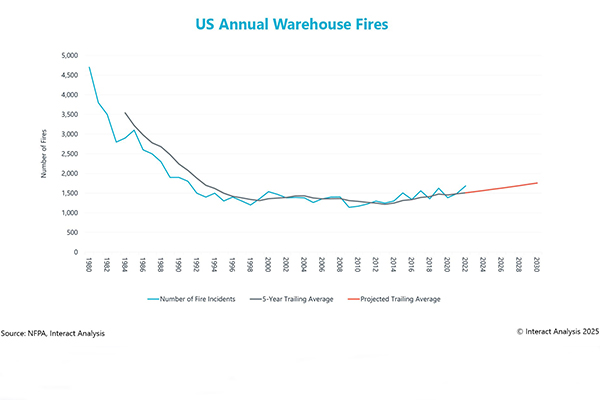
In the United States, warehouse fires have decreased significantly compared with 1980. However, there has been a gradual uptick since 2011.
Get news, papers, media and research delivered. Sign up for our free newsletters.
Stay up-to-date with news and resources you need to do your job. Research industry trends, compare companies and get weekly market intelligence with Robotics 24/7.
Interact Analysis
In the United States, warehouse fires have decreased significantly compared with 1980. However, there has been a gradual uptick since 2011.
Editor’s Note:
Global market research firm Interact Analysis published a 2025 report that examined the fire safety of automation systems installed in warehouses.
The report reviews several fires involving warehouse automation systems, along with steps that automation providers and warehouse operators are taking to prevent fires.
Data in the report indicates the rate of warehouse fires has decreased significantly since 1980, but the five-year trailing average of warehouse fires increased by approximately 2% per year between 2011 and 2022.
The report suggests the most likely answer for this uptick is the general increase in the number of warehouses, driving up the number of incidents. However, it’s also possible that increased warehouse density is playing a role.
To help improve efficiency, logistics operators are storing goods more compactly, using mezzanines and high-density storage arrangements, including automated storage and retrieval systems (ASRS).
An increase in other forms of automation - including robots, conveyors and other warehouse machinery - might also be contributing to the rise. Conversely, the rate of warehouse fires is trending downward in Europe despite comparable trends in automation adoption to the U.S.
Founded in 2016, ASRS provider Attabotics combined the density of ultra-high-density storage with the accessibility of shuttle systems. However, the company filed for bankruptcy in 2025.
Interact Analysis said that one of the defining events in the company’s downfall was a fire at one of Canadian Tire’s warehouses - one of Attabotics’ largest clients. While Attabotics claimed the fire was caused by misconduct on the part of Canadian Tire and subsequently issued a statement of claim against the retailer, the event marked the beginning of the end for the technology provider.
Between 2019 and 2021, Interact Analysis also reported that three separate fires occurred at facilities hosting Ocado ASRS platforms. One was caused by an electrical fault, another by a robot collision, and the third by the ignition of waste packaging.
Regardless of the actual safety record of warehouse automation systems, such events cast a spotlight on the industry, leading to intense public and regulatory attention.
Several warehouse automation companies have released new technologies and features aimed at minimizing fire hazards. This technology not only helps reduce actual fire risk, but also signals to the market that the industry is taking safety seriously.
In response to its fires, Ocado launched metal totes to supplement its plastic containers, helping to prevent the spread of fires.
In 2022, AutoStore stated fire safety was a top priority. The following year, it launched new robots using lithium-titanium oxide (LTO) batteries. Although the primary motivation was faster charging, LTO batteries are among the most fire-resistant battery chemistries and so this was likely also a factor in the decision.

From geometry preparation to AI-assisted analysis, integrated CFD workflows…
GENISOM AI makes ICRA debut at conference in Vienna
North America’s largest robotics and automation event winds down

Automate’s largest day ever draws huge crowds to McCormick Place