STRADVISION
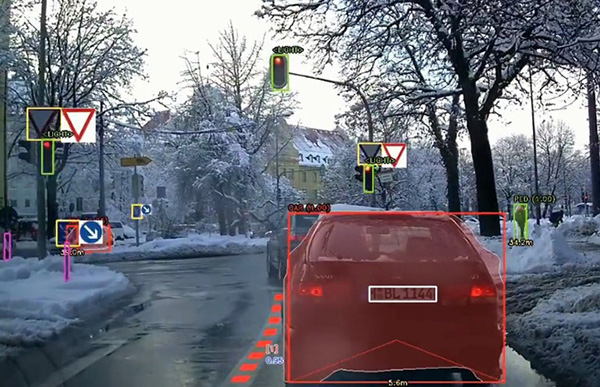
SVNet algorithms run on TI processors for object and lane detection, distance estimation, and traffic sign and light detection and recognition.
Get news, papers, media and research delivered. Sign up for our free newsletters.
Stay up-to-date with news and resources you need to do your job. Research industry trends, compare companies and get weekly market intelligence with Robotics 24/7.
STRADVISION
SVNet algorithms run on TI processors for object and lane detection, distance estimation, and traffic sign and light detection and recognition.
STRADVISION announced at CES last week that its SVNet vehicle perception software is available on the Texas Instruments TDA4 automotive processor. The Seoul, South Korea-based company said designers can use its deep learning-based vision technology for Level 2 advanced driver-assistance systems and automated driving.
“Enabling more cars on the road with advanced driver-assistance capabilities can lead to greater driver comfort and improved road safety," stated Aish Dubey, general manager of automotive processors at Texas Instruments (TI).
"The hardware-optimized SVNet software makes it possible for automotive designers to leverage our automotive system-on-chip [SoC] products to enable surround-view vision, helping them improve the driver experience and road safety,” he said.
SVNet was the first deep neural network to run deep learning-based object-detection software using the TDA2SX processor, claimed STRADVISION. It now also provides deep neural networking across the TI TDA4VM processor family, the company said.
Texas Instruments said its TDA4 processor family offers an entry-level camera system for high-volume L2 ADAS applications and beyond. The processor is purpose-built for advanced driver-assistance systems (ADAS) and autonomous vehicle (AV) applications and builds on over a decade of experience in the ADAS processor market, said the company.
SVNet’s implementation for the TDA4 processor is optimized for high performance along with low power consumption and a reduced bill of materials, according to STRADVISION. "This brings a level of flexibility important to today’s ADAS market and can enable wider mass-market production of L2 systems among automotive OEMs," it noted.
The TDA4 devices combine high-performance computing, a deep-learning engine, and dedicated accelerators for signal and image processing in a functional, safety-compliant-targeted architecture. This also makes them suitable for industrial applications such as robotics, machine vision, and radar sensing, said STRADVISION.
“The software for TI’s automotive processor is optimized for ADAS, and we will strive to lead the ADAS industry market trend of going beyond L2,” said Junhwan Kim, CEO of STRADVISION. “At STRADVISION, our goals have always been ambitious, and the next step in our journey is providing a vision solution for OEM mass production that meets key performance requirements for L2 and the next level.”

Founded in 2014, STRADVISION claimed that it is making ADAS features available at a fraction of the market cost compared with competitors. The company has partnered with OEMs to deploy SVNet on various vehicle models with the goal of accelerating the development of fully autonomous vehicles.
SVNet enables external vehicle perception on more than 18 platforms, including the TI automotive processor, to detect and recognize objects such as other vehicles, lanes, pedestrians, animals, free space, traffic signs, and lights. It can do this even in poor lighting or harsh weather conditions, said STRADVISION.
In addition, the software is certified to ISO 9001:2015 for quality management and ISO 26262 for automotive functional safety.
STRADVISION said it has more than 300 employees worldwide. It closed $88 million in Series C funding in August 2022 and rebranded and reorganized in November.
The company has been recognized with the Gold Award at the 2021 and 2022 AutoSens Awards for "Best-in-Class Software for Perception Systems," as well as the 2020 Autonomous Vehicle Technology ACES Award in Autonomy (software category). It demonstrated the TDA4 SoC during CES in Las Vegas.
StradVision's SVNet calculates the distance and detects various objects as well as parking spaces to generate a safe and complete autonomous driving experience.
GENISOM AI makes ICRA debut at conference in Vienna
World's first omni-modal evaluation including tactile sensing for…
North America’s largest robotics and automation event winds down
Automate’s largest day ever draws huge crowds to McCormick Place