By
Chris Lewis
September 1, 2016
Get news, papers, media and research delivered. Sign up for our free newsletters.
Stay up-to-date with news and resources you need to do your job. Research industry trends, compare companies and get weekly market intelligence with Robotics 24/7.
As the processes, equipment and overall strategies of distribution centers and manufacturing plants are continuously responding to the ever-changing global marketplace, one part of the materials handling process has remained practically unchanged: dock equipment. However, a shift is occurring as DC and plant owners are beginning to focus on how to improve the effectiveness of their dock areas.
To help employees as they transport products from docks to trailers, some companies are incorporating loading and unloading robotics. Others are focusing on their manual dock products by replacing yellow steel guard railings with new types of barriers and installing new dock seals. Additionally, employee safety is a high priority as companies are acquiring equipment like roller conveyors and vehicle restraints.
Through each of these advancements, facilities are not only improving their operational efficiency and employee productivity—they are also preparing for the future of shipping, so they can remain ahead of the curve and continue to increase their bottom lines in the midst of continuous change.
Automation eases complexity
Despite the constant evolution of automation, most loading docks have yet to become automated. After all, humans are very flexible in their abilities to handle different types of loads, so a one-size-fits-all approach won’t work as different types of automation need to be applied depending on the type of load that has to be moved. But, companies are now starting to incorporate some automation in truck loading and unloading.
Improving manual dock products
 Not only do the barriers need to be stronger to protect heavier loads that are moving at faster speeds, but they also have to be flexible to absorb the impacts of high speeds. The barriers must also be detachable, especially when access into a certain space is necessary. After all, steel guard railings have usually been anchored into the ground permanently, so they often weren’t used to protect areas that required access, particularly loading docks.
“This had led to the development of barriers comprised of fabric, plastics and other new materials—and a growing awareness that safety barriers are no longer a one-size-fits-all proposition,” says Troy Bergum, product manager at Rite-Hite. “Safety and facility managers need to become more sophisticated in their evaluations of barrier needs, analyzing location-specific traffic patterns and other issues, rather than just defaulting to steel that is heavy enough to withstand 10,000 pounds at 4 mph.”
Not only do the barriers need to be stronger to protect heavier loads that are moving at faster speeds, but they also have to be flexible to absorb the impacts of high speeds. The barriers must also be detachable, especially when access into a certain space is necessary. After all, steel guard railings have usually been anchored into the ground permanently, so they often weren’t used to protect areas that required access, particularly loading docks.
“This had led to the development of barriers comprised of fabric, plastics and other new materials—and a growing awareness that safety barriers are no longer a one-size-fits-all proposition,” says Troy Bergum, product manager at Rite-Hite. “Safety and facility managers need to become more sophisticated in their evaluations of barrier needs, analyzing location-specific traffic patterns and other issues, rather than just defaulting to steel that is heavy enough to withstand 10,000 pounds at 4 mph.” “The seals also include other high-end features to reduce wear and improve the closure of the gaps found at a typical dock,” explains John Carroll, director of U.S. sales of loading dock products for Entrematic.
 “Since surface mount lifts’ hydraulic systems are pre-plumbed and their electrical is pre-wired, installation is quick, easy and can be done for a fraction of the cost of a pit-mounted lift,” says Pete Norden, dock lift program manager for Southworth Products Corp. “The surface mount lifts also have low collapsed heights, which allow for shorter ramps, resulting in a big space savings.”
Investing in employee safety and ergonomics
Suppliers report an increased focus on dock safety and ergonomics, particularly with regard to employees that unload floor-stacked containers and trailers. Employee turnover can be high in this area as well, since workers are required to use step stools or climb on boxes to reach items that are stacked above their heads.
“Where much time, effort and capital is spent on the loading operation, warehouse management system and order picking side of the operation, the unloading operation generally requires employees to mainly perform manual labor as they hand stack boxes on pallets,” says Richard Kat, vice president of sales and marketing for Engineered Lifting Systems and Equipment. “Equipment such as flexible powered roller conveyors and extendable belt conveyors—as well as ergonomic machines that provide assistance to workers that unload products—are finding their way into warehouses and DCs.”
As companies invest more in employee safety and ergonomics, they are using more powered dock equipment and vehicle restraints. As they do, they are also expecting better control features, as well as the ability to sequence the order of operation for their equipment.
Enhanced controls were once viewed as optional additions to dock packages, but they are now considered a necessity. In fact, according to Entrematic’s Carroll, the percentage of dock packages sold with enhanced controls has increased the last two years, and he expects a continued rise in the future.
“We are also seeing much higher interest in dock and yard management systems as companies continue to pursue operational improvements,” Carroll says. “These systems can greatly reduce the cycle time for loading and unloading products, as well as the movement of traffic in and out of facilities.”

Chris Lewis is the owner of Innovative Written Solutions, a content development and editorial services company. In addition to developing content for Modern Materials Handling and Material Handling Product News as a Products Editor, he has written for nearly 100 companies, magazines and websites. He can be reached at [email protected] or http://www.linkedin.com/in/chris-lewis-aa301b14.
Enjoyed this article? Add Robotics 24/7 as a preferred source in Google Search.
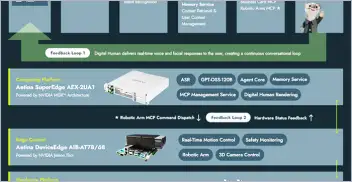
Edge computing gives AI agents the processing power to turn instructions into…

Daimon-TWM world model debuts for the public
Platform helps robots adapt to complex tasks

Look beyond the headlines for the latest in humanoid robots