Sunday
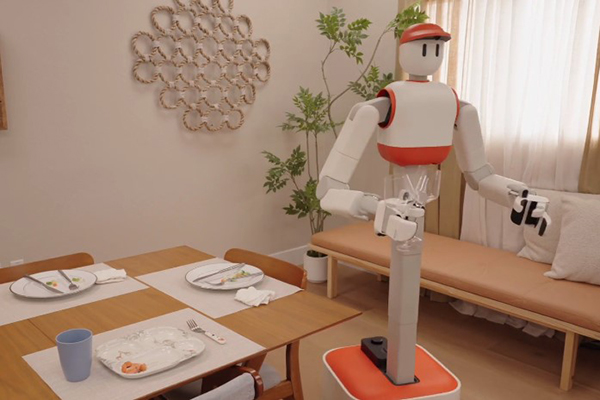
Memo, a new personal services robot from AI startup Sunday, will roll out a Beta program in 2026.
Get news, papers, media and research delivered. Sign up for our free newsletters.
Stay up-to-date with news and resources you need to do your job. Research industry trends, compare companies and get weekly market intelligence with Robotics 24/7.
Sunday
Memo, a new personal services robot from AI startup Sunday, will roll out a Beta program in 2026.
AI company Sunday, founded by Stanford PhD roboticists Tony Zhao (CEO) and Cheng Cti (CTO), has emerged from stealth mode to launch the Memo personal robot.
The California-based startup describes Memo as a personal robot engineered to help families gain back time spent on chores like dishes, laundry and tidying up.
Its development centers on learning from authentic daily routines collected in more than 500 real homes using Sunday’s patented Skill Capture Glove, a wearable that records how people move, clean, and organize.
Memo puts household data at the heart of personal robotics. Unlike most in-home robots, Sunday said Memo’s training comes from approximately 10 million episodes of genuine household routines, representing high levels of data diversity, quality and in-the-wild volume.
The company said this advantage enables Memo to adapt to the unpredictability found in kitchens, living rooms and laundry spaces, mastering “long horizon” tasks like clearing the table, running the dishwasher, folding clothes, putting away shoes and brewing espresso.
“The problem has always been data. Most home robots start as adaptations of industrial machines, and those trained in labs rarely succeed in unpredictable, real-world environments,” Zhao said. “Our Skill Capture Glove changes this by collecting thousands of hours of daily routines from hundreds of families. That practical knowledge lets Memo develop the skills families truly care about. We built Memo to give people back time for what matters, with the safety needs for any family in mind. This is a turning point for home robotics.”
Sunday said Memo is built for homes, with safety and stability as priorities. Instead of a bipedal humanoid shape, Memo features a rolling base for greater balance and lower weight. In the event of power loss, Sunday said Memo remains stable, avoiding the risk of falls.
In conjunction with the company launch and Memo announcement, Sunday has begun accepting applications for Memo’s Founding Family Beta, launching in late 2026. Sunday said 50 households will become early adopters, receiving individually numbered robots along with direct support and the opportunity to guide future capabilities.
“The promise of AI robotics isn’t back-flipping or dancing demos, but robots that work in messy, real-world situations. To have those, we need real-world training data. We have about one-millionth of the data we need,” said Eric Vishria, general partner at Benchmark, one of Memo’s investors. “Tony and Cheng’s approach finally makes collecting robot-ready data at a massive scale possible. Their breakthroughs mark the start of an exponential curve toward a future where robots actually work in our day-to-day lives.”
GENISOM AI makes ICRA debut at conference in Vienna
World's first omni-modal evaluation including tactile sensing for…

Ultrasonic sensing enhances robotics perception

Cybernetix Ventures’ event kicks off Robotics Tech Week 2026 slate of events