By
Gary Forger
October 2, 2024
Get news, papers, media and research delivered. Sign up for our free newsletters.
Stay up-to-date with news and resources you need to do your job. Research industry trends, compare companies and get weekly market intelligence with Robotics 24/7.
Scott Samples
Modern: We’ve got to start this with your title. Robot wrangler. That’s a first for most people. Please tell us about it and what you do every day.
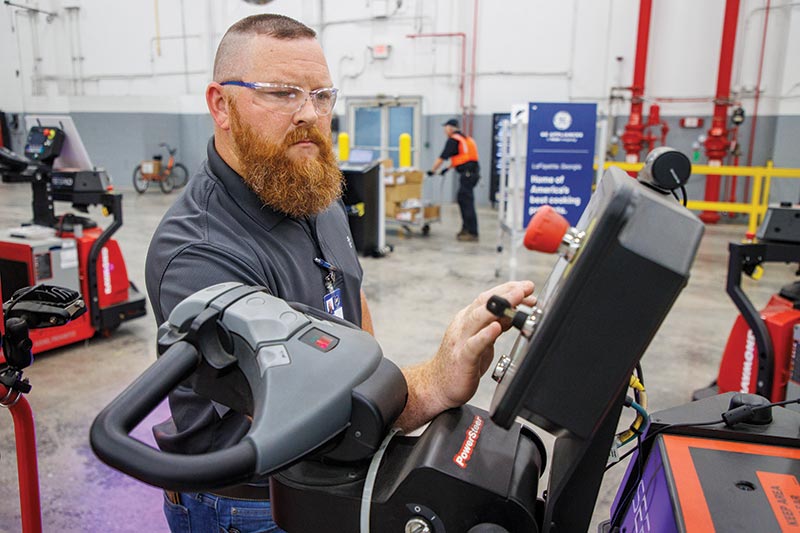
Samples: You’re right. There aren’t a lot of robot wranglers out there. At GE Appliances, it’s an investment in innovation. Both in technology and in workforce management.
I’m focused at our plant on managing a fleet of more than 20 autonomous mobile robots (AMRs) and automatic guided vehicles (AGVs). While AGVs have been around a lot longer than AMRs, both are advanced automation that improves processes and efficiencies while reducing costs.
But while both are automated, they don’t run themselves. That’s where I come in. My job is to manage their daily activities from how we are using them out on the manufacturing floor to maintenance. Making them most efficient actually requires someone like me. Or you’re not getting all possible efficiencies from them.
Modern: That’s a completely different take on automation than most people have. The usual scenario is no people, and you always get maximum efficiency. But now, a management team of one makes some sense.
Tell us some more about the workforce management aspects here. It almost sounds like you’re equating robots with people.
Samples: I am. I look at each member of the fleet as a part of my team. We even give them names. Iron Man and Wonder Woman are two of my favorites.
They run their own routes. Have their own maintenance requirements. We use each in a particular way, depending on our manufacturing needs at any given point.
And yes, everyone has to show up for work every day.
Modern: When you describe it that way, makes sense. But it’s an unconventional take on automation. Are you one of a kind?
Samples: I hear there are a couple of our plants that have someone like me. But robot wranglers aren’t everywhere at GE Appliances or anywhere else, as far as I know.
That said, the company looks at what I’m doing as an essential part of the $118 million invested in innovation here at Lafayette alone. And I hear that’s the case for the more than $2 billion the company has invested in innovation since 2016.
Anytime you have assets, someone has to manage them. That’s why I’m here.
Modern: Who would have thought. How exactly did you get into this? Are you a guinea pig or a pioneer?
Samples (with a huge smile and without missing a beat): I’m probably both. From the time that I first raised my hand, I have wanted to be the manager of the largest and most productive robot fleet at GE Appliances.
Modern: That’s a high bar. But to turn this to you: What’s the most rewarding aspect of your job?
Samples: My kids. They think it’s cool I play with robots every day. Maybe one day they will want to do the same. Manufacturing is changing and a robot wrangler is just one example of where it’s headed. Ask our leaders and they’ll tell you we’re rebranding manufacturing. Proud to be a part of that.

Gary Forger is an editor at large for Modern Materials Handling. He is the former editorial director of Modern Materials Handling and senior vice president of MHI. He was also the editor of the Material Handling & Logistics U.S. Roadmap to 2030.
Enjoyed this article? Add Robotics 24/7 as a preferred source in Google Search.
Edge computing gives AI agents the processing power to turn instructions into…
Daimon-TWM world model debuts for the public
Platform helps robots adapt to complex tasks
Look beyond the headlines for the latest in humanoid robots