Interact Analysis
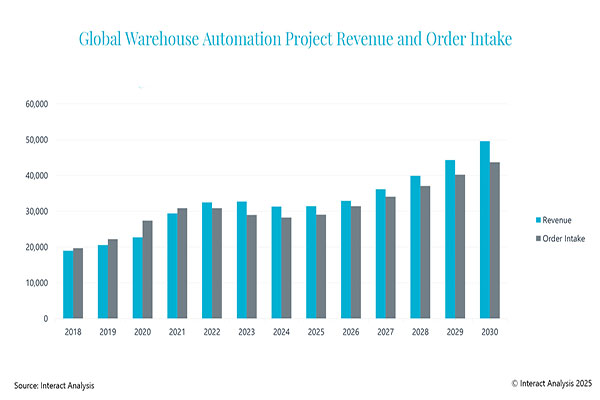
Interact Analysis predicts long term automation order growth expansion projected at a compound annual growth rate (CAGR) of 8% between 2024 and 2030.
Get news, papers, media and research delivered. Sign up for our free newsletters.
Stay up-to-date with news and resources you need to do your job. Research industry trends, compare companies and get weekly market intelligence with Robotics 24/7.
Interact Analysis
Interact Analysis predicts long term automation order growth expansion projected at a compound annual growth rate (CAGR) of 8% between 2024 and 2030.
According to research conducted by market intelligence firm Interact Analysis (IA), warehouse automation orders declined by an estimated 3% in 2024.
The firm said the decline was due to economic, political, and market-specific challenges, including persistently high interest rates in many territories, and the residual effects of an oversupply of warehouses built during the COVID-19 pandemic. Additionally, increasing competition from Chinese vendors is expected to drive down prices and slow revenue growth over the forecast period to 2030.
Global macro-economic factors such as high interest rates, political uncertainty around elections, and the Chinese real estate crisis have significantly impacted sales cycles, slowing the pace of orders.
Despite the forecasted decline, IA said growth is expected to pick up in 2025, which is anticipated to mark a year of slow recovery for the sector. Pre-pandemic growth levels are expected to return in 2026, with long term expansion projected at a compound annual growth rate (CAGR) of 8% between 2024 and 2030.
To produce its Warehouse Automation report, IA conducted more than 100 in-depth research interviews and analyzed more than 120 companies, looking specifically at their past, present, and future investments in warehouse automation.
The durable manufacturing and food & beverage industries continued to spend on automation during the downturn.
Warehouse automation revenues in the food & beverage sector were bolstered by cold-chain automation, as well as by large-scale projects from consumer packaged goods (CPG) manufacturers.
U.S. manufacturing spending was driven in part by federal government subsidies. IA said these subsidies are expected to be rolled back by the Trump Administration, which will look to spur domestic investments through imposing tariffs.
On the second day of his second term, President Donald Trump announced up to $500 billion private sector investment in building AI infrastructure in the United States, according to a CBS News report.
IA reported these two sectors registered the highest growth in warehouse automation revenues between 2022 and 2024, with durable manufacturing increasing 11% and food & beverage increasing by 10%.
Investment in fulfillment automation is expected to return in the mid-term as online retailers fully utilize capacity created during the COVID-19 pandemic and look to expand their networks with new greenfield projects. These factors contribute to IA’s projection of a 9% CAGR in the warehouse automation market between 2026 and 2030.
“We anticipate that warehouse automation investments in the U.S. will increase in 2026 as end-customers settle into the new president’s policies, resulting in an uptick in revenue in 2027,” said Rowan Stott, IA senior research analyst. “Europe is expected to lag behind the U.S. in terms of an economic recovery, particularly Germany and the U.K. which have both experienced sluggish economic growth in recent years. However, Eastern Europe is proving to buck the trend as the region is experiencing an influx of foreign direct investment (FDI) from the likes of Western European companies re-shoring production, as well as Chinese companies looking to enter the European market.”
Although global challenges such as high interest rates and geopolitical tensions have deterred large-scale investment in fulfillment center automation, growth is anticipated to return as e-commerce demand stabilizes and online retailers expand their networks. Between 2027 and 2030, IA predicts a rise in fulfillment projects is forecast to contribute to a CAGR of 28% in warehouse automation order intake.
IA also said sluggish consumer spending in China caused by the housing crisis continues to dampen warehouse automation investment and is not expected to pick up in the short term.
Enjoyed this article? Add Robotics 24/7 as a preferred source in Google Search.
Edge computing gives AI agents the processing power to turn instructions into…

Daimon-TWM world model debuts for the public

Platform helps robots adapt to complex tasks

Look beyond the headlines for the latest in humanoid robots