Lanner Electronics
Lanner Electronics launched its robotic AI platform with NVIDIA Jetson Thor & Blackwell integrations.
Get news, papers, media and research delivered. Sign up for our free newsletters.
Stay up-to-date with news and resources you need to do your job. Research industry trends, compare companies and get weekly market intelligence with Robotics 24/7.

Lanner Electronics
Lanner Electronics launched its robotic AI platform with NVIDIA Jetson Thor & Blackwell integrations.
Rugged edge AI hardware provider Lanner Electronics announced the launch of the EAI-I351, a robotic AI platform that the company said is engineered for the next era of physical AI.
Built on the NVIDIA Jetson Thor system-on-module (SoM), Lanner said that the EAI-I351 is designed to deliver server-class performance for autonomous mobile robots (AMRs), heavy-duty industrial vehicles and edge-native generative AI applications.
As physical AI workloads demand exponentially higher compute for real-time reasoning and sensor fusion, the company said its EAI-I351 bridges the gap between data center architectures and the rugged edge.
Lanner Electronics said that the EAI-I351 utilizes NVIDIA Jetson Thor, powered by NVIDIA Blackwell GPU architecture. The company added that its platform delivers a generational leap in performance, offering up to 2,070 FP4 TFLOPS of AI compute within a highly efficient 130W power envelope.
Compared to its predecessor, NVIDIA Jetson AGX Orin, Lanner said that NVIDIA Jetson Thor series provides:
Lanner said that the system incorporates a suite of dedicated accelerators, including a third-generation Programmable Vision Accelerator (PVA), optical flow accelerators and dual encoders/decoders, ensuring low-latency processing for complex visual tasks.
Recognizing the bandwidth requirements of modern autonomous systems, Lanner said it has engineered the EAI-I351 with high-speed networking and extensive sensor interfaces. The platform is available in two core configurations based on the compute module:
To support high-throughput data transmission, the company said its system offers flexible network I/O configurations, including 1x QSFP28 (4 × 25GbE or 3 × 25GbE, depending on SKU) paired with 1x 5GbE RJ45.
For visual perception and sensor fusion, the EAI-I351 is equipped with 8x GMSL2 deserializers, enabling direct connectivity for high-resolution automotive cameras. Additional I/O includes 4x USB 3.2 Gen1 and 4x Digital I/O (DIO) for legacy device integration.
Designed for harsh industrial environments, Lanner said that the EAI-I351 supports a wide operating temperature range of -25°C to 70°C. The company added that it ensures seamless cloud-to-edge communication via 2x M.2 expansion slots, accommodating Wi-Fi and 5G/LTE connectivity modules.
Lanner added that the platform is fully optimized for the NVIDIA AI software stack, including NVIDIA Isaac for robotics simulation and deployment, NVIDIA Metropolis for vision AI, and NVIDIA Holoscan for real-time sensor processing.
Lanner also said it also supports agentic AI workflows, such as Video Search and Summarization (VSS) using NVIDIA Cosmos Reason.
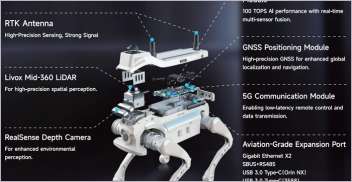
GENISOM AI makes ICRA debut at conference in Vienna

World's first omni-modal evaluation including tactile sensing for…
Ultrasonic sensing enhances robotics perception

North America’s largest automation and robotics event takes place June 22-25