Point One Navigation
PAVE hosts STEER Tech and Point One Navigation webcast
Get news, papers, media and research delivered. Sign up for our free newsletters.
Stay up-to-date with news and resources you need to do your job. Research industry trends, compare companies and get weekly market intelligence with Robotics 24/7.
Point One Navigation
PAVE hosts STEER Tech and Point One Navigation webcast
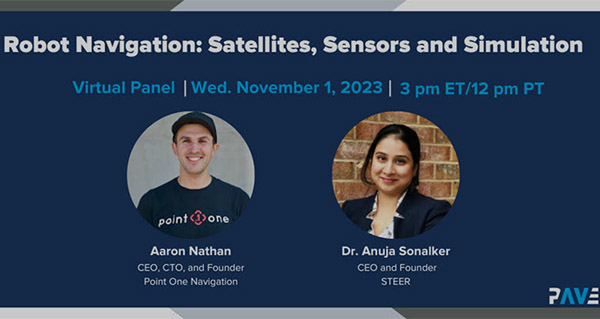
In a PAVE panel today, two autonomous vehicle CEOs will explore the world of robot navigation. Aaron Nathan, founder, chief technology officer, and CEO of Point One Navigation, and Dr. Anuja Sonalker, founder and CEO of STEER Tech, will explain how the pieces of the autonomy stack work together, create redundancies, and provide autonomous vehicles with a full-picture view of the world.
Humans use senses to navigate the world. Through sight, smell, sound, taste, and touch, people explore their surroundings, and these senses work together to help create a complete picture of our environment.
How does an autonomous vehicle (AV) create a picture of the world? Similar to a human, an AV uses its sensors to perceive its surroundings, and based on that data, it makes decisions.
While each sensor serves an important function, the collective input – or sensor fusion – is what makes the system work safely, noted the event organizers. Registration is open, and attendees can submit questions about robotic navigation.
San Francisco-based Point One Navigation said it specializes in building precise location services with accuracy down to a few centimeters at a cost 100x less than existing solutions. The company claimed that state-of-the-art sensor fusion techniques and a proprietary network of sensors enable it "to determine location with unrivaled precision and cost."
Point One Navigation recently joined STMicroelectronics' partner program.
STEER Tech said it is engineering innovations to solve enterprise and consumer mobility challenges. The company has developed autonomy technology for passenger and commercial vehicles that can be applied to parking, low-speed driving, first and last-mile delivery, vehicle maintenance, fleet operations, and other custom use cases.
With its growing network of autonomous transfer hubs for fleet and delivery companies and mapped points of interest for consumers, STEER said it continues to create an ecosystem of users and infrastructures that benefit from space and time efficiency, reduced costs, enhanced user experiences, and new revenue.
Partners for Automated Vehicle Education (PAVE) said it is a coalition of industrial experts, nonprofits, and academics with one goal: To bring the AV conversation to the public so everyone can play a role in shaping the future. The organization said it is purely educational and that it does not advocate for a particular technology or specific public policies.
PAVE added that its members believe that the potential benefits of driverless technology can be achieved only if the public and policymakers know the honest facts. It said it wants to raise public awareness of both what is on the roads today and what is possible for the future.
In recognition of Pedestrian Safety Month, join PAVE for an enlightening virtual panel discussion focusing on the transformative impact of sensor technology and ADAS in enhancing pedestrian safety.
GENISOM AI makes ICRA debut at conference in Vienna
World's first omni-modal evaluation including tactile sensing for…
Ultrasonic sensing enhances robotics perception

Cybernetix Ventures’ event kicks off Robotics Tech Week 2026 slate of events