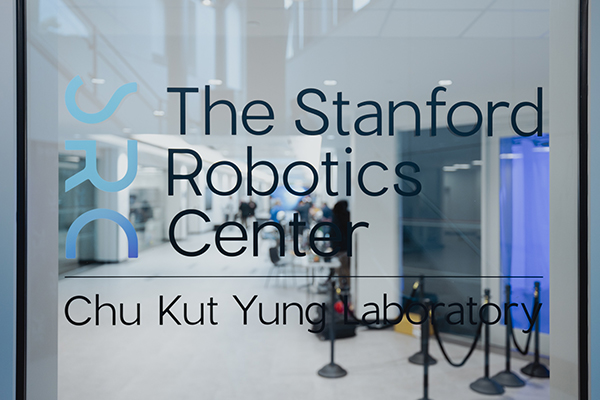
Andrew Brodhead - Stanford University
The newly opened Stanford Robotics Center brings all of the University's robotics researchers together under one roof.
Get news, papers, media and research delivered. Sign up for our free newsletters.
Stay up-to-date with news and resources you need to do your job. Research industry trends, compare companies and get weekly market intelligence with Robotics 24/7.
Andrew Brodhead - Stanford University
The newly opened Stanford Robotics Center brings all of the University's robotics researchers together under one roof.
Once dispersed in labs across campus, Stanford University’s robotics researchers now have a unified, state-of-the-art space for groundbreaking research, education and collaboration.
The basement beneath the Packard Electrical Engineering Building, once a hallway with researchers working behind closed doors, is now a bustling hub for collaboration. After many years of planning, fundraising and development, the all-new Stanford Robotics Center officially opened its doors with a reception in November 2024.
The new facility is a bright, open, and vibrant space with many research bays arranged side-by-side. In one corner, a dancer pirouettes as her movements are digitized and projected on a nearby monitor. Next door, a pair of robotic arms makes a bed while others prepare a meal. Not far away, a medical student gazes into stereoscopic lenses manipulating hand tools while a machine across the room performs a mock surgery.
“I came to Stanford in 1981 and this idea – this dream – was always there, even then,” said Oussama Khatib, director of the new Stanford Robotics Center. “Robotics cannot really be successful unless we bring all the different research areas of robotics together: mechanical engineering, computer science, materials science, electrical engineering, artificial intelligence. There are so many connections between what we all do that we really needed one place to call home.”
Khatib, a professor of computer science, has made headlines with several robots in his more than four decades at Stanford. Khatib was behind the humanoid OceanOne submersible robot that helped explore shipwrecks and deep-sea coral reefs without risk to human divers.
“Oussama and I have been dreaming about a center like this for at least fifteen years,” said Mark Cutkosky, a professor of mechanical engineering and inventor of the Stickybot, among other achievements. Stickybot can scale vertical, glass-like faces using feet inspired by the gripping ability of a gecko’s toes. Back then, the two Stanford professors imagined a large, central robotics center that would unify individual labs to better organize itself for larger projects.
“Currently, everything’s bottom up,” Cutkosky said. “You get the clusters of one, two, or three faculty who may get together and propose something, but this is something totally different that will allow us to pursue large projects that bring together all our different skills in a single effort. There will be many new opportunities.”
Jeannette Bohg, assistant professor of computer science, is one researcher who has already seen the advantages of the Stanford Robotics Center in action. She specializes in domestic robots that might someday clean homes and apartments or even help seniors live independently longer.
Bohg directs the Interactive Perception and Robot Learning Lab and is a key contributor to the multi-university effort TidyBot. TidyBot, developed by team members at Stanford, Columbia University, Carnegie Mellon University, Princeton University and Google, is a domestic robot that uses computer vision and artificial intelligence to recognize everyday objects lying around the house, grab them and put them away in their proper place – dishes in the dishwasher, clothes in the hamper, books on the bookshelf and so forth.
The key challenge, Bohg says, is knowing where that right place is, which is a decision that is personal to each user. The robots must therefore learn their owner’s preferences. Bohg’s team works on TidyBot’s grasping arm and hand components. For her, the new robotics center means space to spread out.
“In 2017, when I came to campus and set up my lab space, it was very small for the type of work we do,” Bohg said. “The lab was basically a forest of robot arms with everyone sitting in each other’s space as they do experiments.”
Learn more about the different robotics projects at the Stanford Robotics Center here.
Enjoyed this article? Add Robotics 24/7 as a preferred source in Google Search.
Edge computing gives AI agents the processing power to turn instructions into…
Daimon-TWM world model debuts for the public
Platform helps robots adapt to complex tasks
Look beyond the headlines for the latest in humanoid robots