VERSES AI
The VERSES AI multi-agent robotics deep learning model requires no training, according to the company.
Get news, papers, media and research delivered. Sign up for our free newsletters.
Stay up-to-date with news and resources you need to do your job. Research industry trends, compare companies and get weekly market intelligence with Robotics 24/7.
VERSES AI
The VERSES AI multi-agent robotics deep learning model requires no training, according to the company.
Cognitive computing company, VERSES AI Inc., which specializes in next-generation agentic software systems, unveiled more details on the development of its robotics model.
The Vancouver-based company said that the VERSES robotics architecture accomplished typical household tasks of tidying the room, preparing the groceries and setting the table, better than other robotics models. And, it accomplished the tasks without any pre-training.
VERSES said that robots often perform well on scripted tasks but can freeze when faced with new situations; even something as simple as a misplaced box can halt progress.
Newer approaches can be more flexible but require huge amounts of training to be effective, which the company said makes existing robotics systems difficult to use in real-world applications where new situations constantly arise.
VERSES said that challenges like this are well-suited to its models’ abilities for quickly adapting to their environment.
“Currently robotics systems are often brittle, and need huge amounts of training data, which makes them expensive and prone to going wrong.” said Sean Wallingford, former CEO and President of Swisslog. “For instance, if you bring a robot to a new factory or ask it to do a different job, it will need a lot of re-training and may not be reliable. VERSES breakthroughs are exciting, because they offer an alternative approach. If we can deploy robots without training, they will be viable in a wide range of activities, from factories and warehouses to domestic and commercial applications.”
In a published paper entitled, Mobile Manipulation with Active Inference for Long-Horizon Rearrangement Tasks, written by members VERSES’ research lab, the robotics model is compared to a deep learning alternative in three tasks:
The VERSES robotics model achieved a success rate of 66.5% across these tasks while the previous best alternative had a success rate of 54.7%. The VERSES robotics model also requires no training, whereas the report found that the other robotics model required 1.3 billion steps to pre-train several skills across the three tasks.
“I believe that by combining our world-modeling and our active inference capabilities, we’ve shown robots can think on their ‘feet’ - navigating and completing complex tasks without months of costly training,” saod Hari Thiruvengada, CTO of VERSES. “Our breakthrough has the potential to transform how robots operate across industries, from factories and warehouses to homes and public spaces, potentially unlocking a new era of truly adaptive, reliable automation.”
VERSES said it plans to present the paper at the International Workshop on Active Inference later in 2025.
VERSES said robots generally fall into two categories: drive-by-wire or deep learning.
Drive-by-wire means everything is pre-programmed, whereas deep learning relies on vast amounts of data for training. For example:
The company said it has solved this problem of adaptability.
When a human needs to get a drink in a new apartment, they don't execute by having practiced this task in hundreds of different apartments; they can adapt because they have a model of how the world works. This allows humans to figure out that they need to open the refrigerator and grab a bottle.
VERSES said its technology equips robots with a world model, allowing them to execute three tasks in different apartment layouts.
VERSES models, similar to its work on the AXIOM digital brain, don’t require any pre-training and instead just adapt by exploring the environment.
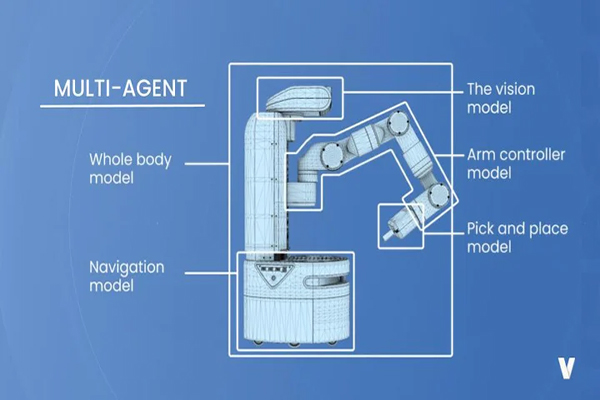
VERSES said its models consist of three modules working together:
At each stage, VERSES said its system can adapt. For example, it can cope with unexpected objects in its way, or needing to pick up something it has dropped.
VERSES also said that most importantly, its model needs no training. All the VERSES model news is basic knowledge such as its arm resting pose when idle or how much resistance the arm will gets from obstacles. By contrast, VERSES said the baseline model of other systems requires extensive offline training of 6,400 episodes per task and 100 million steps per skill across a total of seven skills, such as picking up an object or opening a fridge.
The company said that use cases for this work could include moving inventory around factories and warehouses.

January 5, 2026 60 Minutes showcased how Boston Dynamics’ AI-powered Atlas humanoid robot, through training, has performed countless tasks at a Hyundai automotive production facility in Georgia.
August 16, 2025 VERSES released its robotics model, which the cognitive computing company said outperforms Meta’s Habitat Benchmark, without model pre-training.
August 6, 2024 Oxipital AI will focus on providing its deep-learning machine vision systems for manufacturing robotics after divesting its gripper hardware business to the Schmalz Group.
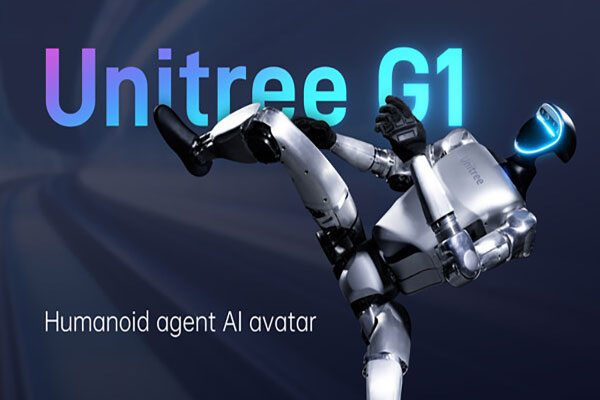
June 11, 2024 Unitree Robotics announced the release of its new G1 humanoid robot, a smaller humanoid compared to its H1 offering, that comes with a base model price of $16K.
January 12, 2024 The Orbbec Gemini 2 XL camera is made for AI-based vision developers looking for an affordable, wide FOV RGB-D PoE camera with high-performance over a long range and varied lighting condition.
June 18, 2022 Order up. Food service management company Chartwells will be placing Picnic’s pizza making robots at an initial five universities across the country.
December 6, 2021 Scientists at MIT CSAIL created a system for co-optimizing the brain and body of soft robots and found that they often resembled real animals while outperforming hand-designed robots.
April 30, 2021 MERL and MIT researchers are working to apply machine learning, collaborative robots, sensors, and vision to help robots more dexterously manipulate items such as food.
September 22, 2020 Update includes expanded Simulink access, new products, major updates and hundreds of new features.
July 16, 2020 Partnership entails new offering of a Deep Learning with MATLAB course.
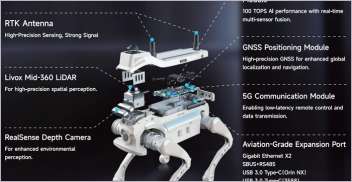
GENISOM AI makes ICRA debut at conference in Vienna
World's first omni-modal evaluation including tactile sensing for…

Ultrasonic sensing enhances robotics perception
Cybernetix Ventures’ event kicks off Robotics Tech Week 2026 slate of events