Antioch
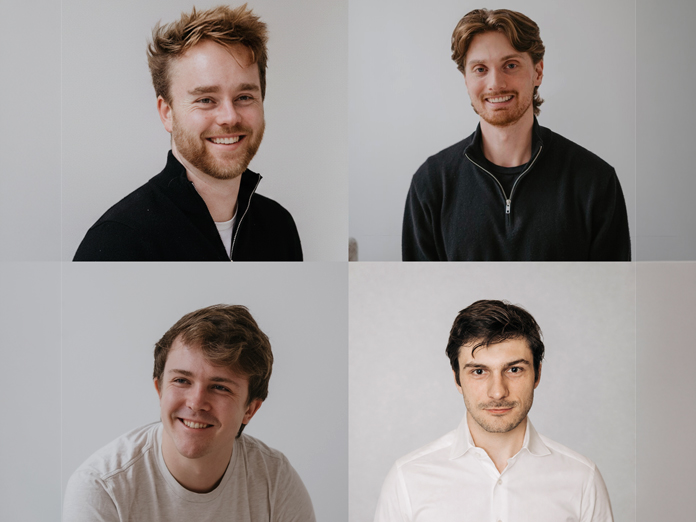
Antioch co-founders (L-R) Harry Mellsop, Alex Langshur, Michael Calvey and Collin Schlager, as the team secured a $32M Series A round.
Get news, papers, media and research delivered. Sign up for our free newsletters.
Stay up-to-date with news and resources you need to do your job. Research industry trends, compare companies and get weekly market intelligence with Robotics 24/7.

Antioch
Antioch co-founders (L-R) Harry Mellsop, Alex Langshur, Michael Calvey and Collin Schlager, as the team secured a $32M Series A round.
Antioch, a simulation platform for physical AI, announced a $32 million Series A led by Greylock, with participation from A*, Category Ventures, Box Group, and Icehouse Ventures.
The company said that it will use the funding to accelerate its product development, expand its engineering team and deepen its simulation capabilities as demand grows across robotics, drones, industrial automation, fixed perception and other physical AI applications.
Antioch said that it enables robotics and autonomy teams to develop, test and validate AI systems in high-fidelity simulation, scaling from a single experiment to thousands of parallel evaluations before real-world deployment.
The company announced an $8.5 million funding round in April 2026.
"AI has transformed the pace and possibilities of software development in the blink of an eye," said Harry Mellsop, co-founder of Antioch. "Now, physical AI is extending that same transformation into the real-world. Bringing these systems into reality requires a new approach to testing, powered by high-fidelity simulations that enable faster, safer, and more reliable deployment."
Antioch said that it is already working with leading physical AI teams - including Amazon’s Ring - helping customers accelerate development cycles, while dramatically increasing the volume of testing they can run before deploying systems in the real world. The company added that it has established partnerships with physical AI infrastructure players, including NVIDIA and Nebius.
“Antioch is changing how we develop and validate complex systems by enabling us to rely on simulation with a level of confidence that wasn't previously possible”, said Jason Mitura, VP of software development at Amazon and CPO at Ring. “Antioch's simulations have closely matched our physical test results, including in scenarios we deliberately held out of calibration. That confidence lets us move more testing and development into simulation, reducing reliance on costly physical test programs, accelerating engineering cycles, and allowing our teams to focus on delivering better products for customers”.
Antioch said that AI has fundamentally changed how software is built, compressing development cycles from weeks to days. But the company said that same acceleration has yet to meaningfully reach the physical world, despite the physical economy accounting for an estimated $50 trillion in annual economic activity.
As investment in physical AI accelerates, Antioch said that physical validation has emerged as one of the industry's biggest bottlenecks. The company said that while simulation promises to accelerate development, today's platforms lack both the fidelity and scale needed to accurately predict real-world performance.
“Simulation isn’t new to the industry, but low fidelity, lack of scale, and tooling fragmentation have limited its role in the development process,” said Alex Langshur, co-founder of Antioch. “Antioch is the first platform that takes autonomous systems from design to validation to mass deployment in a single simulation environment."
Antioch said that it gives physical AI teams the trusted development loop to build, test and validate autonomous systems before deploying them in the real world. By calibrating high-fidelity simulations to each customer's hardware and running them at cloud scale, the company said that its platform enables enterprises to accelerate development, increase test coverage and bring new capabilities to production faster.
"It's increasingly clear that physical AI and robotics are hitting a key inflection moment," said Saam Motamedi, general partner at Greylock. "As AI accelerates every industry, advantage comes from how teams can harness it to accelerate innovation cycles, and the teams that do this best will win. Software-speed innovation in the physical world will be the foundation of the next industrial revolution. We believe Antioch is building the core development platform for this next phase of physical AI.”
Enjoyed this article? Add Robotics 24/7 as a preferred source in Google Search.

Edge computing gives AI agents the processing power to turn instructions into…
Daimon-TWM world model debuts for the public
Platform helps robots adapt to complex tasks

Look beyond the headlines for the latest in humanoid robots