By
Amy Wunderlin
November 4, 2024
Get news, papers, media and research delivered. Sign up for our free newsletters.
Stay up-to-date with news and resources you need to do your job. Research industry trends, compare companies and get weekly market intelligence with Robotics 24/7.
When it comes to automatic guided vehicles (AGV), repetitive, low-value tasks are the name of the game in today’s warehouses and distribution centers. AGVs are increasingly being called on to help move goods back and forth, offering labor cost savings, a safer work environment and higher accuracy.
“It’s all about movement of goods, whether that’s delivery to a production line in a manufacturing facility, or delivery of goods to specific destinations around a warehouse at a pallet level or case level, that’s where I see AGVs playing,” says Phil Pletcher, vice president of solution automation at FORTNA.
Often used synonymously—and inaccurately—with autonomous mobile robots (AMR), AGVs are typically a less expensive option for the daily movement of goods. While AMRs are more flexible in a more dynamic environment because they can offer obstacle avoidance and task interleaving capabilities, these advanced capabilities are not always needed.
“If you’re just moving pallets to and from pick up and drop off locations, and you’re doing that all day long, AGVs might be the better solution for you,” says Pletcher.
He adds that “if you just need simple movements in a non-dynamic environment, and you don’t need that flexibility, you may be able to do the same job with an AGV for a smaller investment than an AMR.”
The availability and cost of labor remains one of the industry’s largest challenges. For many, automation has been a transformative solution to filling this gap, especially in warehouses that require a lot of materials handling capabilities such as lift truck operators.
“There are two big drivers that are leading more and more companies to adopt automation. One is labor costs…the other is the availability of labor,” says David Griffin, chief sales officer at Seegrid, an AMR provider. “There are situations where we’re hearing from customers on any given day, as much as 20% or 30% of their staff does not show up, and so this helps to solve a labor need as well.”
AGVs can replace a human driver or operator by moving autonomously with pre-programmed routes using QR codes or light detection and ranging (LiDAR) systems to navigate.
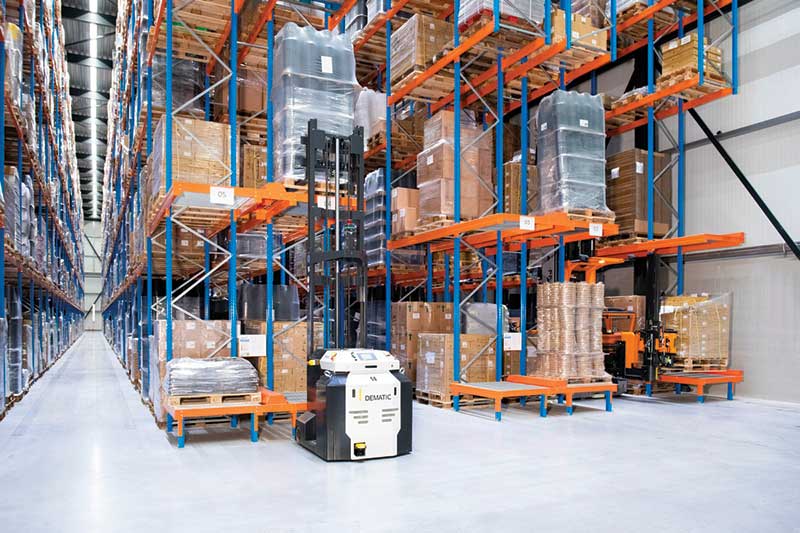
“This not only boosts efficiency but also helps avoid mistakes and injuries that can happen with manual transport,” says Mike Perrot, director of mobile automation in North America for Dematic.
AGVs address several pain points in the supply chain, Perrot adds, particularly around flexibility, efficiency and scalability.
“One of their biggest advantages is enabling warehouses to run 24/7 without needing additional labor, which boosts productivity while reducing operational costs,” says Perrot. “AGVs also streamline operations by eliminating bottlenecks and reducing unpredictability in logistics, which is crucial for businesses aiming for consistent output.”
This is especially helpful in a two-shift operation.
“Robotics, when taken care of, don’t need breaks; they keep working,” says Pletcher. “We typically see a return on investment in less than three years; sometimes even better than that depending on how the customer is currently operating.”
AGVs can automate a myriad of materials handling tasks from pallet load transport and high-level storage to bulk transport when you add tuggers and carts. AGVs also work really well with other types of automation, giving warehouses the flexibility to integrate with their other warehouse software platforms and even phase in automated vehicles as their needs change.
“One of the biggest advantages is that AGVs are equipped with their own software that communicates seamlessly with existing warehouse management systems (WMS) and warehouse execution systems (WES),” says Perrot. “This integration allows them to synchronize tasks with fixed automation like conveyors and sortation systems, ensuring smooth, efficient operations with minimal downtime.”
Load deck AGVs, for example, can be equipped with other systems, such as conveyors or shuttle systems, to move unit loads between workstations or facilities, while compact transfer AGVs are smaller and are specialized for compact material transfers in limited spaces. AGVs can even be customized, Perrot says, to meet specific operational needs and offer a solution that fits unique environments and challenges.
“By automating these processes, AGVs not only remove the manual strain of repetitive tasks, but also improve overall efficiency by maintaining a steady, predictable flow of goods through the warehouse, regardless of the time of day,” adds Perrot.
Despite the advantages of automation, Pletcher says that because AGVs are typically slower than people operating traditional fork trucks, it’s critical that you understand the problem you’re trying to solve before you throw AGVs at it.

Seegrid’s Lift RS1 AMR can perform with predictability and agility in diverse industrial environments.
“If you’re considering replacing your current workforce with AGVs, it’s important to recognize that direct replacement may not be feasible,” says Pletcher. “AGVs typically operate at slower speeds, lack real-time decision-making capabilities, and cannot avoid obstacles autonomously. As a result, you may require more AGVs than initially anticipated. It is advisable to collaborate closely with your vendor or systems integrator to ensure your objectives are clearly understood and effectively met.”
You also need to consider what loads you’re trying to move, and whether a human operator can do that safer and more efficiently or whether the addition of robotics can actually simplify the operation.
“You need to fully understand the operating environment, including footprint, travel distances, constraints, and potential obstacles, as well as the objectives and operational challenges that need to be addressed with automation,” says Pletcher. “Begin by assessing these factors to determine whether AGVs will meet your needs or if the flexibility of AMRs is required.”
When considering automation, Griffin’s No. 1 piece of advice is to “start with a win.”
“It’s often in the interest of the customer to try to automate the absolute hardest process in their plan…and that’s, quite frankly, the worst thing you could do,” says Griffin. “Different applications, different use cases, are better or worse for automation, and so our recommendation is to find those use cases that are more straightforward to automate that will give the company experience with the equipment, with the process changes required. Then as the customer increases their automation maturity, we can continue to expand the use cases and tackle more and more complex situations that give a much higher chance of success than if you were to start with the hardest things first,” he adds.
Because AGVs are fixed path and typically separate from humans in the warehouse, they also offer an element of increased safety. Not only do they have safety mechanisms that help them avoid collisions, but that separation between AGV and human creates an inherently safer work environment.
Whereas traditionally, materials handling equipment and pedestrian workers are crossing path throughout the warehouse, AGVs require a fixed path that can be designed away from where humans will be walking or working.
“Simply going through the process of deploying a typical AGV in your facility often provides inherent safety benefits,” says Pletcher. “This is largely due to considerations around fixed AGV paths and the separation of humans and machines.”
As artificial intelligence (AI) and truly autonomous technology that can make real-time decisions become a bigger part of the warehouse environment, the line between AGV and AMR has become increasingly blurred.
With innovations from companies like Seegrid, which offers a feature called sliding scale autonomy, robots can now operate as like an AGV and an AMR depending on what’s best suited for the application.
For example, AGVs that operate on fixed path navigation work better during long haul routes from one side of the facility to the other where consistency is critical.
In tight space quarters where you’re picking on and off assembly lines or you’re moving out of inventory staging buffers, AMRs using free form navigation allow a robot to move more freely and pick items that may be skewed or not placed exactly right.
“With that introduction of that sliding scale economy autonomy, we’re able to do both inside the same vehicle, which we think should be really, really important going forward,” says David Griffin, chief sales officer at Seegrid.
Mike Perrot, director of mobile automation in North America for Dematic, agrees, noting that as advancements in AI, Internet of Things (IoT), and machine learning drive greater flexibility and efficiency, software will play a key role in transforming AGVs.
“Integrating data analytics and predictive maintenance tools will help AGVs self-diagnose issues, in turn reducing downtime and improving performance,” says Perrot. “Software, while already being used to optimize AGV performance, will also enable seamless coordination with other warehouse systems to make operations more efficient and scalable. As AGVs become more intelligent and connected, warehouses will be able to scale and adapt more easily to future demands.”
By operating autonomously without human supervision, AGVs also lower their risk of human errors that can lead to costly damages or accidents, which Perrot says “significantly lowers the financial impact of mistakes commonly seen with manual forklifts.”
Seegrid’s Griffin agrees, noting “automated units are far, far safer than the manual units. Our customers see a huge reduction in safety incidents, which is obviously not only better for their staff, but it’s a tremendous cost savings as well for the company.”
In addition to understanding your infrastructure and operational goals, before automating, warehouses must also consider the maintenance needs around AGV technology.
Like any new piece of equipment, AGVs require some in-house expertise that may go above and beyond what your normal maintenance staff deals with on a daily basis.
“There’s an initial training phase to ensure that the machine’s paths are correct, followed by ongoing calibration of navigation system,” says Pletcher. “If you’re not accustomed to these processes, you may find yourself in a situation where you’re not satisfied with your investment.”
To address this issue, Griffin is seeing more and more companies create designated automation teams to help them navigate the process.
“We’re seeing that in almost all of our large customers. They’re developing these teams because they have such an interest in scaling their automation in the future,” says Griffin.
He adds that companies are starting to realize that a certain level of experience and expertise can be beneficial.
“Successfully automating is as much about the customer’s operation and processes as it is about the vendor’s technology, so they’re forming these centralized automation teams that essentially build and maintain this level of experience and expertise that they can then disseminate through the company,” says Griffin.
Perrot notes that overall, however, AGVs offer lower operational and maintenance costs compared to manual forklifts.
“Since they’re designed to run autonomously and efficiently, they require less frequent maintenance and reduce the need for a large workforce to operate them,” he explains. “The long-term savings from reduced labor and minimized errors make AGVs a smart investment for warehouses looking to streamline their operations.”

Amy Wunderlin is a freelance supply chain and technology writer. She has written for several weekly and daily newspapers, in addition to trade publications such as Supply & Demand Chain Executive, Food Logistics and Building Operating Management, among others. She is a 2013 graduate of the University of Wisconsin-Whitewater, where she earned her B.A. in journalism.
Enjoyed this article? Add Robotics 24/7 as a preferred source in Google Search.
Edge computing gives AI agents the processing power to turn instructions into…

Daimon-TWM world model debuts for the public

Platform helps robots adapt to complex tasks

Look beyond the headlines for the latest in humanoid robots