By
Eugene Demaitre
September 27, 2021
DARPA
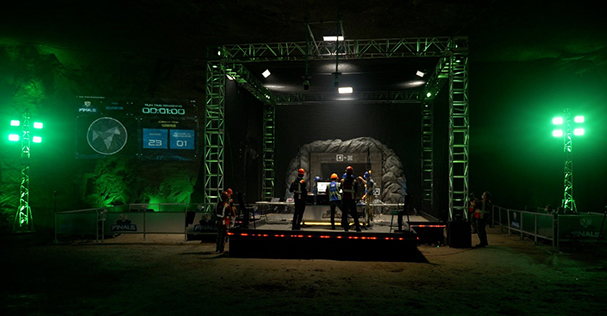
DARPA's SubT finals included obstacles from tunnel, urban, and cave environments.
Get news, papers, media and research delivered. Sign up for our free newsletters.
Stay up-to-date with news and resources you need to do your job. Research industry trends, compare companies and get weekly market intelligence with Robotics 24/7.

DARPA
DARPA's SubT finals included obstacles from tunnel, urban, and cave environments.
After a three-year journey and several rounds of trials, the DARPA Subterranean Challenge announced the winners of its final event at the Mega Cavern in Louisville, Ky., last week. Team CERBERUS won $2 million in the Systems Competition, and Team Dynamo won $750,000 in the Virtual Competition. Each of the final rounds included four teams. The DARPA SubT Challenge was intended to advance robotics and software for exploring GPS-denied environments.
“In time-sensitive missions, such as active combat operations or disaster response, warfighters and first responders face difficult terrain, unstable structures, degraded environmental conditions, severe communication constraints, and expansive areas of operation,” said Timothy Chung, program manager of the SubT Challenge at the Defense Advanced Research Projects Agency (DARPA). “The challenge has helped to significantly advance technological tools for tackling these impediments and safeguarding lives.”
Since the challenge began in 2018, teams have competed in three circuit events – tunnel, urban, and cave. The Cave Circuit was shifted to virtual-only because of the COVID-19 pandemic. The final, four-day event tested qualifying teams on courses that incorporated relevant challenges from all three environments.
Team CERBERUS deployed a diverse set of robots with the prime systems being four ANYmal C legged systems and aerial drones. In the Prize Round of the Final Event, the team won the competition and scored 23 points by correctly detecting and localizing 23 of 40 of the artifacts that DARPA had placed inside the environment.
"We are delighted to have done so well," said Prof. Maurice Fallon, lead of the Oxford University team that was part of CERBERUS. "Contributing to CERBERUS has really accelerated our research. After three years of preparation, it was fantastic to test it in the DARPA’s complex underground maze."
The final Systems Competition involved four teams that developed a wide variety of mapping and navigation systems. They were applied and tested in realistic field environments such as human-made tunnels, urban underground settings, and caves. The final scores were as follows:
"We congratulate all members of the team, and we are proud of this incredible and historic achievement!" said CERBERUS. "Most importantly, we are excited to be part of this amazing community pushing the frontier of resilient robotic autonomy in extreme environments."
CERBERUS is a collaboration between University of Nevada, Reno; ETH Zurich; Sierra Nevada Corp., the University of California, Berkeley; Flyability; the Norwegian University of Science and Technology (NTNU); and the University of Oxford.
"Team CERBERUS draws conceptual inspiration from the mythological Cerberus, the three-headed dog protecting the underworld," said the team in its mission statement. "From a robotics standpoint, we are inspired from the potential of combining two very different modalities of locomotion, namely walking and flying, while simultaneously addressing in a unified manner the perception and navigation challenges."
"In the underground environment, there are so many challenges from lighting and communications to the slipperiness of terrain itself," said Dr. Marco Camurri, a senior researcher at Oxford University. "This demanded a whole range of breakthroughs by our team."
Teams in the Virtual Competition developed software and algorithms using virtual models of systems, environments, and terrain to compete in simulation-based events and explore simulated environments.
The teams also used virtual drones and mobile robots to find artifacts hidden in the different environments and report their locations and types to within a 5 m (15-ft.) radius during each 60-minute ismulation. Each correct report was worth one point.
DARPA reported the following final scores:
Dynamo was a one-man team with Hilario Tome, chief technology officer at Keybotic in Barcelona, Spain.
"We come from a humanoid robotics background, an exciting and complex field, where real-world applications still seem too far in the future," stated Tome. "The DARPA SubT Challenge seemed a very interesting challenge with comparable complexity but with direct applicatbility to a real-world problem."
"Our solution relies on a team of quadcopters," he added. "Both humanoids and quadcopters share a basic characteristic, which is that they are underarticulated. They have more degrees of freedom than the number of control inputs, and thus they share similar control techniques."
"Shifting from the very expensive humanoid robots, the goal is to use the lowest-cost sensors available and to leverage the complexity of the problem to the software," Tome said. "This can only be achieved using sensor-fusion techniques, optimization, and machine learning."
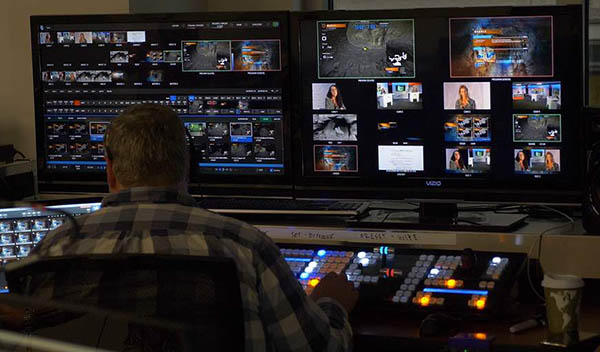
DARPA Subterranean Challenge final event, Day 4, prize-round coverage.

Eugene Demaitre was editorial director of Robotics 24/7. Prior to joining Peerless Media, he was a senior editor at Robotics Business Review and The Robot Report. Demaitre has also worked for BNA (now part of Bloomberg), Computerworld, and TechTarget. He has participated in numerous robotics-related webinars, podcasts, and events worldwide.
Artificial Intelligence Machine Vision Machine Learning Autonomy Drones Mobile Robots Components Motion Control Sensors Cameras Lidar Software Data Management Simulation News ANYbotics DARPA Disaster Recovery ETH Zurich Flyability Keybotic Navigation Norwegian University of Science and Technology Sensors Sierra Nevada
GENISOM AI makes ICRA debut at conference in Vienna

World's first omni-modal evaluation including tactile sensing for…

North America’s largest robotics and automation event kicks off

North America’s largest automation and robotics event takes place June 22-25