By
Eugene Demaitre
October 18, 2022
Veo Robotics
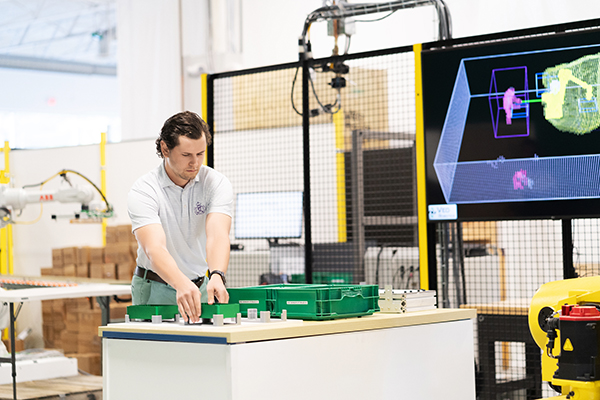
FreeMove 2.0 supporting adjacent workcells.
Get news, papers, media and research delivered. Sign up for our free newsletters.
Stay up-to-date with news and resources you need to do your job. Research industry trends, compare companies and get weekly market intelligence with Robotics 24/7.
Veo Robotics
FreeMove 2.0 supporting adjacent workcells.
As manufacturers adopt more automation, they need to guarantee safety on their factory floors. Veo Robotics Inc. today announced the release of its FreeMove 2.0 Engine, a high-performance industrial computer with a proprietary architecture that works with FreeMove Sensors to monitor workcells in 3D. The redesigned system implements speed and separation monitoring to enable safe interaction between humans and robots.
“Six years ago, we developed FreeMove as a first-of-its-kind safety solution to fill a gaping need in the industrial robotics industry,” said Patrick Toner, director of product marketing at Veo Robotics. “Since then, we’ve worked with the world’s largest robot companies to bring manufacturers the ability to more seamlessly combine the strength, precision, and speed of standard industrial robots with the ingenuity, judgment, and dexterity of humans on their facility floors."
"FreeMove 2.0 builds on this progress, adding even more support for manufacturers to unlock the true power of human-robot collaboration,” he added.
To get returns on their investments in robotics, companies need flexibility, said Waltham, Mass.-based Veo Robotics. The company said its research found that human-robot collaboration has risen for six out of 10 manufacturers in the past year.
"[Xometry company] Thomas reported that more than half of manufacturers are thinking of moving production out of China, and many are considering reshoring," said Patrick Sobalvarro, president and CEO of Veo Robotics, at The Vision Show last week in Boston.
"But total productivity growth hasn't improved. Increased use of automation and fixed capital can introduce inflexibility," he said. "Bernstein Research noted an inverse relationship between automation levels and labor productivity."
"That's why collaborative robots have seen the success that they have," Sobalvarro said. "Current safety approaches limit automation productivity."
Veo Robotics said its FreeMove safeguarding system for industrial robots "enables fluid, efficient, and flexible production lines." The company works with the world’s top four robot manufacturers: FANUC, Yaskawa, ABB, and KUKA.
FreeMove 2.0 adds support for more complex manufacturing applications, including the ability to monitor limited-access zones and adjacent workcells. With congested and busy production floors, manufacturers typically have FreeMove supporting overlapping workcells, said Veo Robotics. The upgraded engine can safeguard multiple workcells in a variety of configurations.
In addition, the new engine is more robust for work in harsh environments, has a reduced startup time, and improves sensor registration, Veo said.
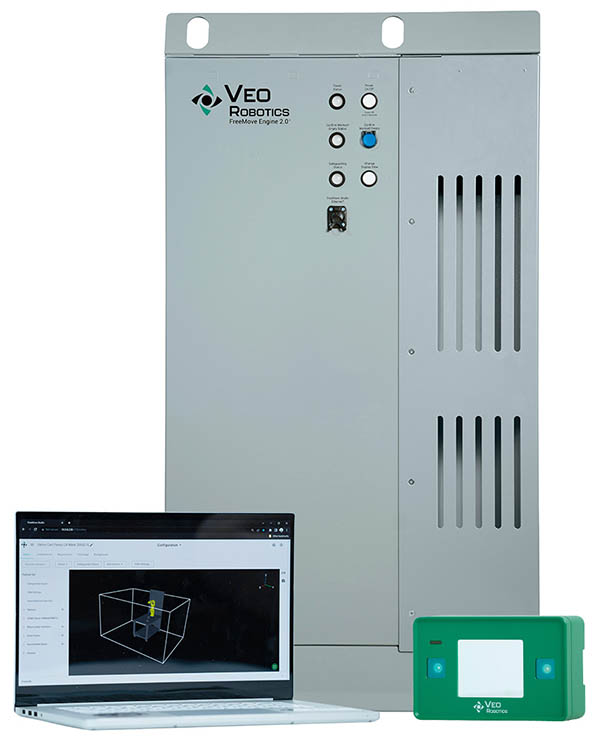
"We've worked to reduced the size of the FreeMove computation engine," said Sobalvarro. "FreeMove is safer than a task-based risk assessment. You don't want to depend just on administrative controls. TÜV Rhineland certified Veo for ISO compliance."
The FreeMove software still runs on fail-safe hardware, providing manufacturers dynamic speed and separation monitoring to automatically stop a robot when human co-workers move closer to the robot during operation. This lets manufacturing teams prioritize safety and productivity without sacrificing one for the other, the company claimed.
"We had to build our own hardware," Sobalvarro explained. "It includes two server-class Intel motherboards with dual Xeon processors. All safety outputs have to fail over to the right positions, and we follow a dual-channel approach throughout."
“We’ve always believed our advanced safety system to be a game-changer for human-robot collaboration,” added Toner. “We’re proud to continue helping our customers meet the unique demands of today’s flexible manufacturing environment and boost their productivity while keeping their workers safe.”
FreeMove 2.0 is shipping in January 2023, said Sobalvarro. While the system's list price and integrator price might be higher than that of a cobot, an industrial robot arm is cheaper and provides higher productivity, he said.
Boston-area robotics startup builds sensing systems to help robot arms work better alongside their human counterparts.

Eugene Demaitre was editorial director of Robotics 24/7. Prior to joining Peerless Media, he was a senior editor at Robotics Business Review and The Robot Report. Demaitre has also worked for BNA (now part of Bloomberg), Computerworld, and TechTarget. He has participated in numerous robotics-related webinars, podcasts, and events worldwide.
Enjoyed this article? Add Robotics 24/7 as a preferred source in Google Search.
Edge computing gives AI agents the processing power to turn instructions into…
Daimon-TWM world model debuts for the public
Platform helps robots adapt to complex tasks
Look beyond the headlines for the latest in humanoid robots