Voyant Photonics
Carbon weighs less than 10 ounces, but features 45 vertical and 90 horizontal degrees of view, with 128 lines per frame scanning natively.
Get news, papers, media and research delivered. Sign up for our free newsletters.
Stay up-to-date with news and resources you need to do your job. Research industry trends, compare companies and get weekly market intelligence with Robotics 24/7.

Voyant Photonics
Carbon weighs less than 10 ounces, but features 45 vertical and 90 horizontal degrees of view, with 128 lines per frame scanning natively.
Sensor provider Voyant Photonics recently announced availability of its Carbon lidar sensors.
Carbon’s highly integrated silicon photonic chip with solid state beam steering is fingernail-sized and can provide high-resolution, precise object detection, and static/dynamic segmentation for up to 200 meters (about 650 feet).
Voyant’s Carbon lidar is available for order now at $1,490 for single units, with volume pricing available along with a two-year warranty.
The company will attend CES 2025 and demonstrate Carbon at booth 3175 in the LVCC, West Hall Vehicle Tech and Advanced Mobility section.
Carbon uses Frequency Modulated Continuous Wave (FMCW) Technology. Unlike time-of-flight lidar, FMCW enables instant velocity measurement at each point on top of traditional distance, reflectivity, and intensity measurements.
FMCW can provide ‘4D’ sensing capability, providing high-fidelity point cloud data with accuracy to give software applications a real-time view of their environment up to 20 times per second. Instant velocity also enables vehicle ego-positioning capabilities, which Voyant said is extremely efficient in GPS denied environments, and potentially making a high-end inertial measurement unit (IMU) substitutable.
Voyant said its Carbon can outperform time-of-flight lidar sensors in operating through dust, fog, rain, and snow, and is immune to sunlight interference, most notably at sunrise and sunset. The technology is also invulnerable to highly-reflective objects, particularly retroreflectors - such as street signs, traffic cones, and safety vests - that suffer from blooming that can blind legacy time of flight lidar sensors.
Carbon weighs 250 grams (about 8.8 ounces), and features an IP67 dust and water ingress protection, along with strong shock and vibration endurance. In addition, the low power required by FMCW laser technology helps ensure eye safety.
Carbon’s native 128 lines per frame scanning provides camera-level resolution, with up to 1000 lines in real time for static scenes. Coupled with instant velocity measurement, Carbon can enable highly accurate detection and tracking of moving objects up to 200 meters away.
The field of view is 45 vertical and 90 horizontal degrees. Maximum detectable radial velocity is 63 meters per second (140 miles per hour).
Voyant said its sensor’s software-defined lidar allows customers to modify frame rate and adjust field of view during operation with a precision of less than two centimeters (about 0.78 inches). The adjustable FOV allows the lidar to be focused on a zone of interest when and where it is needed and make any small object detectable and classifiable.
Enjoyed this article? Add Robotics 24/7 as a preferred source in Google Search.
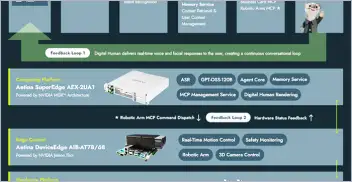
Edge computing gives AI agents the processing power to turn instructions into…
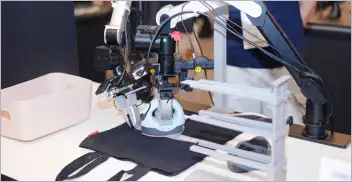
Daimon-TWM world model debuts for the public
Platform helps robots adapt to complex tasks
Look beyond the headlines for the latest in humanoid robots