By
Gary Forger
May 11, 2023
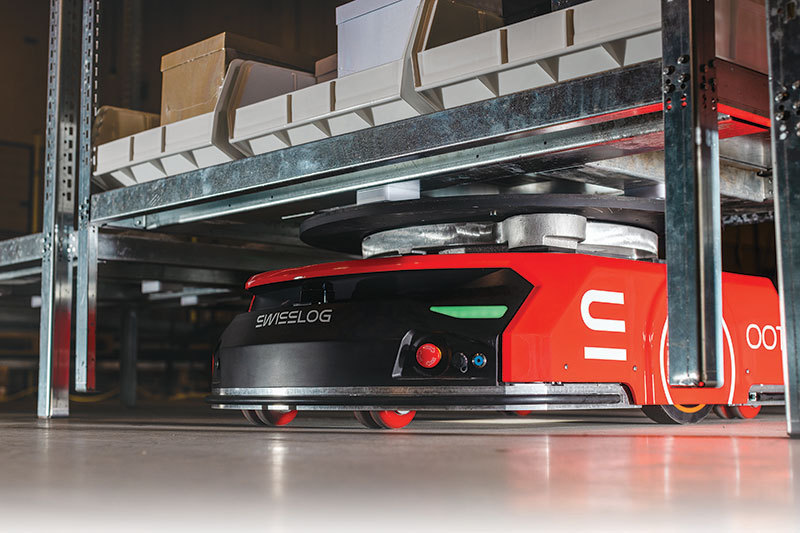
Autonomous mobile robots set their own paths, often bringing goods to people at pre-set locations.
Get news, papers, media and research delivered. Sign up for our free newsletters.
Stay up-to-date with news and resources you need to do your job. Research industry trends, compare companies and get weekly market intelligence with Robotics 24/7.
Autonomous mobile robots set their own paths, often bringing goods to people at pre-set locations.
If you’re feeling a little overwhelmed by industrial robots these days, you’re in good company.
To begin, there are so many different types. Suffice it to say that Gartner’s Dwight Klappich, who tracks robots closer than most, says about 34 different robots are currently in use in plants and warehouses.
That’s a lot, and the invasion of the robots is not becoming less of an issue any time soon. In fact, the likelihood of robots working in your facility in the near future is extremely high. A recent Gartner survey says more than 90% of facilities already have robots and plan to increase the size of their robotic fleets.
So, it’s time to get up to speed with robots. Now, we aren’t going to try and identify every different one in this relatively short article. But we’re going to try and give you an overview of the key types, how they are used, and identify key resources to help you in planning and selecting robotic materials handling equipment.
Part of the confusion is simple nomenclature. A robot by any other name can still be a robot.
Consider a storage/retrieval machine (sometimes called a crane) that automatically puts and retrieves inventory in locations of an automated storage and retrieval system (AS/RS). Another type of robot is a shuttle that moves loads in a different AS/RS configuration.
You’ve also got automatic guided vehicles (AGVs) that move loads in a facility along predetermined paths. Autonomous mobile robots (AMRs) are a close cousin that also move loads along the floor, but set their own path.
And, fixed-position robots perform tasks from welding to assembly of heavy parts in cages to protect people from injury. This is quite different from “cobots” that are fixed-position robot arms that work collaboratively with people.
Enough already. Point made.
Robots are complicated, but also essential to manufacturing and distribution going forward. Nearly 500,000 industrial robots were installed worldwide in 2021, according to the International Federation of Robotics (IFR) last June—a 27% increase over the previous year.
Earlier this year, the IFR International Federation of Robotics (ifr.org) reported more than one million robots are at work in the global automotive industry. In the United States alone, we have 1,457 robots per 10,000 human employees. Yes, the robots are coming.
As impressive as those numbers are, they are only a partial count of total robots. The IFR only tracks robots that are “automatically controlled, re-programmable multipurpose manipulator, programmable in three or more axes, which can be fixed in place or fixed to a mobile platform for use in automation applications in an industrial environment.” Translation: Most of the robots mentioned earlier are not even part of this count.
So, don’t get too hung up on numbers. But do realize that in addition to the IFR, two other organizations provide valuable resources about robots.
One is the Association for Advancing Automation (A3, automate.org). It holds the trade show Automate in Detroit later this month (May 22-25).
The other is The Robotics Group (TRG), which is part of the MHI trade association. While the smallest of the three robotic organizations, TRG’s Robotics Group (mhi.org) are the broadest representation of the various types of robotics covered here, especially when combined with other MHI industry group resources.
For all the consternation currently about the number of jobs that will be lost to artificial intelligence, robots have been on that path for decades. Remember now, the first industrial robot debuted in 1961.
But rather than focusing on lost jobs (most of which humans don’t want and can’t do as well as a robot), the better focus is on robots as an important extension of human capabilities, increasing productivity and reducing costs in plants and warehouses of all types.
Key applications, says TRG, are handling, transporting, palletizing, manufacturing and welding, to name five leading uses. TRG cites six key benefits of robots: accuracy; flexibility; lower labor costs; quiet operation; reduced product damage; and speed. And robots are widely used in industries ranging from automotive and aerospace to consumer goods, healthcare and retail.
When you look at robots from those three perspectives—industries, applications and benefits—there’s little wonder there has been such a proliferation of robot types. Each has its own form factor, size, range of motion and level of autonomous behavior based on the tasks the robot is expected to complete.
The remainder of this article focuses on the key robot types and where they might fit in your facility.
The short answer to that is: We all do. And have actually been relying on robots for longer and in applications we may not have even thought about.
For instance, AS/RS, palletizers/depalletizers and automatic guided vehicles are all are well established in the plant and warehouse, and have been making work and workflows a lot easier for decades.
That said, we’ll start with the types of robots most people think of first.
• Industrial robots
Industrial robots include those types defined by the IFR just a few paragraphs earlier. Yes, you associate these robots with automotive assembly lines doing a lot of nasty work from welding to assembly of large and not so large parts.
But as monolithic as this group of robots appears to be, they’re anything but. They include fixed-position cartesian robots that perform functions in a range of axes that the robot arm can access. Articulated robots with joints have a different range of motion than cartesian robots. Other variations with their own range of motion include cylindrical, delta and polar, to name three.
• Automatic palletizing/depalletizing robots
Similar but different to industrial robots are automatic palletizing/depalletizing robots. These fixed-position units pick up, move and place/remove items on a pallet with great speed and accuracy.
They look similar to the IFR robots. By replacing people from the palletization/depalletization process, these robots eliminate ergonomics from the workflow equation and greatly speed up the handling process.
• Robots in automated storage
Storage/retrieval machines load and unload an AS/RS. These robots are typically dedicated to a single aisle, picking up a large or even a pallet load at the front of the AS/RS, carrying it down the aisle to a predetermined location and placing it in that location. Picking is simply the reverse process.
Just like every other robot mentioned so far, these are not people friendly and operate in a highly controlled environment.
Some AS/RS are called mini-loads and handle smaller loads such as totes, trays and cases. Some use a storage/retrieval machine like a unit load AS/RS. Others use what is called a robotic vehicle or bot or shuttle to move loads.
These shuttles are small (not much bigger than a bread box), highly mobile, and not confined to moving totes or similarly sized loads in a single aisle. Instead, they range across all locations in the storage unit.
To make things a little more complicated, robotic vehicles known as a “mole” typically operate in a deep-lane storage systems, moving pallet loads to the back of the lane, leaving it at a specified location and moving out to the center aisle to go pick up or drop off another load. Needless to say, moles are heavy duty cousins of bots.
• AGVs/AMRs/Autonomous lift trucks
Now that we’ve moved into mobile robots, we’ve got three more variations on a theme. Automatic guided vehicles (AGVs) have been transporting, tugging and otherwise moving loads along manufacturing and distribution floors for decades. Autonomous mobile robots (AMRs) are a much newer technology, and they are a little bigger than a bot. Autonomous lift trucks are just what you think they are.
All three are robots that transport loads. AGVs follow a pre-set path that might be on the floor or on the walls, using guidance technology to get the vehicle to a preset destination. AMRs and autonomous lift trucks use a different technology (LiDAR) to map the facility and store that data onboard. The vehicle then uses it to decide for itself the path it will follow safely in the facility, avoiding obstacles and people along the way.
• Robotic mashups
Now we start to graft robots. For instance, a pick-and-place robot can be in a fixed position or mounted on an AMR to move about the facility. It looks much like the IFR robots mentioned earlier, but smaller.
Functionally, it does just what its name says with great precision and speed guided by operating software. Some pick-and-place robots work in cages while others collaboratively work with humans and are called cobots.
While not definitive, that should get you started in the world of robots. There’s no turning back on this one.

Gary Forger is an editor at large for Modern Materials Handling. He is the former editorial director of Modern Materials Handling and senior vice president of MHI. He was also the editor of the Material Handling & Logistics U.S. Roadmap to 2030.
From geometry preparation to AI-assisted analysis, integrated CFD workflows…
Software-based GripperAI manages mixed picking through basic geometry
Safety, communication and motion control components enable smooth operation

North America’s largest robotics and automation event winds down