MHI/MODEX
By
Tim Culverhouse
March 13, 2026
MHI/MODEX
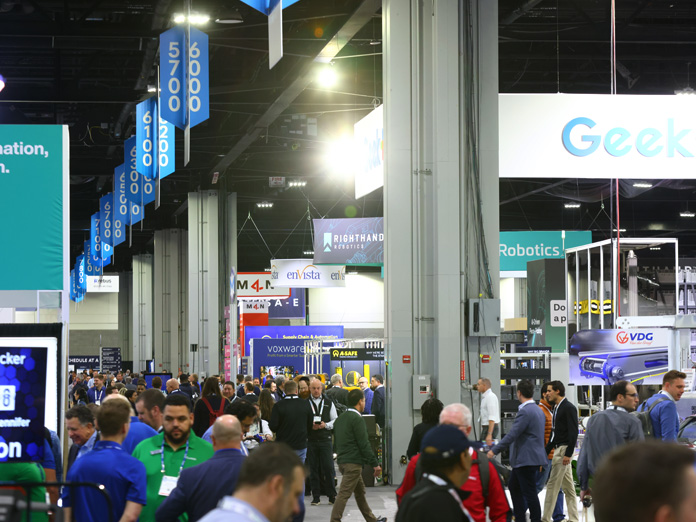
MODEX 2026 in Atlanta is expected to have over 1,060 exhibitors and 50,000 attendees.
Get news, papers, media and research delivered. Sign up for our free newsletters.
Stay up-to-date with news and resources you need to do your job. Research industry trends, compare companies and get weekly market intelligence with Robotics 24/7.
MHI/MODEX
MODEX 2026 in Atlanta is expected to have over 1,060 exhibitors and 50,000 attendees.

MODEX 2026 is nearly upon us. The “Super Bowl of the Supply Chain” will draw over 50,000 attendees and 1,060 exhibitors to the Georgia World Congress Center from April 13 to 16.
Before supply chain, logistics, warehouse and materials handling leaders from around the globe descend on Atlanta, Robotics 24/7 had a chance to connect with John Paxton, CEO of MHI.
RB247: How many MODEX exhibitors and attendees are you expecting in 2026? How does this compare to MODEX 2024?
JP: The physical size of MODEX has grown 8% over the previous show. It is wall-to-wall in all three halls of the Georgia World Congress Center, using every square foot of the facility.
We'll have over 1,060 exhibitors, which is exciting from a breadth of the show perspective. From the attendee perspective, registrations are tracking ahead of MODEX 2024. This is expected to be another record with registered attendees tracking over 50,000.
All signs are strong for an absolute record event, both on scale and attendees.
RB247: What does this record growth mean for the supply chain and logistics industries?
JP: The record growth of the show is a positive indicator for the overall supply chain industry. We've seen continued investments in technologies, such as robotics and automation, as these technologies have continued to advance.

For example, 220 companies have submitted entries for the Innovation Awards. These are the companies that have new product developments that are being launched at the show. This continues to positively demonstrate the innovation in our industry.
The attendees come to see new solutions and the full breadth of supply chain technologies, and the show delivers. When people come to MODEX, they come to see the equipment and tech. The exhibitors bring these solutions, and the attendees can see them in action. It's really positive from the technology aspect, and great for the attendees to evaluate solutions.
RB247: How does this MODEX compare to the pre-COVID era and mid-COVID era MODEX?
JP: We're blowing past those days. Coming out of COVID, a record MODEX was 400,000 square feet, and now we are over 630,000. The growth required the addition of Hall A in the Georgia World Congress Center to increase the footprint. Now we're using the complete facility. Likewise, with the attendees, pre-COVID, the attendees were in the 30,000 range, and now we're attracting over 50,000.
As we all know, COVID really disrupted the supply chain; however, it also advanced supply chain investment with the growth of e-commerce. Companies needed to respond to the changing markets, and that triggered investment in new technologies. There were fewer people in the process and much higher picking volumes, which really accelerated the implementation of robotics and automation.
We have seen that robots are very good in manufacturing applications with repeatable processes. Because there are so many different types and sizes of products in the supply chain, the processes are not very repeatable. The supply chain implementation of robotics has evolved. Robots with vision systems were now able to “see.” The grab systems have evolved, and now they're able to physically grab various shapes and sizes.
Now, adding AI to these systems, the robots can “think” and can adapt. These breakthroughs brought robotics and automation to a new level in the supply chain. We started to see early adoption in 2019. Then, post-COVID, we have seen an acceleration of these solutions being used in many operations.
Moving to today, we continue to see uncertainty as a top challenge in the supply chain, with both tariffs and geopolitical challenges. In addition, the workforce remains a top challenge. The uncertainty, coupled with workforce challenges, continues to drive investment in new solutions even further.
RB247: You mentioned vision systems and AI. Do you think those are the two biggest technological breakthroughs that have driven this accelerated adoption of robotics and automation in the supply chain?
JP: I think we can break it down into a couple of areas. The first area would be "travel automation,” moving items on the floor. In warehousing, associates walk many miles a day to pick parts. Walking around the warehouse is not a very efficient or fulfilling process. The first breakthroughs came in the Automatic Mobile Robots (AMR) development, where they can detect obstacles and operate in and around people without safety issues. We saw that as the first breakthrough with several AMR companies offering operational solutions.
We've had automation in the Automatic Storage and Retrieval (ASRS) area for quite some time. But those solutions were more focused on pallet movement, heavy items and dense storage. The increased e-commerce demand for piece picking accelerated the ASRS innovation in goods-to-person handling of smaller items. That brought breakthroughs in high-volume, high-speed, goods-to-person systems. Now, vision systems and AI have enabled picking robots to be included in the process. You could travel well, you can store densely, and now you can also pick the parts with automation.
The developments over the past couple of years were not just one type of isolated system. Now we are seeing breakthroughs with the orchestration of complete systems. You may have an AMR, an ASRS and a picking robot all working together. If you look back five or six years, processes may have had an AMR, an ASRS and/or picking systems, but they were individual, discrete solutions without much orchestration. We are seeing a lot more connections between these systems.
Layering AI into these systems helps to connect the data with the warehouse management systems and the warehouse execution systems. The goal is to have all of these systems seamlessly working together.
RB247: It feels like the vision and orchestration space has exploded over the last couple of years. Would you agree?
JP: Yes, and I think that's where companies really can excel by connecting these systems. I was recently talking to one of our members. For their solution, it does not matter which physical robot is being used. They install the AI brains to the robot. The AI serves as the brains of the robot, and it's built off the vision systems and the grabbing systems.
In high-level terms, the picking robots can adapt, think and learn. Those are impressive breakthroughs that have only happened over the past few years. These technological developments are moving fast, and it's going to move even faster in the future.
RB247: There’s so much about AI and the different types of AI in use across robotics and automation. How do you view its use across the supply chain?
JP: AI solutions are very specific tools and use cases. For example, one educational session covers how to use AI to prevent theft. It uses vision systems and analyzes the video to flag if there's something missing from a shipment, before it goes out the door. We've always had cameras, but people typically would only look at them when there's a problem after the fact. This solution analyzes a packing station in real time and provides an alert if there is an error.
Another example is from a Start Up Award finalist, which uses cameras for warehouse safety and then analyzes the results using AI for notification, corrective action and training.
In addition, there are AI solutions for shipment receiving, inventory slotting, demand forecasting, transportation routing, predictive maintenance, risk mitigation and customer personalization, just to name a few.
RB247: What sessions and speakers are you most excited for at MODEX 2026?
JP: Throughout the past two years, there has been a lot of discussion on the applications of AI and the supply chain. First, we asked, 'What is AI?” Last year, there was a focus on generative AI and how you can use it to do research, analyze data, produce reports, and save time.
Now, by adding the agentic AI, companies are putting these agents in place to execute specific steps in a process.
Operations that have large manual processes provide a great opportunity for AI agents. There is a lot of data in the supply chain. For example, transportation data, inventory data, forecasting data and customer demand data. This provides opportunities for AI to streamline those manual processes and to provide process efficiencies.
We are now seeing very specific use cases where AI is being used as it has moved from concept to implementation.
At MODEX, there are 200 education sessions, and 66 of them cover AI topics and solutions. It's not just a high-level AI overview, but they are actual use cases.
For example, AI is already being utilized in robotic systems, warehouse management systems, inventory management systems and forecasting systems. We are seeing those tools being rolled out as part of the process automation. Two years ago, we were asking, ‘What is AI?,” now we are seeing agentic use cases in practice.
At MODEX, the Tuesday, April 14th keynote will cover AI uses in the supply chain, now and in the future. Salim Ismail is a technology expert and an exponential strategist, and I'll be very interested to hear his perspective.
Don't miss that Tuesday keynote, but then also plan to attend the education sessions. The registration, keynote and education sessions are at no cost. Pro Tip: The educational sessions fill up quickly. Plan to arrive 10 minutes early; otherwise, you may not find a seat.
RB247: What are you most excited about related to the MHI Innovation Awards?
JP: There are 220 Innovations on the MODEX website, and those feature exciting cutting-edge technologies that companies will be introducing at the show. You can see all the different products and new ideas that will be on display. Then, plan to visit their booths by using your My Show Planner.
MODEX is a very big show, and you really need to have a plan. It's the event where everybody in our industry comes together to see Supply Chains From Every Angle.

Tim is the Editorial Director of Robotics247.com. His mission is to provide valuable information and insights to robotics professionals and decision-makers, and to help them solve business challenges. He is a creative, deadline-driven, and detail-oriented storyteller. In addition, he is a sports broadcaster and public address announcer.
Artificial Intelligence Machine Vision Machine Learning Autonomy Drones Lift Trucks Mobile Robots Industrial Automation Collaborative Robots Robot Arm Components Controllers Grippers Motion Control Sensors Cameras Lidar Software Cloud and Edge Data Management Fleet Management Simulation News Features Editors Pick AGVs ASRS Autonomous Mobile Robots Computer Vision Conferences Materials Handling MHI MODEX Orchestration Startups
GENISOM AI makes ICRA debut at conference in Vienna
World's first omni-modal evaluation including tactile sensing for…

Ultrasonic sensing enhances robotics perception
North America’s largest automation and robotics event takes place June 22-25