
Samworth Brothers Supply Chain, Oak Meadow, Leicester. Photo by Tim Heaton. Used with permission from Wikimedia Commons.
A Gartner survey found that generative AI (GenAI) tools at supply chain organizations have created a productivity paradox as improvement for desk-based employees is accompanied by increased work environment frictions.
Get news, papers, media and research delivered. Sign up for our free newsletters.
Stay up-to-date with news and resources you need to do your job. Research industry trends, compare companies and get weekly market intelligence with Robotics 24/7.
Samworth Brothers Supply Chain, Oak Meadow, Leicester. Photo by Tim Heaton. Used with permission from Wikimedia Commons.
A Gartner survey found that generative AI (GenAI) tools at supply chain organizations have created a productivity paradox as improvement for desk-based employees is accompanied by increased work environment frictions.
Generative AI (GenAI) is in use by 72% of supply chain organizations, but most are experiencing middling results for productivity and ROI, according to a survey by Gartner, Inc.
The Gartner survey found that productivity gains from GenAI use for individual, desk-based workers are not translating to greater team-level productivity. Additionally, GenAI tool deployment is increasing anxiety among many employees, dampening their productivity.
Gartner said that chief supply chain officers (CSCOs) deploying GenAI need to shift from a sole focus on efficiency to a strategy that incorporates full organizational productivity. This strategy must better incorporate frontline workers, assuage growing employee anxieties from the use of GenAI tools and focus on use cases that promote creativity and innovation, rather than only on saving time.
"Early GenAI deployments within supply chain reveal a productivity paradox," said Sam Berndt, senior director in Gartner’s Supply Chain practice. "While its use has enhanced individual productivity for desk-based roles, these gains are not cascading through the rest of the function and are actually making the overall working environment worse for many employees. CSCOs need to retool their deployment strategies to address these negative outcomes.”
As part of the research, Gartner surveyed 265 global respondents in August 2024 to assess the impact of GenAI in supply chain organizations. In addition to the survey, Gartner conducted 75 qualitative interviews with supply chain leaders to gain deeper insights into the deployment and impact of GenAI on productivity, ROI and employee experience, focusing on both desk-based and frontline workers.
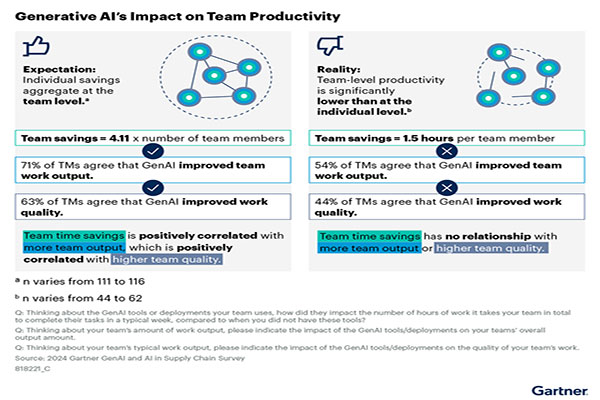
Gartner’s data showed increasing productivity from GenAI for desk-based workers, with GenAI tools saving 4.11 hours weekly for these employees. The time saved also correlated to increased output and higher quality work. However, these gains decreased when assessing team-level productivity. The amount of time saved declined to 1.5 hours per team member weekly, and there was no correlation to either improved output or higher quality of work (see Figure 1 below).
The deployment of GenAI in supply chain has brought with it several additional negative organizational impacts, including:
“In their pursuit of efficiency and time savings, CSCOs may be inadvertently creating a productivity ‘doom loop,’ whereby they continuously pilot new GenAI tools, increasing employee anxiety, which leads to lower levels of productivity,” Berndt said. “Rather than introducing even more GenAI tools into the work environment, CSCOs need to reexamine their overall strategy.”
Based on the survey results, Gartner recommends shifting from focusing on individual productivity gains to an aligned organizational productivity approach. This approach prioritizes creativity-based use cases that enhance strategic thinking and innovation across the entire workforce, including frontline workers. These use cases encourage employees to utilize GenAI tools to approach their strategic tasks more thoughtfully, emphasizing those that incorporate interactions with direct peers and colleagues.
To achieve aligned organizational productivity, CSCOs need to rethink their GenAI strategy in three key areas:
GENISOM AI makes ICRA debut at conference in Vienna

World's first omni-modal evaluation including tactile sensing for…

Ultrasonic sensing enhances robotics perception

North America’s largest automation and robotics event takes place June 22-25